
Mouth taping
What is mouth taping?
Mouth taping means putting a strip of tape over your lips at night so you breathe through your nose. Supporters say it reduces snoring, dry mouth and mild sleep apnea. A 2025 systematic review found only 10 small studies with 213 patients, two showing benefit, and warned of harm for people with nasal obstruction or sleep apnea.
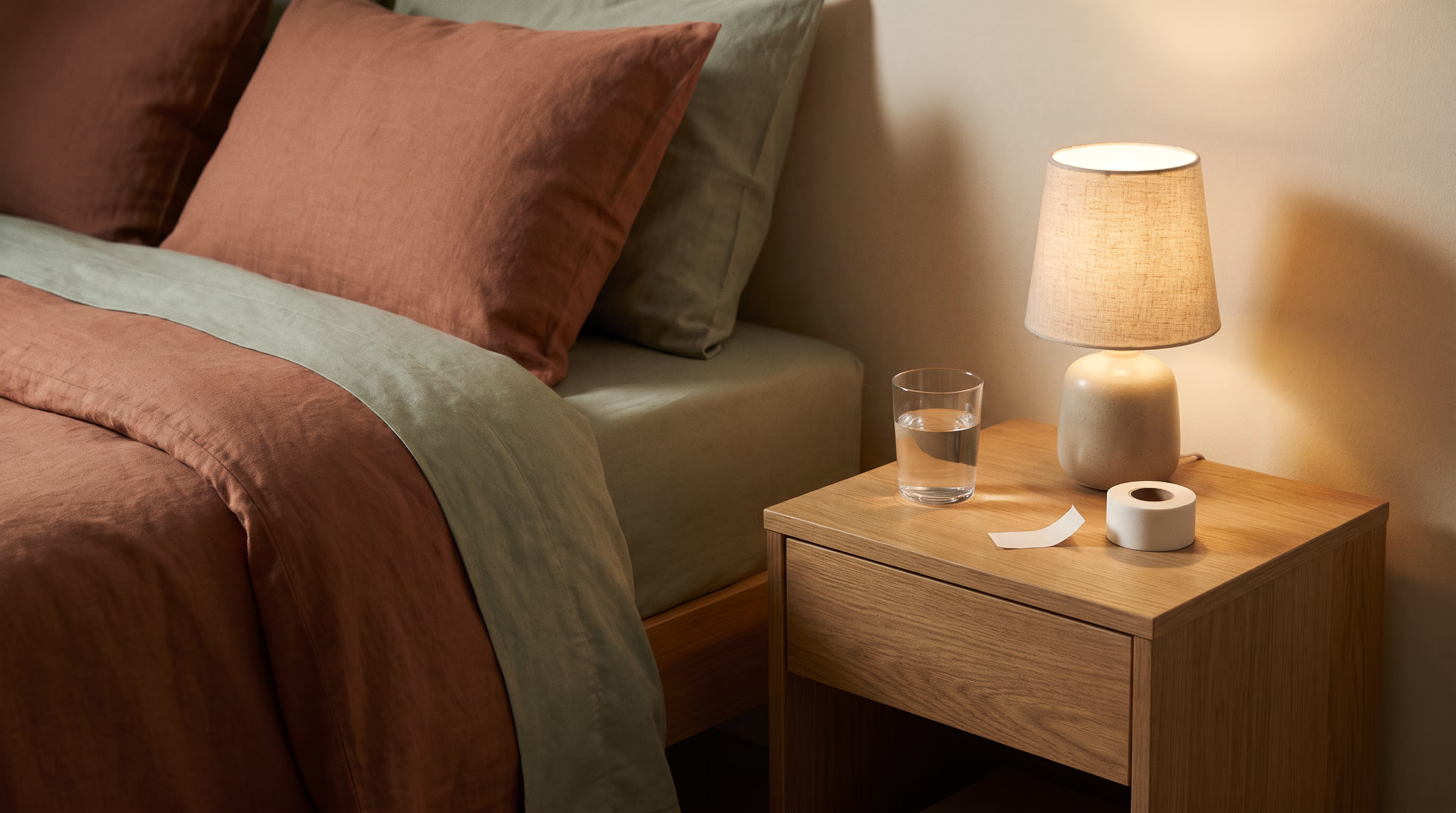
Sleep medicine agrees that nasal breathing during sleep is better than mouth breathing, but not that tape is a good way to get there. The positive studies are small, short and uncontrolled, and limited to mild sleep apnea; one randomized trial supports it for mouth breathers on CPAP. Sleep specialists warn it can be dangerous with a blocked nose or untreated sleep apnea.
The rules
The rules ofMouth taping
- 1Close the lips at bedtime and hold them shut with tape for the whole night.
- 2Use skin-safe porous or silicone tape, or a purpose-made strip, never duct tape or plastic film.
- 3Breathe only through the nose while the tape is on.
- 4Be able to remove the tape instantly at any time.
- 5Only tape when the nose is clear.
Share these rules as an image or a link.
| Vertical strip | A short strip of microporous tape placed vertically over the middle of the lips, leaving the corners open. |
|---|---|
| Full horizontal cover | Tape across the whole width of the closed lips. |
| Lip-surround strips | Elastic strips such as MyoTape that sit around the lips and guide them closed without covering them. |
| Porous oral patch | A layered patch that covers the mouth but lets some air through, as tested in a 2015 pilot study. |
| Mouth tape with CPAP | Tape used with a nasal CPAP mask to stop mouth leak, under a sleep team's guidance. |
| Daytime practice | Wearing tape while reading or working to get used to nasal breathing before trying it overnight. |
What it aims to do
- Keep the mouth closed during sleep so breathing goes through the nose.
- Reduce snoring and morning dry mouth.
- Reduce mild obstructive sleep apnea in mouth breathers.
- Stop air leaking out of the mouth during CPAP.
- Supporters also claim better sleep quality, energy, dental health and facial shape, which have not been tested.
What it claims, and what the evidence shows
Grades reflect evidence in people. Animal and cell results alone never earn more than limited.
Sleep
Limited evidenceSleep
Mixed evidenceSleep
Limited evidenceEnergy and fatigue
Limited evidenceHeart and blood vessels
Not enough evidenceLowers blood pressure and heart rate
No study has measured blood pressure or heart rate with mouth taping.
Hormones
Not enough evidenceLowers cortisol or raises testosterone
No study has measured hormones with mouth taping.
Key takeaways
- 1
A 2025 systematic review found only 10 studies with 213 patients, two showing better sleep apnea measures, and warned of serious risk with indiscriminate use [1].
- 2
Nasal breathing matters: forcing healthy sleepers to breathe through the mouth raised AHI from 1.5 to 43 events an hour [2].
- 3
In 20 mouth breathers with mild sleep apnea, tape lowered median AHI from 8.3 to 4.7, but the study had no control group [3].
- 4
- 5
The best evidence is for mouth breathers on CPAP, where tape added 51.8 minutes of use a night in a randomized trial [6].
- 6
Never tape over a blocked nose, a child's mouth or undiagnosed loud snoring; get a sleep study first.
What is mouth taping?
Mouth taping is putting a strip of tape over closed lips at bedtime so you breathe through your nose while you sleep. It grew out of the Buteyko breathing method and spread through the book Breath and social media, where nearly all posts about it are positive.
The idea is simple. Healthy people breathe almost entirely through the nose during sleep, and the nasal route keeps the upper airway more open than mouth breathing does [2]. If your mouth falls open at night, tape is meant to keep it shut.
People use several kinds of product:
- Microporous paper tape, the cheapest option, often a short vertical strip over the middle of the lips. This is the version tested in the Buteyko-style asthma trial [9].
- Silicone or hypoallergenic tape, used in the main sleep apnea study [3] and the CPAP trial [6].
- Purpose-made strips, such as MyoTape, which surround the lips rather than covering them, and porous oral patches with a breathing layer [7].
Popularity has run far ahead of research. In an analysis of 390 Instagram reels tagged #mouthtape, 94.4% endorsed it, 55.4% came from companies and only 11.6% from medical professionals [10]. Science writer James Nestor's book Breath brought it to a wide audience, and breathing coach Patrick McKeown, who designed MyoTape, promotes it.
Does mouth taping work?
The evidence is thin. A 2025 systematic review found 10 studies with 213 patients in total; two showed better sleep apnea measures and the rest found no difference. No large randomized trial has tested mouth taping for snoring, sleep quality or sleep apnea in the general public.
Three reviews published in 2025 and 2026 reached similar conclusions. The PLOS One review from Western University found 10 eligible studies with 213 patients: two showed statistically significant improvement in sleep apnea markers, others found no difference, and several raised the risk of asphyxiation when the nose is blocked [1]. A US scoping review found nine studies and little consensus on benefit [11]. A 2026 meta-analysis had too few mouth taping studies to pool, and could only describe two small ones that reported lower AHI in mild sleep apnea [12].
| Study | Who | Design | Result |
|---|---|---|---|
| Huang 2015 [7] | 30 adults, mild sleep apnea | Uncontrolled pilot, porous patch | AHI 12.0 to 7.8; less snoring and sleepiness |
| Lee 2022 [3] | 20 mouth breathers, mild sleep apnea | Uncontrolled, 1 week apart | AHI 8.3 to 4.7; 13 of 20 responded |
| Jau 2023 [4] | 71 adults | Two nights, with and without tape | About half did not improve |
| Yang 2024 [5] | 54 adults, sleep apnea | Mouth held closed during sleep endoscopy | Airflow up overall, down in heavy mouth breathers |
| Meksukree 2025 [6] | 62 CPAP users | Randomized crossover | 51.8 more minutes of CPAP a night |
| Cooper 2009 [9] | 51 adults with asthma | Randomized crossover | No effect on asthma control |
What the evidence does not show
No study has shown that mouth taping improves sleep quality, energy or health in people without sleep apnea. No randomized trial compares tape with no tape for snoring. The positive sleep apnea studies are small, short and uncontrolled, and they excluded people with nasal obstruction, which means they say nothing about the people most at risk [1].
Does mouth taping help snoring and sleep apnea?
In small uncontrolled studies of mouth breathers with mild sleep apnea, tape cut snoring by about half or more and lowered AHI by about 4 events an hour. But about half of people do not respond, and in heavy mouth breathers closing the mouth can reduce airflow. It is not a treatment for sleep apnea.
The two positive studies were in carefully selected patients: mouth breathers with mild obstructive sleep apnea who could tolerate tape. With tape, median AHI fell from 8.3 to 4.7 events an hour and the snoring index by 47% [3]; with a porous patch, AHI fell from 12.0 to 7.8 and the snoring index from 146.7 to 40.0 an hour [7]. Neither study had a control group, so some of the change may be night-to-night variation.
Two studies show why the response is uneven:
- With tape on, about half of 71 participants did not improve their oxygen desaturation index. Many of them puffed air out of the side of the mouth during the night, had more severe apnea and had narrower airways [4].
- During sleep endoscopy, holding the mouth closed raised airflow in moderate mouth breathers but lowered it in people who breathed mostly through the mouth, especially when the soft palate blocked the nasal route [5]. For them, mouth breathing is a bypass, and closing it removes the bypass.
Sleep surgeon Brian Rotenberg, who led the 2025 review, worries most about people with undiagnosed sleep apnea who tape instead of getting tested. Loud snoring, pauses in breathing, gasping and heavy daytime sleepiness need a sleep study, and proven treatments such as CPAP or oral appliances, not tape.
Sleep test results before and with mouth tape
- AHI, usual sleep8.3 events per hour (median)
- AHI, mouth taped4.7 events per hour (median)
- Supine AHI, usual sleep9.4 events per hour (median)
- Supine AHI, mouth taped5.5 events per hour (median)
- Oxygen desaturation index, usual sleep8.7 events per hour (median)
- Oxygen desaturation index, mouth taped5.8 events per hour (median)
Show the data
| Item | Value (events per hour (median)) | Low | High | Note |
|---|---|---|---|---|
| AHI, usual sleep | 8.3 | |||
| AHI, mouth taped | 4.7 | |||
| Supine AHI, usual sleep | 9.4 | |||
| Supine AHI, mouth taped | 5.5 | |||
| Oxygen desaturation index, usual sleep | 8.7 | |||
| Oxygen desaturation index, mouth taped | 5.8 |
Why does nasal breathing matter during sleep?
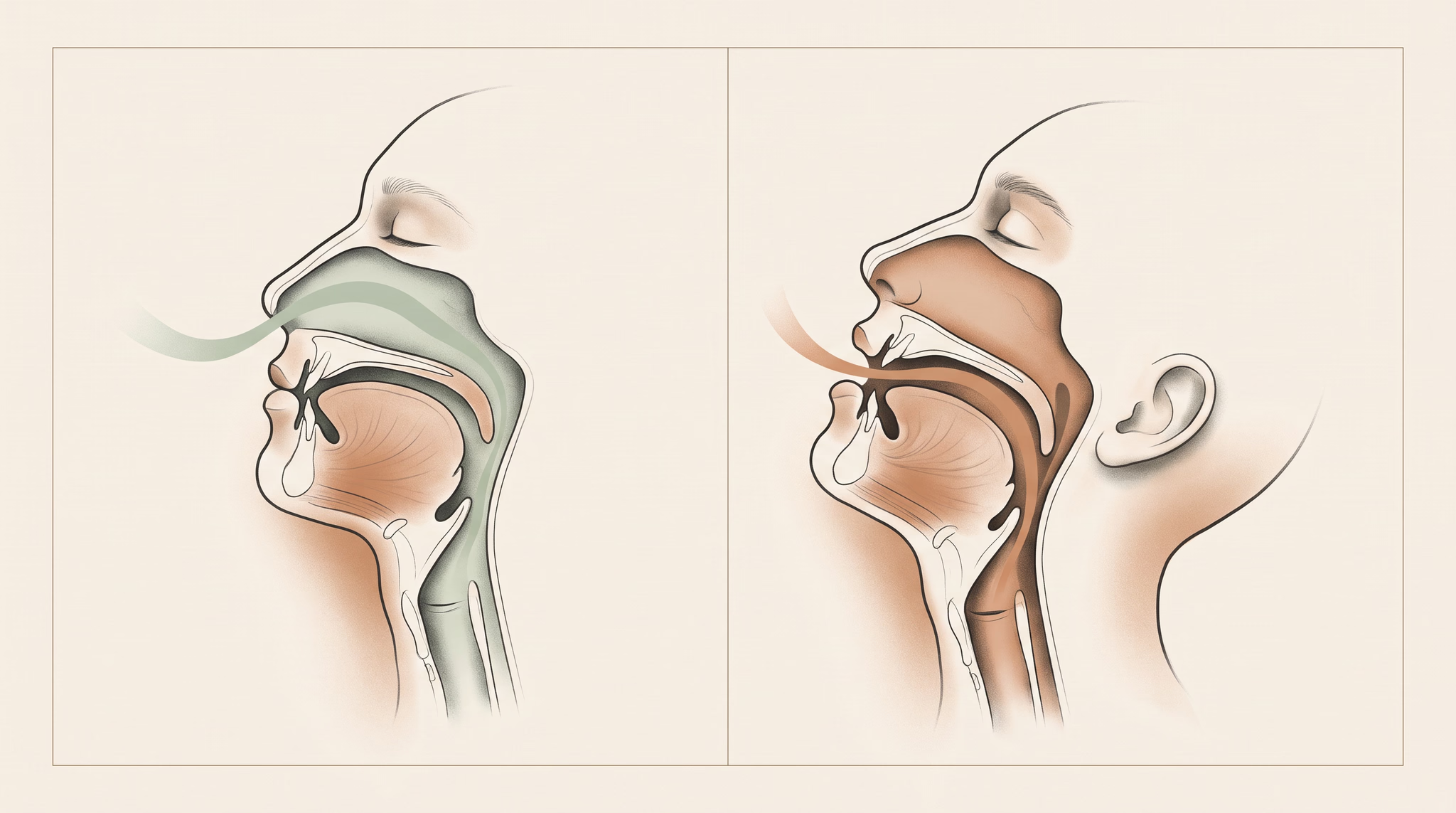
Breathing through the nose keeps the throat more open in sleep. When healthy volunteers were made to breathe only through the mouth, sleep apnea events rose from 1.5 to 43 an hour. That is the real science behind mouth taping, but it argues for a clear nose, not necessarily for tape.
The strongest evidence in this area is about the breathing route, not about tape. In a randomized crossover study, 12 healthy adults slept breathing through the nose or through the mouth. Upper airway resistance was 5.2 cmH2O/L/s through the nose and 12.4 through the mouth, and AHI was 1.5 versus 43 events an hour [2]. A 2026 meta-analysis found that blocking the nose raised AHI by 13.78 events an hour [12].
The nose also does things the mouth cannot. It warms, filters and humidifies air, and the sinuses produce nitric oxide, which supports defense against microbes and, carried into the lungs, may help oxygen uptake [13]. Some popular claims go further than this: McGill University science writer Jonathan Jarry traced the claim that nose breathing delivers 18% more oxygen to a 1996 study of six intubated hospital patients.
The logical fix for a mouth that falls open because the nose is blocked is to treat the nose. In a randomized trial in people with nasal obstruction and sleep apnea, a decongestant plus an external nasal dilator strip cut mouth breathing during sleep by 30 percentage points and modestly lowered AHI, though it did not cure the apnea [14]. Taping over a blocked nose does the opposite: it removes the only open route.
Breathing route and airway collapse in sleep
- Nose breathing1.5 apnea-hypopnea events per hour
- Mouth breathing43 apnea-hypopnea events per hour
Show the data
| Item | Value (apnea-hypopnea events per hour) | Low | High | Note |
|---|---|---|---|---|
| Nose breathing | 1.5 | |||
| Mouth breathing | 43 |
Is mouth taping safe?
It is probably low risk for healthy adults with a clear nose who use porous tape and can remove it easily. It can be dangerous for people with nasal obstruction or untreated sleep apnea, and for children. The 2025 review judged indiscriminate taping a potentially serious risk.
We found no published case reports of serious injury from mouth taping, but the literature is too small to measure rare harms, and the reviews flag several plausible ones [1]:
- Suffocation risk with a blocked nose. A cold, hay fever, a deviated septum, nasal polyps or enlarged tonsils can leave the mouth as the only airway.
- Worse apnea in some people. Heavy mouth breathers can lose airflow when the mouth is closed [5].
- Vomiting or reflux at night. Sleep medicine professionals quoted by Sleep Review raise the risk of aspiration if someone vomits with tape in place.
- Masking a serious condition. Less snoring can hide sleep apnea that still needs treatment.
- Skin and comfort. Irritation, sore lips and anxiety are the common minor problems.
Sleep physicians are cautious rather than uniformly opposed. Raj Dasgupta, a spokesperson for the American Academy of Sleep Medicine, says nose breathing has real benefits but people must rule out nasal obstruction first. CU Anschutz sleep physician Jessica Camacho advises against it for people with diagnosed sleep apnea or cardiovascular disease. Patrick McKeown, who sells mouth tape, also warns against using it on young children.
Before you try mouth tape
Before you try mouth tape, check each of these
- Breathing only through your nose, mouth closed, for several minutes is hardStop. See a clinician about nasal blockage.
- You snore loudly, stop breathing or gasp in sleep, or are very sleepy in the dayGet a sleep study first. Do not self-treat with tape.
- The tape is for a childDo not tape.
- None of these applyUse porous or silicone tape, practice during the day first, and stop if you sleep worse or snore more.
Be able to remove the tape at once, and skip nights with a cold, allergies, nausea, alcohol or sedatives.
Can mouth tape help with CPAP?
For mouth breathers on CPAP, yes, in one randomized trial: silicone mouth tape raised nightly CPAP use by 51.8 minutes and improved sleepiness, snoring and dry mouth. Air leaking out of an open mouth weakens nasal CPAP, so keeping the mouth closed helps the machine work. Ask your sleep team first.
This is the use with the best evidence. In a randomized crossover trial of 62 people with obstructive sleep apnea who breathed through the mouth on CPAP, 30 days with silicone tape compared with 30 days without raised average use by 51.8 minutes a day, raised the share of nights with 4 hours or more by 17.6 percentage points, and improved daytime sleepiness, snoring, mouth and throat dryness and night awakenings [6].
The mechanism is well established. With nasal ventilation, air escaping through the mouth reduces the pressure support the machine delivers, raises carbon dioxide and disrupts sleep; a night with the mouth taped closed avoided that in a small crossover study [8].
The difference from home use is supervision. CPAP keeps the airway open with pressure, and a sleep team has already measured the apnea. Alternatives for mouth leak include a chin strap, a full-face mask and heated humidification; which is right depends on the mask and the leak, so this is a decision for the clinician who manages the CPAP. The app's sleep consistency protocol covers the habits that matter alongside any device.
Does mouth taping change your jawline, blood pressure or hormones?
There is no evidence that it does. No study has tested mouth taping for jawline shape, blood pressure, cortisol or testosterone in adults. The only controlled trial outside sleep apnea, in asthma, found no effect.
Many of the claims that drive searches have never been studied:
| Claim | Evidence |
|---|---|
| Better sleep quality in healthy people | No trials found [1][11] |
| Less snoring | Two small uncontrolled studies in mild sleep apnea [3][7] |
| Less dry mouth | Improved in CPAP users in one trial [6]; untested otherwise |
| Better asthma control | No effect in a randomized trial of 51 adults [9] |
| Sharper jawline or face shape | No studies |
| Lower blood pressure, heart rate or cortisol | No studies of mouth tape |
| Higher testosterone | No studies |
Jarry notes that facial structure is largely genetic, so a strip of tape at night is an unlikely way to change it. In children, persistent mouth breathing has a cause that a clinician should assess, and even tape sellers advise against taping young children.
The commercial context matters when reading claims. Most posts promoting mouth tape come from companies [10], and the MyoTape website states that 94% of customers in its own survey reported better sleep, without a published method.
The studies, by type
Strongest designs first. Scroll each row; every card links to the paper and says whether it supports the protocol.
Systematic reviews and meta-analyses (3)
Randomized controlled trials (3)
Large observational studies in people (1)
Mechanistic studies in people (6)
Hypotheses and expert reviews (1)
Who follows it, who backs it, who doubts it
Public positions summarized in our words. Follow each link for the full context.
Support it
James NestorScience journalist and author of Breath: The New Science of a Lost Art
Tapes his own mouth at night and argues that, for some people, a little tape to encourage nasal breathing reduces snoring and sometimes sleep apnea, while stressing that it is not a fix for everyone and that CPAP has saved many lives.
Patrick McKeownButeyko breathing instructor; designer of MyoTape
Promotes nasal breathing at night and designed MyoTape, a strip that surrounds the lips to guide them closed; his company's site claims better sleep, less dry mouth and better CPAP use. He has a commercial interest in the product.
Mixed or cautious
Raj DasguptaPulmonary, critical care and sleep physician; American Academy of Sleep Medicine spokesperson
Agrees that nose breathing during sleep has real benefits but urges care with taping: rule out nasal blockage such as a deviated septum first, and see a doctor about possible sleep apnea rather than relying on tape.
Oppose or doubt it
Brian RotenbergOtolaryngologist and sleep surgeon, Western University; senior author of the 2025 systematic review
Says the trend lacks good evidence and can worsen sleep-disordered breathing, with a risk of suffocation when the nose is blocked; he is most concerned about people who have sleep apnea without knowing it.
Jonathan JarryScience communicator, McGill University Office for Science and Society
Calls the evidence paper thin, traces popular claims such as extra oxygen from nose breathing to weak sources, and argues that one-size-fits-all taping is unsafe for people with nasal obstruction, while accepting that nasal breathing has real benefits.
Jessica CamachoSleep physician, University of Colorado Anschutz
Advises against mouth taping because the studies are small, uncontrolled and mixed, it can restrict airflow in narrowed airways, and people with sleep apnea or heart disease should avoid it; she recommends regular sleep habits instead.
Public examples
- MyoTape
A commercial lip-surround strip designed by Buteyko instructor Patrick McKeown and marketed for nasal breathing during sleep.
- Silicone mouth tape with CPAP, as tested
The published crossover protocol: hypoallergenic silicone tape over the lips with nasal CPAP for 30 nights, compared with 30 nights without tape, in mouth breathers with sleep apnea.
- Buteyko-style night taping, as tested in asthma
The published protocol: microporous tape over the lips every night for 4 weeks, compared with usual breathing in adults with asthma.
How to follow it
- Rule out the warning signs first: loud snoring, pauses in breathing, gasping at night or heavy daytime sleepiness need a sleep study, not tape.
- Check your nose: sit with your mouth closed and breathe only through your nose for several minutes. If that is hard, see a clinician about nasal blockage instead.
- Choose skin-safe porous paper tape, silicone tape or a lip-surround strip; never use duct tape, packing tape or anything you cannot pull off at once.
- Practice during the day for a few sessions of reading or screen time to get used to nasal breathing with tape on.
- At night, use a small strip, often vertical over the middle of the lips, and fold one end over to make a tab you can grab.
- Skip taping on any night with a cold, allergies, nausea, or after alcohol or sedatives.
- Stop if you wake gasping, feel panicky, sleep worse, or a bed partner or snoring app reports more snoring or pauses.
How to know you are following it
Count the nights per week you tape and whether the tape is still in place in the morning. To see whether it does anything for you, track snoring with a bed partner or a snoring app, rate dry mouth on waking, and compare 2 weeks with tape against 2 weeks without. Anyone with suspected sleep apnea should judge it by a sleep test, not by feel.
Common mistakes
- Taping over a blocked nose, the main source of danger.
- Using tape to quiet snoring without ever being tested for sleep apnea.
- Using strong, non-porous tape that is hard to remove.
- Taping a child's mouth.
- Taping after drinking alcohol or taking sleeping pills.
- Judging success by fewer snores alone, which can hide apnea that still needs treatment.
- Adding tape to CPAP without asking the sleep team.
Who should be careful
Check with a clinician first if you
- snore loudly, stop breathing or gasp during sleep, or feel very sleepy in the day, which can mean undiagnosed sleep apnea
- have a blocked nose from allergies, a cold, a deviated septum, nasal polyps or enlarged tonsils
- have diagnosed obstructive sleep apnea or use CPAP
- have heart or lung disease, including asthma or COPD
- have reflux, nausea or a tendency to vomit at night
- are thinking of taping a child
Possible side effects
- Skin irritation, redness or sore lips from the adhesive.
- Anxiety, a feeling of suffocation and broken sleep, especially in the first nights.
- Air puffing out of the side of the mouth, which signals the tape is not working.
- Worse airflow in people who depend on mouth breathing.
- A risk of suffocation if the nose blocks during the night, which has been raised by reviewers but not measured.
Watch
Talks and explainers worth your time. Nothing loads from YouTube until you press play.
No evidence for viral mouth-taping trend, Western sleep expert says
Western UniversityWestern University@westernuniversitySubscribers21.4KStartedMarch 2009CountryCanadaVideos3KTotal views18.2MNew videos, last 30 days11New videos, last year118From YouTube, 2026-10-31Open on YouTube
The senior author of the 2025 systematic review explains what the studies found and who is at risk.
The Truth about Mouth Taping: A Sleep Surgeon Review
Vik Veer - ENT SurgeonVik Veer - ENT Surgeon@vikveerentsurgeonSubscribers215KStartedJanuary 2018CountryUnited KingdomVideos418Total views33.2MNew videos, last 30 days5New videos, last year133From YouTube, 2026-10-31Open on YouTube
An ENT surgeon walks through the research and who might or might not benefit.
New Research Says STOP Using Mouth Tape (Do THIS Instead)
Sleep DoctorSleep Doctor@thesleepdoctorSubscribers555KStartedOctober 2012CountryUnited StatesVideos1.5KTotal views52.4MNew videos, last 30 days45New videos, last year368From YouTube, 2026-10-31Open on YouTube
A sleep medicine channel's take on the recent reviews and the alternatives.
Common questions
Does mouth taping really work?
Is mouth taping safe?
For a healthy adult with a clear nose using porous tape, the risk is probably low. It can be dangerous with a blocked nose, untreated sleep apnea or night-time vomiting, and it should never be used on children. The 2025 review judged indiscriminate use potentially seriously harmful [1].
Can mouth taping help sleep apnea?
Does mouth taping stop snoring?
It may reduce snoring caused by mouth breathing; snoring index fell by 47% in one small study [3]. It does nothing for snoring from the nose or throat, and quieter nights can hide sleep apnea, so loud snorers should be tested first.
Mouth tape or nasal strips: which is better?
They solve different problems. Nasal strips open the nose; tape closes the mouth. If your mouth opens because your nose is blocked, treating the nose makes more sense: a decongestant and dilator strip cut mouth breathing in sleep by 30 percentage points in a trial [14].
Mouth tape or chin strap?
Both aim to keep the mouth closed. Chin straps are mainly used with CPAP to stop mouth leak, as are full-face masks. Neither has been well tested on its own for snoring; if you use CPAP, your sleep team should choose.
Can you use mouth tape with CPAP?
Some sleep teams recommend it for mouth leak. In a randomized trial, silicone tape added 51.8 minutes of CPAP use a night in mouth breathers and improved dry mouth and sleepiness [6]. Ask the clinician who manages your CPAP before trying it.
Can mouth taping change your jawline?
There is no evidence that it does. No study has measured facial shape with mouth taping, and the claim mostly comes from social media, where most mouth tape posts are made by companies [10].
Does mouth taping lower blood pressure or cortisol?
How long does mouth taping take to work?
In the main study, sleep tests were repeated after 1 week of taping [3]. If two weeks bring no change in snoring or how you feel, it is unlikely to help you, and worse sleep is a reason to stop.
Sources
- 1.Rhee J, Iansavitchene A, Mannala S, et al. Breaking social media fads and uncovering the safety and efficacy of mouth taping in patients with mouth breathing, sleep disordered breathing, or obstructive sleep apnea: A systematic review. PLoS One, 2025. doi:10.1371/journal.pone.0323643
- 2.Fitzpatrick MF, McLean H, Urton AM, et al. Effect of nasal or oral breathing route on upper airway resistance during sleep. Eur Respir J, 2003. doi:10.1183/09031936.03.00047903
- 3.Lee YC, Lu CT, Cheng WN, et al. The Impact of Mouth-Taping in Mouth-Breathers with Mild Obstructive Sleep Apnea: A Preliminary Study. Healthcare (Basel), 2022. doi:10.3390/healthcare10091755
- 4.Jau JY, Kuo TBJ, Li LPH, et al. Mouth Puffing Phenomenon and Upper Airway Features May Be Used to Predict the Severity of Obstructive Sleep Apnea. Nat Sci Sleep, 2023. doi:10.2147/NSS.S384387
- 5.Yang H, Huyett P, Wang TY, et al. Mouth Closure and Airflow in Patients With Obstructive Sleep Apnea: A Nonrandomized Clinical Trial. JAMA Otolaryngol Head Neck Surg, 2024. doi:10.1001/jamaoto.2024.3319
- 6.Meksukree A, Pitipanyakul S, Laohavinij W, et al. The role of mouth tape for CPAP use in patients with mouth breathing and OSA. J Clin Sleep Med, 2025. doi:10.5664/jcsm.11870
- 7.Huang TW, Young TH. Novel porous oral patches for patients with mild obstructive sleep apnea and mouth breathing: a pilot study. Otolaryngol Head Neck Surg, 2015. doi:10.1177/0194599814559383
- 8.Teschler H, Stampa J, Ragette R, et al. Effect of mouth leak on effectiveness of nasal bilevel ventilatory assistance and sleep architecture. Eur Respir J, 1999. doi:10.1183/09031936.99.14612519
- 9.Cooper S, Oborne J, Harrison T, et al. Effect of mouth taping at night on asthma control--a randomised single-blind crossover study. Respir Med, 2009. doi:10.1016/j.rmed.2009.02.003
- 10.Bizzoca ME, Durante C, Santos FJV, et al. The Spread of Non-Evidence-Based Health Claims on Social Media: The Case of #Mouthtape on Instagram, a Cross-Sectional Study. Dent J (Basel), 2026. doi:10.3390/dj14070418
- 11.Fangmeyer SK, Badger CD, Thakkar PG. Nocturnal mouth-taping and social media: A scoping review of the evidence. Am J Otolaryngol, 2025. doi:10.1016/j.amjoto.2024.104545
- 12.Alshehri NA, Alsaif NF, Abdulrazaq AN, et al. Impact of Nasal Obstruction and Mouth Taping on Sleep Apnea Indicators: Systematic Review and Meta-Analysis. OTO Open, 2026. doi:10.1002/oto2.70294
- 13.Lundberg JO. Nitric oxide and the paranasal sinuses. Anat Rec (Hoboken), 2008. doi:10.1002/ar.20782
- 14.McLean HA, Urton AM, Driver HS, et al. Effect of treating severe nasal obstruction on the severity of obstructive sleep apnoea. Eur Respir J, 2005. doi:10.1183/09031936.05.00045004
AumniVIDA explains health information for general wellness. Talk to your clinician before changing your diet, training or medication for a health condition.