
Morning sunlight
What is morning sunlight?
Morning sunlight is the practice of getting outdoor daylight into your eyes soon after waking, usually for 5 to 30 minutes, to set the body clock. Daytime outdoor light is often 100 times brighter than indoor light. Evidence supports effects on circadian timing and, through light therapy trials, on mood; claims about cortisol and weight are weaker.
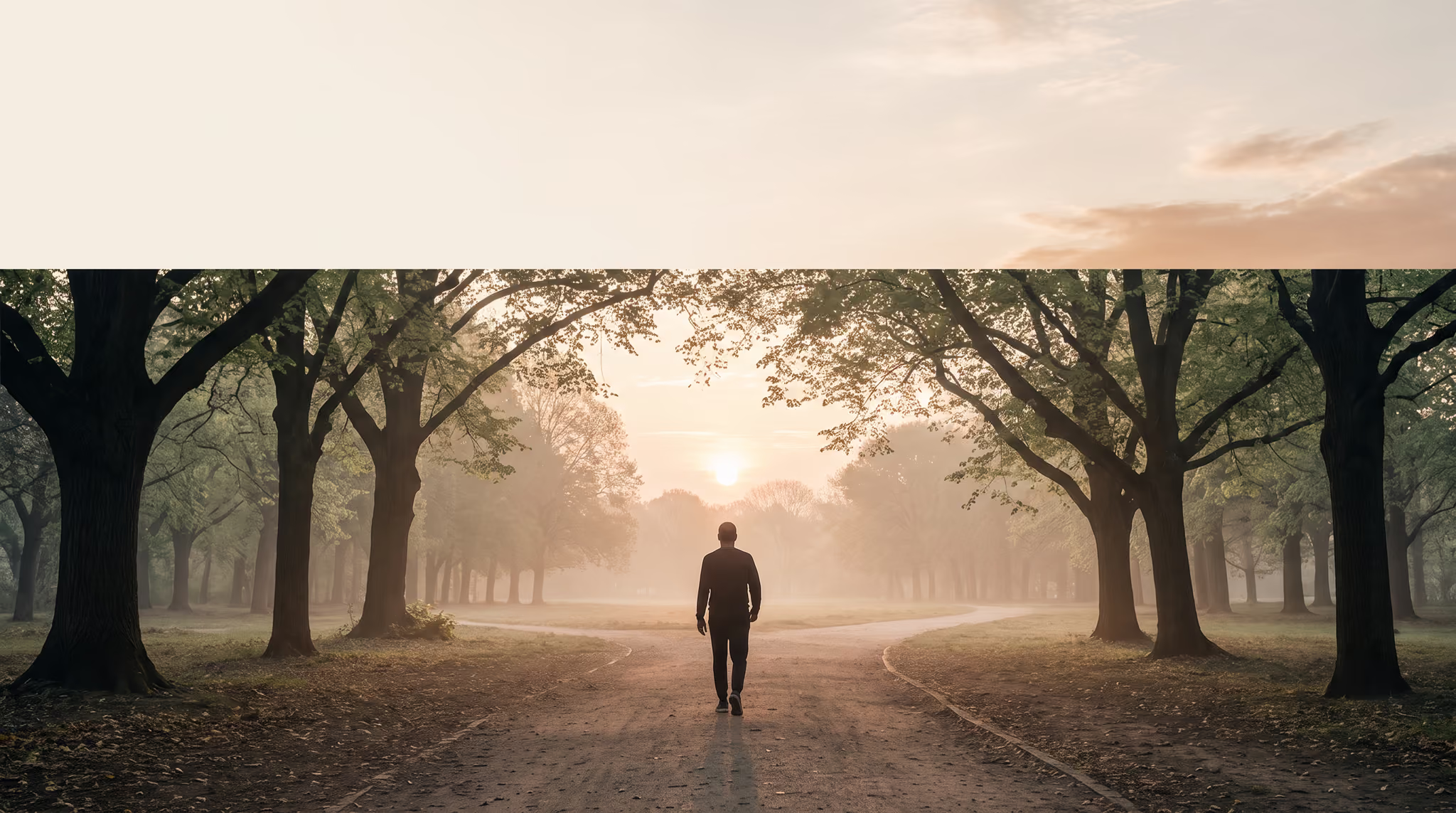
That light timing sets the human circadian clock is well established, and an international expert consensus recommends bright days and dim evenings. The popular protocol itself (a fixed number of minutes outside within an hour of waking) has not been tested in randomized trials in healthy people, and claims about cortisol, testosterone and weight go beyond the evidence.
The rules
The rules ofMorning sunlight
- 1Go outside within 30 to 60 minutes of waking (some versions say within 15 to 30 minutes).
- 2Spend about 10 minutes outside on a clear morning, 20 minutes when cloudy and 30 to 60 minutes when very overcast.
- 3Face the bright part of the sky without looking directly at the sun.
- 4Skip sunglasses for this practice when it is safe to do so; prescription glasses and contact lenses are fine.
- 5If you wake before sunrise, turn on bright indoor lights and go outside once the sun is up, or use a 10,000 lux light box.
- 6Repeat daily, including weekends, and keep evening light dim in the last hours before bed.
Share these rules as an image or a link.
| Huberman toolkit | Outside within 30 to 60 minutes of waking for 10, 20 or 30 to 60 minutes depending on cloud cover, plus some afternoon light. |
|---|---|
| Light box | A 10,000 lux light box for about 30 minutes in the early morning, the dose used in depression trials. |
| Morning walk | A daily outdoor walk or active commute after waking, which combines light and movement. |
| Blueprint | Bryan Johnson's routine: outdoors within 15 to 30 minutes of waking, or a 10,000 lux lamp for 3 to 4 minutes when he is up before the sun. |
| All-day daylight | The expert consensus target: at least 250 lux melanopic EDI at the eye through the daytime, at most 10 lux in the 3 hours before bed. |
What it aims to do
- Anchor the body clock to the solar day so sleepiness comes earlier in the evening.
- Feel more alert in the morning.
- Make it easier to fall asleep and to wake at a steady time.
- Support mood, especially in winter.
- Create a strong contrast between bright days and dark nights.
What it claims, and what the evidence shows
Grades reflect evidence in people. Animal and cell results alone never earn more than limited.
Sleep
Moderate evidenceMood and stress
Moderate evidenceEnergy and fatigue
Limited evidenceHormones
Limited evidenceTimes a healthy cortisol peak
The cited evidence is one study in 8 sleep-deprived men in which 3 hours of bright light at 05:00 raised cortisol by more than 50%, with no health outcome measured. [6]
Blood sugar and insulin
Mixed evidenceLifespan and mortality
Limited evidenceLowers the risk of early death
In 88,905 adults, brighter days and darker nights predicted lower mortality over 8 years, but this is observational and cannot show cause. [17]
Bone health
Not enough evidenceProvides vitamin D
Vitamin D-producing ultraviolet B peaks around midday, so early morning light is not a reliable vitamin D source. [18]
Key takeaways
- 1
Light timing sets the human body clock: light after waking moves it earlier, light late at night moves it later [1].
- 2
Outdoor light measured at eye level is around 11,000 to 18,000 lux versus about 100 to 160 lux indoors [2].
- 3
- 4
The 10 to 30 minute rules are practical guides, not doses tested in trials; experts recommend at least 250 lux melanopic EDI through the day [5].
- 5
Is morning sunlight good for you?
Probably, for the body clock: daylight soon after waking is the strongest signal that keeps sleep and alertness on time, and bright light treats depression in trials. The exact doses promoted online, and claims about cortisol, testosterone and weight, rest on much thinner evidence.
Morning sunlight became a household habit through podcasts, but the core idea comes from decades of circadian research. Light reaching the eyes is the main cue that keeps the internal clock in step with the solar day, and light timing matters: light in the hours after waking moves the clock earlier, while light late in the evening moves it later [1].
The practice is cheap and low risk, which is why many sleep scientists endorse a version of it. What the evidence does and does not show differs by claim:
- Strongest: natural light shifts the clock earlier in field studies [8], and bright light boxes treat seasonal and nonseasonal depression in randomized trials [3] [4].
- Moderate: light therapy improves sleep problems with small to medium effects [10]; more daylight is linked to better mood and sleep in very large cohorts [11].
- Weak or untested: fixed minute counts, cortisol timing, weight loss and hormone claims.
No randomized trial has tested the popular protocol itself (10 minutes outside within an hour of waking) in healthy people against a control group. The case for it is built from mechanism studies, light therapy trials and observational data.
| Claim | What the evidence shows | Strength |
|---|---|---|
| Sets the body clock earlier | Natural light moved the clock about 2 hours earlier in a week of camping | Moderate to strong (mechanism) |
| Improves sleep | Light therapy helps sleep problems; no trial of a short morning walk in healthy sleepers | Moderate |
| Lifts mood | Light boxes treat depression in trials; outdoor time linked to lower depression odds | Moderate |
| Times a healthy cortisol peak | One lab study of 8 sleep-deprived men | Limited |
| Helps weight and blood sugar | Correlations only; one trial found bright light raised insulin resistance | Mixed |
| Gives you vitamin D | UVB peaks near midday, not in the early morning | Insufficient |
How does morning light set your body clock?
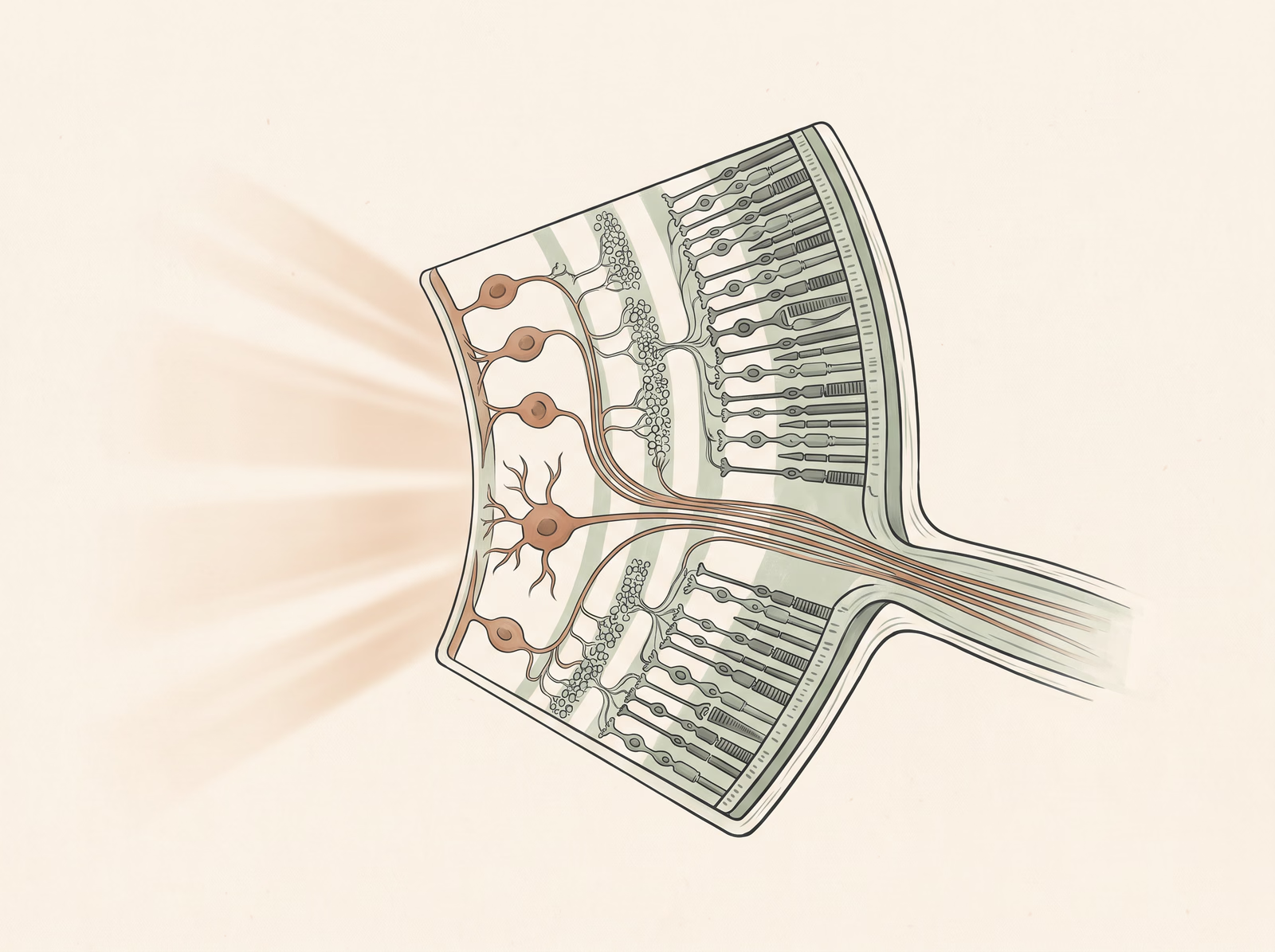
Special cells in the retina that contain the pigment melanopsin sense light directly and signal the suprachiasmatic nucleus, the brain's master clock. Light in the hours after waking moves the clock earlier, so you get sleepy earlier that evening.
In 2002 two papers showed that a small group of retinal ganglion cells respond to light on their own, without input from rods and cones, and that these cells contain melanopsin and project to the suprachiasmatic nucleus [19] [20]. These intrinsically photosensitive cells are most sensitive to blue-cyan light, which is plentiful in daylight.
The clock's response to light depends on when the light arrives. In a laboratory study of 21 adults, bright light given after the body's temperature low point (a few hours before habitual waking) advanced the clock, while light given before it delayed the clock [1]. That is the reason morning light is singled out: it pushes the clock earlier, against the natural tendency of many people to drift later.
The clock is also very sensitive to evening light. Ordinary room light of about 25 lux halved melatonin in the evening on average, and people differed more than tenfold in how sensitive they were [21]. A bright morning can be partly undone by a bright evening, so researchers talk about the contrast between day and night, not morning light alone [5].
In mice, irregular light directly worsened mood-like behavior and learning through melanopsin cells, even when sleep stayed normal [22]. That finding is suggestive for humans but comes from animals.
How morning light reaches the body clock
Step 1
Daylight enters the eye
Outdoor daylight is often 100 times brighter than indoor light.
Step 2
Melanopsin cells in the retina
These ganglion cells sense light directly, most of all blue-cyan light.
Step 3
Signal to the master clock
The cells project to the suprachiasmatic nucleus in the brain.
Step 4
The clock sets daily timing
It times evening melatonin, morning alertness and sleep.
Timing decides the direction. Light after the body's temperature low point, a few hours before habitual waking, moves the clock earlier; light before it, in the late evening and night, moves it later.
How much morning sunlight do you need?
No trial has set a minimum dose. Andrew Huberman suggests about 10 minutes on a clear day, 20 when cloudy and 30 to 60 when overcast. An expert consensus instead recommends at least 250 lux of melanopic light at the eye throughout the day.
The minute counts most people quote come from Andrew Huberman's sleep toolkit: go outside within 30 to 60 minutes of waking and view morning light for about 10 minutes on a clear day, 20 minutes on a cloudy day and 30 to 60 minutes on a very overcast day. They are practical rules of thumb, not doses tested in trials.
What is well measured is how much brighter outdoors is. At eye level in Singapore, open outdoor light measured 11,080 to 18,176 lux against 112 to 156 lux indoors [2]. In Colorado, a week of camping raised average light while awake from 979 to 4,487 lux [8]. Even a cloudy morning outside usually beats a well-lit office.
A 2022 consensus of circadian and lighting researchers gave the first numeric targets, using melanopic equivalent daylight illuminance (melanopic EDI), a unit weighted to melanopsin [5]:
| Time of day | Recommended light at the eye |
|---|---|
| Daytime | At least 250 lux melanopic EDI |
| Last 3 hours before bed | At most 10 lux melanopic EDI |
| During sleep | At most 1 lux melanopic EDI |
The consensus notes that many people spend their days below 250 lux. In clinical trials for depression, the dose was usually a 10,000 lux light box for 30 minutes in the early morning [4]. A useful reading of the evidence: more daytime light is better, earlier is better for most people, and a short daily outdoor walk is an easy way to get it. A brisk walk can also count toward Zone 2 cardio.
Light at eye level by setting
- Outdoors in the open14,628 lux
- Outdoors under a tree6,716 lux
- Outdoors with a brimmed hat6,134 lux
- Outdoors with sunglasses4,296 lux
- Indoors134 lux
With or without a window
Show the data
| Item | Value (lux) | Low | High | Note |
|---|---|---|---|---|
| Outdoors in the open | 14,628 | 11,080 | 18,176 | |
| Outdoors under a tree | 6,716 | 5,556 | 7,876 | |
| Outdoors with a brimmed hat | 6,134 | 4,112 | 8,156 | |
| Outdoors with sunglasses | 4,296 | 1,792 | 6,800 | |
| Indoors | 134 | 112 | 156 | With or without a window |
Does morning sunlight work through a window?
Partly. Indoors near a window, light at the eye is usually a small fraction of outdoor light, and window glass filters some wavelengths. Going outside, even into shade or with sunglasses, gives far more light than sitting inside.
In the Singapore measurements, indoor light with a window measured 112 to 156 lux at eye level, while shade under a tree measured 5,556 to 7,876 lux and even sunglasses outdoors gave 1,792 to 6,800 lux [2]. That is roughly 11 to 43 times more light with sunglasses than indoors, and around 100 times more in the open.
Windows still matter over a whole day. Office workers in windowless spaces reported worse sleep quality and vitality, and workers with windows got more light and slept longer by actigraphy, though this was a small pilot study [15].
Practical points that follow from the measurements:
- Step outside rather than standing at a window when you can.
- Sunglasses and hats cut light but do not erase the benefit; Huberman's toolkit advises skipping sunglasses for this practice when it is safe, while regular glasses and contact lenses are fine.
- Never look directly at the sun. Look toward the bright sky.
- Light boxes are the fallback when you wake before sunrise or live far north. Trials used 10,000 lux at a set distance, usually for 30 minutes [4]. Bryan Johnson's Blueprint uses a 10,000 lux lamp for 3 to 4 minutes before sunrise, a much shorter dose than in trials.
Average light while awake: modern week versus camping week
- Normal week with electric light979 lux
- Camping week with natural light only4,487 lux
Show the data
| Item | Value (lux) | Low | High | Note |
|---|---|---|---|---|
| Normal week with electric light | 979 | |||
| Camping week with natural light only | 4,487 |
Does morning sunlight help you sleep?
It likely helps you fall asleep earlier and wake more easily by moving the clock earlier, and light therapy improves sleep problems modestly. Evidence that a short morning walk improves sleep in people who already sleep well is limited.
The best human evidence comes from natural light experiments. After a summer week with only natural light, eight adults' internal clocks moved about 2 hours earlier and their sleep moved about 1.2 hours earlier, with no change in sleep duration [8]. A single weekend of camping produced about 69% of that shift [9]. These studies changed the whole light environment, including dark evenings, not just morning light.
Across 53 studies, light therapy improved sleep problems in general (Hedges g 0.39), including circadian rhythm sleep disorders and insomnia, with signs of publication bias [10]. In more than 400,000 UK adults, each extra hour of daytime outdoor light was linked to easier waking, less tiredness, fewer insomnia symptoms and an earlier chronotype [11].
Two caveats. First, observational links cannot separate light from what people do outside, such as walking and socializing. Second, the evening matters as much as the morning: dim the lights in the last 3 hours before bed [5] [21]. If you track sleep regularity as part of Outlive-style planning, morning light is one of the simplest levers for keeping wake time steady.
A light diet across 24 hours
- Bright day: at least 250 lux melanopic EDI07:00 to 20:00
- Dim evening: at most 10 lux melanopic EDI20:00 to 23:00
- Dark night: at most 1 lux melanopic EDI23:00 to 07:00
- Morning outdoor walk07:30
Times are an example for a 07:00 wake and 23:00 bedtime. Many people spend their days below 250 lux: indoor light near a window measured 112 to 156 lux at the eye, open outdoor light 11,080 to 18,176 lux.
Can morning light help with depression and mood?
Bright light therapy, usually 10,000 lux for about 30 minutes in the morning, treats seasonal and nonseasonal depression in randomized trials. Whether daily sunlight prevents depression in healthy people is not proven, though more outdoor time is linked to better mood.
Light therapy is one of the better supported non-drug treatments in psychiatry. A 2005 meta-analysis found effect sizes of 0.84 for bright light in seasonal depression and 0.53 in nonseasonal depression, similar to many antidepressant trials, while noting that most studies were small [3]. A 2020 meta-analysis of 19 trials confirmed a benefit in seasonal depression, with moderate to high risk of bias [12].
For nonseasonal major depression, an 8-week trial found that a 10,000 lux box for 30 minutes each early morning beat a sham device, and the combination with fluoxetine worked best [4]. A 2025 meta-analysis of 11 trials found remission in 40.7% with light therapy added versus 23.5% without [13].
Prevention is less clear. A Cochrane review found only one small trial of preventing winter depression with light, too weak to draw conclusions [14]. In the general population, each extra hour outdoors was linked to lower odds of depression and antidepressant use [11], but people who feel well may also go outside more.
Light boxes are medical treatment when used for depression. Anyone with depression, and especially bipolar disorder, should use them with a clinician, even though trials in bipolar depression did not find more mood switches with light [23].
Does morning sunlight lower cortisol, raise testosterone or help weight loss?
The cortisol claim comes from one lab study, and bright morning light raised cortisol rather than lowering it. Weight links are correlations, one trial found bright light raised insulin resistance, and we found no human trials on testosterone.
Cortisol. The study behind the claim exposed eight men to 3 hours of bright light from 05:00 to 08:00 during a night without sleep. Cortisol rose by more than 50% and alertness held up better; afternoon light had no effect [6]. That shows light can act on the stress hormone system at certain times of day. It does not show that a 10 minute walk times a healthier cortisol rhythm in rested people, or that this changes health.
Weight and blood sugar. In 54 adults, those whose bright light came earlier in the day had lower BMI [16], a correlation that could reflect lifestyle. In a randomized inpatient study, 3 hours of blue-enriched light raised insulin resistance whether given in the morning or evening [7]. The metabolic story is unsettled.
Mortality. In 88,905 UK Biobank adults who wore light sensors for a week, the brightest days were linked to 17% to 34% lower all-cause mortality and the brightest nights to higher mortality over 8 years [17]. This is observational, and people who spend daylight hours outside differ in many ways.
Vitamin D. Morning light is for the clock, not for vitamin D. Ultraviolet B that makes vitamin D peaks around noon, and dermatologists note that supplements are a safer route [18].
Testosterone and dopamine. We found no human trials showing that morning sunlight raises testosterone or dopamine in a meaningful way. Daylight researchers themselves list many open questions about daylight's effects beyond the clock [24].
The studies, by type
Strongest designs first. Scroll each row; every card links to the paper and says whether it supports the protocol.
Systematic reviews and meta-analyses (6)
Randomized controlled trials (2)
Large observational studies in people (5)
Mechanistic studies in people (5)
Animal and cell studies (3)
Hypotheses and expert reviews (3)
Who follows it, who backs it, who doubts it
Public positions summarized in our words. Follow each link for the full context.
Follow it
Andrew HubermanNeuroscientist at Stanford and host of the Huberman Lab podcast
Popularized the practice. His sleep toolkit advises going outside within 30 to 60 minutes of waking and viewing morning light for about 10, 20 or 30 to 60 minutes depending on cloud cover, without sunglasses when safe.
Bryan JohnsonEntrepreneur, founder of Blueprint
His published protocol tells readers to get outside within 15 to 30 minutes of waking, and he uses a 10,000 lux lamp for 3 to 4 minutes because he wakes before sunrise.
Support it
Matthew WalkerSleep scientist at UC Berkeley and author of Why We Sleep
Says outdoor morning light is critical for setting the clock and suggests 30 to 40 minutes, while noting that the exact dose-response relationship is not well understood.
FoundMyFitness: The importance of early-day light for improved sleep
Russell FosterProfessor of circadian neuroscience at the University of Oxford
Argues that getting the right light at the right times supports health, mood and sleep as modern life pushes activity later.
Feel Better, Live More podcast (Rangan Chatterjee), October 2024
Oppose or doubt it
Christy HarrisonRegistered dietitian and author of the Rethinking Wellness newsletter
After looking into the slogan sunlight before screen light, she concluded that good science does not back it as stated, and that claims linking morning light to body size are unsupported.
Public examples
- Huberman Lab Toolkit for Sleep
The most cited public version of the protocol, with minute counts by cloud cover.
- Blueprint (Bryan Johnson)
Includes morning light within 15 to 30 minutes of waking, or a 10,000 lux lamp, as one of ten sleep habits.
How to follow it
- Pick a fixed wake time you can keep on weekdays and weekends.
- Within the first hour after waking, step outside for about 10 minutes on a clear day and longer when it is cloudy.
- Look toward the bright sky or horizon, never directly at the sun, and leave sunglasses off if it is safe.
- Combine it with something you already do: a walk, a coffee on the balcony, the commute or walking a dog.
- If you wake before sunrise or live far north in winter, use bright indoor light and consider a 10,000 lux light box; talk to a clinician first if you have depression or an eye condition.
- Keep evenings dim: lower lights and screens in the last 3 hours before bed so the morning signal is not undone.
How to know you are following it
Count the days each week you spent at least 10 minutes outdoors within an hour of waking, and note your wake time. A wearable with a light sensor, or a phone light meter app held at eye level, can show how many lux you actually got. Over 2 to 4 weeks, compare sleep onset, wake time regularity and morning alertness.
Common mistakes
- Standing behind a window and counting it as outdoor light.
- Looking directly at the sun, which can damage the eyes.
- Doing it on weekdays but sleeping in and skipping it on weekends.
- Undoing the signal with bright light and screens late in the evening.
- Treating the minute counts as exact doses instead of rough guides.
- Using a light box for depression without clinical support.
Who should be careful
Check with a clinician first if you
- You have an eye condition such as retinal disease or recent eye surgery: ask an eye doctor before bright light routines or light boxes.
- You take medicines that make skin or eyes sensitive to light: check with a pharmacist or clinician.
- You have bipolar disorder or depression: use light boxes only with a clinician, who can watch for changes in mood.
- You have a history of skin cancer: use sun protection on the skin for longer outdoor time, while still letting daylight reach the eyes.
Possible side effects
- Glare, eye strain and headaches, mostly with light boxes used too close.
- Irritability or trouble sleeping if a light box is used late in the day.
- Sunburn with long unprotected exposure later in the morning.
- Rarely, agitation or elevated mood in people prone to mania.
Watch
Talks and explainers worth your time. Nothing loads from YouTube until you press play.
Optimal Morning & Evening Sunlight Routine | Dr. Andrew Huberman
Huberman Lab ClipsHuberman Lab Clips@hubermanlabclipsSubscribers1.5MStartedJuly 2021CountryUnited StatesVideos574Total views137.5MNew videos, last 30 days22New videos, last year204From YouTube, 2026-10-31Open on YouTube
Huberman explains the protocol in his own words, including morning and late-day light.
How to Get Morning Light Without Direct Sunshine
Huberman Lab ClipsHuberman Lab Clips@hubermanlabclipsSubscribers1.5MStartedJuly 2021CountryUnited StatesVideos574Total views137.5MNew videos, last 30 days22New videos, last year204From YouTube, 2026-10-31Open on YouTube
Covers cloudy days and indirect daylight, the most common practical question.
"Doing This for 5 Minutes Every Morning Improves Mood, Sleep, & Alertness" - Andrew Huberman
FoundMyFitness ClipsFoundMyFitness Clips@foundmyfitnessclipsSubscribers554KStartedJanuary 2019CountryUnited StatesVideos2.1KTotal views161.7MNew videos, last 30 days38New videos, last year423From YouTube, 2026-10-31Open on YouTube
A shorter conversation with Rhonda Patrick on why morning light matters.
Light, sleep and circadian interactions: Biology to new therapeutic targets - Russell Foster
The Physiological SocietyThe Physiological Society@physoctvSubscribers28.9KStartedMarch 2010CountryNot statedVideos807Total views4.5MNew videos, last 30 days0New videos, last year26From YouTube, 2026-10-31Open on YouTube
A scientific lecture on how the eye's light-sensing cells set the clock, from a leading circadian researcher.
“THE VITAL DAYLIGHT” featuring Russell Foster, Laureate of The Daylight Award 2020 for Research
The Daylight AwardThe Daylight Award@thedaylightaward5119Subscribers1.3KStartedSeptember 2019CountryDenmarkVideos32Total views85.1KNew videos, last 30 days0New videos, last year0From YouTube, 2026-10-31Open on YouTube
A short film on daylight and the body clock for a general audience.
Common questions
How long should I get morning sunlight?
No trial has set a dose. A common guide is about 10 minutes on a clear morning, 20 when cloudy and 30 to 60 when very overcast. Depression trials used a 10,000 lux light box for 30 minutes.
What time is best for morning sunlight?
Within the first hour after waking is the usual advice. Light after the body's temperature low point, which falls a few hours before your usual wake time, moves the clock earlier, so early light has the most effect.
Does morning sunlight work through a window?
Only partly. Light at eye level indoors was about 112 to 156 lux in one study versus 11,080 to 18,176 lux outdoors, so stepping outside gives far more light than sitting by a window.
Is morning sunlight better than evening sunlight?
For the body clock, yes: morning light moves it earlier and late evening light moves it later. Daylight in the afternoon is still useful, and dim light in the last 3 hours before bed matters as much as the morning.
Does morning sunlight give you vitamin D?
Not much. The ultraviolet B that makes vitamin D peaks around midday. Morning light is useful for the clock, and supplements are a more reliable way to raise vitamin D.
Does morning sunlight lower cortisol?
The evidence points the other way: in a lab study, bright light at 05:00 raised cortisol by more than 50% in sleep-deprived men. Whether this timing effect improves health in rested people is unknown.
Can I use a light lamp instead of the sun?
Yes, a 10,000 lux light box is the tool used in depression trials, usually for 30 minutes in the morning. Check with a clinician first if you have depression, bipolar disorder or an eye condition.
Should I wear sunglasses for morning sunlight?
Sunglasses reduce light at the eye, but outdoor light with sunglasses was still 11 to 43 times brighter than indoors in one study. Skip them when it is safe; regular glasses are fine. Never look straight at the sun.
Sources
- 1.Khalsa SB, Jewett ME, Cajochen C, Czeisler CA. A phase response curve to single bright light pulses in human subjects. Journal of Physiology, 2003. doi:10.1113/jphysiol.2003.040477
- 2.Lanca C, Teo A, Vivagandan A, et al. The Effects of Different Outdoor Environments, Sunglasses and Hats on Light Levels: Implications for Myopia Prevention. Translational Vision Science and Technology, 2019. doi:10.1167/tvst.8.4.7
- 3.Golden RN, Gaynes BN, Ekstrom RD, et al. The efficacy of light therapy in the treatment of mood disorders: a review and meta-analysis of the evidence. American Journal of Psychiatry, 2005. doi:10.1176/appi.ajp.162.4.656
- 4.Lam RW, Levitt AJ, Levitan RD, et al. Efficacy of Bright Light Treatment, Fluoxetine, and the Combination in Patients With Nonseasonal Major Depressive Disorder: A Randomized Clinical Trial. JAMA Psychiatry, 2016. doi:10.1001/jamapsychiatry.2015.2235
- 5.Brown TM, Brainard GC, Cajochen C, et al. Recommendations for daytime, evening, and nighttime indoor light exposure to best support physiology, sleep, and wakefulness in healthy adults. PLoS Biology, 2022. doi:10.1371/journal.pbio.3001571
- 6.Leproult R, Colecchia EF, L'Hermite-Balériaux M, Van Cauter E. Transition from dim to bright light in the morning induces an immediate elevation of cortisol levels. Journal of Clinical Endocrinology and Metabolism, 2001. doi:10.1210/jcem.86.1.7102
- 7.Cheung IN, Zee PC, Shalman D, et al. Morning and Evening Blue-Enriched Light Exposure Alters Metabolic Function in Normal Weight Adults. PLoS One, 2016. doi:10.1371/journal.pone.0155601
- 8.Wright KP Jr, McHill AW, Birks BR, et al. Entrainment of the human circadian clock to the natural light-dark cycle. Current Biology, 2013. doi:10.1016/j.cub.2013.06.039
- 9.Stothard ER, McHill AW, Depner CM, et al. Circadian Entrainment to the Natural Light-Dark Cycle across Seasons and the Weekend. Current Biology, 2017. doi:10.1016/j.cub.2016.12.041
- 10.van Maanen A, Meijer AM, van der Heijden KB, Oort FJ. The effects of light therapy on sleep problems: A systematic review and meta-analysis. Sleep Medicine Reviews, 2016. doi:10.1016/j.smrv.2015.08.009
- 11.Burns AC, Saxena R, Vetter C, et al. Time spent in outdoor light is associated with mood, sleep, and circadian rhythm-related outcomes: A cross-sectional and longitudinal study in over 400,000 UK Biobank participants. Journal of Affective Disorders, 2021. doi:10.1016/j.jad.2021.08.056
- 12.Pjrek E, Friedrich ME, Cambioli L, et al. The Efficacy of Light Therapy in the Treatment of Seasonal Affective Disorder: A Meta-Analysis of Randomized Controlled Trials. Psychotherapy and Psychosomatics, 2020. doi:10.1159/000502891
- 13.Menegaz de Almeida A, Aquino de Moraes FC, Cavalcanti Souza ME, et al. Bright Light Therapy for Nonseasonal Depressive Disorders: A Systematic Review and Meta-Analysis. JAMA Psychiatry, 2025. doi:10.1001/jamapsychiatry.2024.2871
- 14.Nussbaumer-Streit B, Forneris CA, Morgan LC, et al. Light therapy for preventing seasonal affective disorder. Cochrane Database of Systematic Reviews, 2019. doi:10.1002/14651858.CD011269.pub3
- 15.Boubekri M, Cheung IN, Reid KJ, et al. Impact of windows and daylight exposure on overall health and sleep quality of office workers: a case-control pilot study. Journal of Clinical Sleep Medicine, 2014. doi:10.5664/jcsm.3780
- 16.Reid KJ, Santostasi G, Baron KG, et al. Timing and intensity of light correlate with body weight in adults. PLoS One, 2014. doi:10.1371/journal.pone.0092251
- 17.Windred DP, Burns AC, Lane JM, et al. Brighter nights and darker days predict higher mortality risk: A prospective analysis of personal light exposure in >88,000 individuals. Proceedings of the National Academy of Sciences, 2024. doi:10.1073/pnas.2405924121
- 18.Terushkin V, Bender A, Psaty EL, et al. Estimated equivalency of vitamin D production from natural sun exposure versus oral vitamin D supplementation across seasons at two US latitudes. Journal of the American Academy of Dermatology, 2010. doi:10.1016/j.jaad.2009.07.028
- 19.Berson DM, Dunn FA, Takao M. Phototransduction by retinal ganglion cells that set the circadian clock. Science, 2002. doi:10.1126/science.1067262
- 20.Hattar S, Liao HW, Takao M, Berson DM, Yau KW. Melanopsin-containing retinal ganglion cells: architecture, projections, and intrinsic photosensitivity. Science, 2002. doi:10.1126/science.1069609
- 21.Phillips AJK, Vidafar P, Burns AC, et al. High sensitivity and interindividual variability in the response of the human circadian system to evening light. Proceedings of the National Academy of Sciences, 2019. doi:10.1073/pnas.1901824116
- 22.LeGates TA, Altimus CM, Wang H, et al. Aberrant light directly impairs mood and learning through melanopsin-expressing neurons. Nature, 2012. doi:10.1038/nature11673
- 23.Lam RW, Teng MY, Jung YE, et al. Light Therapy for Patients With Bipolar Depression: Systematic Review and Meta-Analysis of Randomized Controlled Trials. Canadian Journal of Psychiatry, 2020. doi:10.1177/0706743719892471
- 24.Münch M, Wirz-Justice A, Brown SA, et al. The Role of Daylight for Humans: Gaps in Current Knowledge. Clocks and Sleep, 2020. doi:10.3390/clockssleep2010008
AumniVIDA explains health information for general wellness. Talk to your clinician before changing your diet, training or medication for a health condition.