
How to lower homocysteine
Updated October 31, 2026 · 25 sources · Written by the AumniVIDA team
UnitsShort answer
Folic acid is the strongest lever: 0.4 mg a day lowers homocysteine by about 20% and 0.8 mg by about 23%. Vitamin B12 adds about 7%, riboflavin helps people with the MTHFR TT genotype, and diet moves it by under 1 µmol/L. Lowering it has not prevented heart attacks in trials.
How much each B vitamin lowers homocysteine
- Folic acid 5 mg/day25 % lower homocysteine
- Folic acid 2 mg/day23 % lower homocysteine
- Folic acid 0.8 mg/day23 % lower homocysteine
Smallest dose with close to the full effect
- Folic acid 0.4 mg/day20 % lower homocysteine
About 90% of the maximum effect
- Folic acid 0.2 mg/day13 % lower homocysteine
- Vitamin B12 0.4 mg/day, added to folic acid7 % lower homocysteine
- Vitamin B6, added to folic acid0 % lower homocysteine
No significant effect on fasting homocysteine
Show the data
| Item | Value (% lower homocysteine) | Low | High | Note |
|---|---|---|---|---|
| Folic acid 5 mg/day | 25 | 22 | 28 | |
| Folic acid 2 mg/day | 23 | 20 | 26 | |
| Folic acid 0.8 mg/day | 23 | 21 | 26 | Smallest dose with close to the full effect |
| Folic acid 0.4 mg/day | 20 | 17 | 22 | About 90% of the maximum effect |
| Folic acid 0.2 mg/day | 13 | 10 | 16 | |
| Vitamin B12 0.4 mg/day, added to folic acid | 7 | 4 | 9 | |
| Vitamin B6, added to folic acid | 0 | No significant effect on fasting homocysteine |
Key takeaways
- 1
Folic acid lowers homocysteine by 13% at 0.2 mg, 20% at 0.4 mg and about 23 to 25% at 0.8 mg or more; higher doses add little [1].
- 2
B12 adds about 7% on top of folic acid, while B6 adds nothing significant to fasting levels [1].
- 3
- 4
- 5
Lowering homocysteine did not reduce heart attacks in 15 trials, with a small stroke reduction (RR 0.90) [6].
What lowers homocysteine the most?
Folic acid, alone or with B12, lowers homocysteine more than anything else, by about a quarter at typical doses. Riboflavin, betaine and diet follow with smaller effects.
The table ranks the levers by effect size from controlled studies. The supplement trials report percent or absolute change against placebo; diet studies compare a full diet with a control diet.
How much you lower depends on where you start. Folic acid gives bigger drops when homocysteine is higher and folate lower to begin with, and the effect is larger in women than in men [1][7]. In people who already eat folic-acid-fortified food, the room to lower is smaller [8].
The bar chart puts the main absolute changes side by side: folic acid plus B12 lowered homocysteine by 3.8 µmol/L in SEARCH [9] and HOPE-2 lowered it by 3.2 µmol/L against placebo [10]; riboflavin lowered it by 3.6 µmol/L in TT carriers [2]; folic acid 0.8 mg and betaine 6 g lowered it by 2.7 and 1.8 µmol/L [11]; and coffee raised it by 1.5 µmol/L [5].
| Lever | Dose or change | Effect on homocysteine | Source |
|---|---|---|---|
| Folic acid | 0.8 mg or more a day | About 23 to 25% lower | HLTC 2005, 25 trials |
| Folic acid | 0.4 mg a day | About 20% lower | HLTC 2005 |
| Folic acid | 0.2 mg a day | About 13% lower | HLTC 2005 |
| Folic acid plus B12 | 2 mg + 1 mg a day | 3.8 µmol/L (28%) lower | SEARCH 2010 |
| Vitamin B12 added to folic acid | 0.4 mg a day | About 7% further | HLTC 2005 |
| Riboflavin (MTHFR TT only) | 1.6 mg a day, 12 weeks | 22% lower; 40% if riboflavin was low | McNulty 2006 |
| Betaine | 6 g a day, 6 weeks | 1.8 µmol/L lower | Steenge 2003 |
| Betaine | 4 g or more a day | 1.23 µmol/L lower | McRae 2013, 5 trials |
| DASH-style diet | Fruit, vegetables, low-fat dairy, 8 weeks | About 0.8 µmol/L lower than control | Appel 2000 |
| Vitamin B6 added to folic acid | Various | No significant extra effect | HLTC 2005 |
| Cutting heavy coffee | 1 L a day of filtered coffee removed | Avoids a 1.5 µmol/L (18%) rise | Urgert 2000 |
| Not smoking | Fewer cigarettes per day | Lower levels in observational data; no trial | Nygård 1995 |
Homocysteine change by lever, in µmol/L
- Folic acid 2 mg + B12 1 mg (SEARCH)-3.8 µmol/L change
Armitage 2010, heart attack survivors, 28% lower
- Riboflavin 1.6 mg, MTHFR TT only-3.6 µmol/L change
McNulty 2006, from 16.1 to 12.5 µmol/L; no effect in CC or CT
- Folic acid, B6 and B12 (HOPE-2), against placebo-3.2 µmol/L change
Lonn 2006, minus 2.4 versus plus 0.8 on placebo
- Folic acid 0.8 mg, 6 weeks-2.7 µmol/L change
Steenge 2003, mildly raised homocysteine
- Betaine 6 g, 6 weeks-1.8 µmol/L change
Steenge 2003
- Betaine 4 g or more, pooled-1.23 µmol/L change
McRae 2013, five trials, healthy adults
- DASH-style diet, 8 weeks-0.8 µmol/L change
Appel 2000, against a typical American diet
- Paper-filtered coffee 1 L/day1.5 µmol/L change
Urgert 2000, an increase of 18%
Show the data
| Item | Value (µmol/L change) | Low | High | Note |
|---|---|---|---|---|
| Folic acid 2 mg + B12 1 mg (SEARCH) | -3.8 | Armitage 2010, heart attack survivors, 28% lower | ||
| Riboflavin 1.6 mg, MTHFR TT only | -3.6 | McNulty 2006, from 16.1 to 12.5 µmol/L; no effect in CC or CT | ||
| Folic acid, B6 and B12 (HOPE-2), against placebo | -3.2 | Lonn 2006, minus 2.4 versus plus 0.8 on placebo | ||
| Folic acid 0.8 mg, 6 weeks | -2.7 | -4.5 | -0.9 | Steenge 2003, mildly raised homocysteine |
| Betaine 6 g, 6 weeks | -1.8 | -3.6 | 0 | Steenge 2003 |
| Betaine 4 g or more, pooled | -1.23 | McRae 2013, five trials, healthy adults | ||
| DASH-style diet, 8 weeks | -0.8 | Appel 2000, against a typical American diet | ||
| Paper-filtered coffee 1 L/day | 1.5 | 0.9 | 2.1 | Urgert 2000, an increase of 18% |
How much folic acid lowers homocysteine?
Most of the effect comes by 0.4 to 0.8 mg a day. In a meta-analysis of 25 trials, 0.2 mg gave 60% and 0.4 mg 90% of the maximum reduction.
The Homocysteine Lowering Trialists' Collaboration pooled individual data from 25 trials and 2,596 people. Standardised to a starting homocysteine of 12 µmol/L, daily folic acid lowered it by 13% at 0.2 mg, 20% at 0.4 mg, 23% at 0.8 mg, 23% at 2 mg and 25% at 5 mg [1]. The authors concluded that 0.8 mg or more is typically needed for the maximal effect.
Higher doses add little to homocysteine and are less studied for safety. A 2026 meta-analysis of 36 trials in people with hyperhomocysteinemia found larger drops at 5 to 15 mg a day, but the trials were small and biased, none measured heart attacks or strokes, and the three studies at 15 mg a day reported more cardiovascular events [12].
Folic acid can also mask the anaemia of B12 deficiency, so clinicians usually check B12 before high doses. Dose decisions belong with a clinician.
How much each B vitamin lowers homocysteine
- Folic acid 5 mg/day25 % lower homocysteine
- Folic acid 2 mg/day23 % lower homocysteine
- Folic acid 0.8 mg/day23 % lower homocysteine
Smallest dose with close to the full effect
- Folic acid 0.4 mg/day20 % lower homocysteine
About 90% of the maximum effect
- Folic acid 0.2 mg/day13 % lower homocysteine
- Vitamin B12 0.4 mg/day, added to folic acid7 % lower homocysteine
- Vitamin B6, added to folic acid0 % lower homocysteine
No significant effect on fasting homocysteine
Show the data
| Item | Value (% lower homocysteine) | Low | High | Note |
|---|---|---|---|---|
| Folic acid 5 mg/day | 25 | 22 | 28 | |
| Folic acid 2 mg/day | 23 | 20 | 26 | |
| Folic acid 0.8 mg/day | 23 | 21 | 26 | Smallest dose with close to the full effect |
| Folic acid 0.4 mg/day | 20 | 17 | 22 | About 90% of the maximum effect |
| Folic acid 0.2 mg/day | 13 | 10 | 16 | |
| Vitamin B12 0.4 mg/day, added to folic acid | 7 | 4 | 9 | |
| Vitamin B6, added to folic acid | 0 | No significant effect on fasting homocysteine |
Does B12 or B6 lower homocysteine?
B12 adds about 7% on top of folic acid and matters most when B12 is low. B6 does not lower fasting homocysteine further, although it acts on the transsulfuration step.
B12 is the cofactor for methionine synthase. Added to folic acid at 0.4 mg a day it lowered homocysteine by a further 7% [1]; the earlier pooled analysis gave a similar 7% for about 0.5 mg [7]. When B12 is actually deficient, the effect is larger: metformin users who became B12 deficient averaged 23.7 µmol/L, against 14.9 µmol/L in those with normal B12 [13].
People most likely to benefit from B12 are those with a reason to be low: long-term metformin [13], vegan or vegetarian diets without supplements [14] and older age. A whole-food plant-based diet keeps B12 on its checklist for this reason.
Vitamin B6 is needed for the transsulfuration exit, but it did not significantly lower fasting homocysteine when added to folic acid [1][7]. In NORVIT, the group given B6 with folic acid and B12 trended toward more cardiovascular events (RR 1.22) [15], so high-dose B6 offers no clear advantage.
Which foods and other supplements lower homocysteine?
Diet patterns rich in vegetables, fruit, legumes and low-fat dairy lower homocysteine by under 1 µmol/L. Betaine and riboflavin have larger, more specific effects.
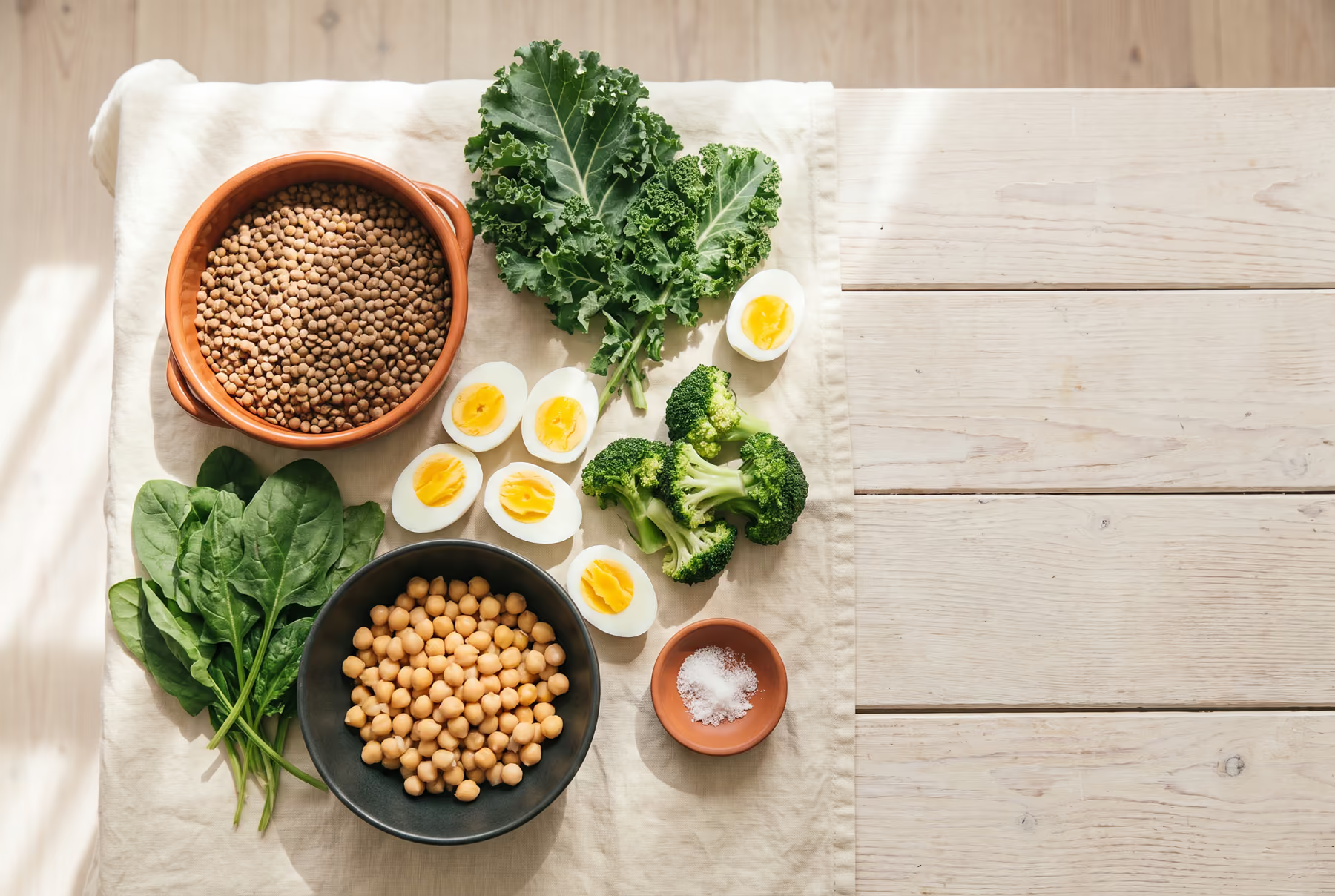
Diet. In a controlled feeding study, a DASH-style diet rich in fruit, vegetables and low-fat dairy lowered homocysteine by about 0.8 µmol/L compared with a typical American diet, and the change tracked a rise in serum folate [4]. Folate-rich foods include leafy greens, legumes and fortified grains; B12 comes from animal foods or fortified foods and supplements [14]. The Mediterranean diet and MIND diet both emphasise these foods.
Betaine (trimethylglycine) remethylates homocysteine through a separate liver enzyme. Six grams a day lowered fasting homocysteine by 1.8 µmol/L [11], and five trials of 4 g or more gave 1.23 µmol/L [3]. Beets, spinach and whole grains contain betaine.
Riboflavin (vitamin B2) stabilises the MTHFR enzyme. At 1.6 mg a day for 12 weeks, it lowered homocysteine from 16.1 to 12.5 µmol/L in people with the TT genotype, and had no effect in CC or CT carriers [2].
Do coffee and smoking raise homocysteine?
Yes. A litre a day of filtered coffee raised homocysteine by 1.5 µmol/L, and levels climb with each cigarette smoked per day. Both are easier wins than most supplements for heavy users.
In a randomised crossover trial, drinking 1 litre a day of paper-filtered coffee for 4 weeks raised fasting homocysteine from 8.1 to 9.6 µmol/L, an 18% increase, in 24 of 26 volunteers, without changing B-vitamin levels [5]. Ordinary intakes have smaller effects.
In the Hordaland study of 16,176 adults, homocysteine rose with the number of cigarettes smoked per day, especially in women, and heavy-smoking older men averaged 4.8 µmol/L more than young non-smoking women [16]. These are observational differences; there is no trial of quitting and homocysteine, but quitting has many other benefits.
Physical activity was linked to lower homocysteine and higher blood pressure and cholesterol to higher levels in the same population [16][17].
How long does it take to lower homocysteine?
Supplement effects show within 6 to 12 weeks in trials. Large trials held the reduction for 5 to 7 years.
Betaine and folic acid lowered homocysteine within 6 weeks [11], and riboflavin within 12 weeks [2]. The betaine meta-analysis included trials of 6 to 24 weeks [3]. In the big outcome trials, the reduction lasted: SEARCH held a 28% reduction for 6.7 years [9] and HOPE-2 for an average of 5 years [10].
If you retest, use the same conditions as the first test, ideally fasting and with prompt processing, because single values vary by about 8% [18]. See the homocysteine test for preparation.
What does lowering homocysteine actually achieve?
It reliably lowers the number. It has not reduced heart attacks or deaths in trials, it modestly reduced stroke, and it slowed brain atrophy in older adults with high homocysteine.
- Heart attack and death: no benefit. Across 15 trials and 71,422 people, heart attack risk was RR 1.02 and death RR 1.01 [6]. Eight large trials pooled gave RR 1.01 for major vascular events [19].
- Stroke: small benefit. The same Cochrane review found stroke RR 0.90 [6]. In low-folate China, folic acid plus enalapril cut first stroke from 3.4% to 2.7% (HR 0.79) [20].
- Brain: promising but unproven for dementia. In VITACOG, B vitamins slowed brain atrophy from 1.08% to 0.76% a year and by 53% in people above 13 µmol/L [21], but pooled effects on global cognition are very small [22].
- B12 deficiency: real benefit. Treating true deficiency prevents anaemia and nerve damage, and homocysteine is one way to monitor it [23][24].
So the strongest reason to lower homocysteine is to correct a deficiency. Using B vitamins mainly to prevent heart disease is not supported. Talk to a clinician before starting high-dose supplements, especially with kidney disease, after a heart event or on medication.
More about Homocysteine
- Homocysteine: the full guideHomocysteine is an amino acid your body makes when it uses methionine from protein.
- Homocysteine test: why it is done and how to prepareA homocysteine test measures total homocysteine in plasma, in µmol/L.
- What does high homocysteine mean?High homocysteine, above about 15 µmol/L, usually means a folate or B12 shortfall, reduced kidney function, hypothyroidism, a drug effect or the MTHFR TT genotype with low folate.
- What is a normal homocysteine level?A normal homocysteine level in adults is about 5 to 15 µmol/L, with lab upper limits that rise with age, from 14.5 at 18 to 60 years to 21.3 after 80 at one large US lab.
- Homocysteine, B12 and MTHFRVitamin B12 and folate recycle homocysteine, so low B12 raises homocysteine and methylmalonic acid, while low folate raises homocysteine only.
Protocols that act on Homocysteine
- Plant-based and vegan dietsA plant-based diet gets most or all of its food from plants: vegan diets exclude all animal foods, vegetarian diets exclude meat and fish.
- Mediterranean dietThe Mediterranean diet is an eating pattern built on vegetables, fruit, legumes, whole grains, nuts, fish and olive oil as the main fat, with little red or processed meat, butter or sweets.
- MIND dietThe MIND diet (Mediterranean-DASH Intervention for Neurodegenerative Delay) is a brain-focused hybrid of the Mediterranean and DASH diets that scores 15 food groups: more leafy greens, berries, nuts, beans, whole grains, fish and olive oil, and less red meat, butter, cheese, sweets and fried food.
Common questions
What is the best vitamin for homocysteine?
How do you lower homocysteine naturally?
How do you lower homocysteine with MTHFR?
Folic acid lowers it in all genotypes, and riboflavin lowered it by 22% in TT carriers specifically [2]. See the B12 and MTHFR page.
Is there a homocysteine diet?
No single diet, but patterns high in fruit, vegetables and low-fat dairy lowered it modestly in a feeding trial [4].
Does lowering homocysteine reduce heart attack risk?
How can I increase homocysteine naturally?
There is rarely a reason to. Low values are uncommon; if yours is low, a clinician can look at supplement doses, since many people with low values take vitamins [25].
Sources
- 1.Homocysteine Lowering Trialists' Collaboration. Dose-dependent effects of folic acid on blood concentrations of homocysteine: a meta-analysis of the randomized trials. Am J Clin Nutr, 2005. doi:10.1093/ajcn/82.4.806
- 2.McNulty H, Dowey le RC, Strain JJ, et al. Riboflavin lowers homocysteine in individuals homozygous for the MTHFR 677C->T polymorphism. Circulation, 2006. doi:10.1161/CIRCULATIONAHA.105.580332
- 3.McRae MP. Betaine supplementation decreases plasma homocysteine in healthy adult participants: a meta-analysis. J Chiropr Med, 2013. doi:10.1016/j.jcm.2012.11.001
- 4.Appel LJ, Miller ER 3rd, Jee SH, et al. Effect of dietary patterns on serum homocysteine: results of a randomized, controlled feeding study. Circulation, 2000. doi:10.1161/01.cir.102.8.852
- 5.Urgert R, van Vliet T, Zock PL, et al. Heavy coffee consumption and plasma homocysteine: a randomized controlled trial in healthy volunteers. Am J Clin Nutr, 2000. doi:10.1093/ajcn/72.5.1107
- 6.Martí-Carvajal AJ, Solà I, Lathyris D, et al. Homocysteine-lowering interventions for preventing cardiovascular events. Cochrane Database Syst Rev, 2017. doi:10.1002/14651858.CD006612.pub5
- 7.Homocysteine Lowering Trialists' Collaboration. Lowering blood homocysteine with folic acid based supplements: meta-analysis of randomised trials. Homocysteine Lowering Trialists' Collaboration. BMJ, 1998. PubMed 9569395
- 8.Jacques PF, Selhub J, Bostom AG, et al. The effect of folic acid fortification on plasma folate and total homocysteine concentrations. N Engl J Med, 1999. doi:10.1056/NEJM199905133401901
- 9.Armitage JM, Bowman L, Clarke RJ, et al. Effects of homocysteine-lowering with folic acid plus vitamin B12 vs placebo on mortality and major morbidity in myocardial infarction survivors: a randomized trial. JAMA, 2010. doi:10.1001/jama.2010.840
- 10.Lonn E, Yusuf S, Arnold MJ, et al. Homocysteine lowering with folic acid and B vitamins in vascular disease. N Engl J Med, 2006. doi:10.1056/NEJMoa060900
- 11.Steenge GR, Verhoef P, Katan MB. Betaine supplementation lowers plasma homocysteine in healthy men and women. J Nutr, 2003. doi:10.1093/jn/133.5.1291
- 12.Long ZP, Wang CW, Sun FF, et al. Efficacy and safety of folic acid on homocysteine and cardiovascular surrogate biomarkers in hyperhomocysteinemia: a systematic review and meta-analysis of RCTs. BMC Nutr, 2026. doi:10.1186/s40795-026-01343-y
- 13.de Jager J, Kooy A, Lehert P, et al. Long term treatment with metformin in patients with type 2 diabetes and risk of vitamin B-12 deficiency: randomised placebo controlled trial. BMJ, 2010. doi:10.1136/bmj.c2181
- 14.Obersby D, Chappell DC, Dunnett A, et al. Plasma total homocysteine status of vegetarians compared with omnivores: a systematic review and meta-analysis. Br J Nutr, 2013. doi:10.1017/S000711451200520X
- 15.Bønaa KH, Njølstad I, Ueland PM, et al. Homocysteine lowering and cardiovascular events after acute myocardial infarction. N Engl J Med, 2006. doi:10.1056/NEJMoa055227
- 16.Nygård O, Vollset SE, Refsum H, et al. Total plasma homocysteine and cardiovascular risk profile. The Hordaland Homocysteine Study. JAMA, 1995. doi:10.1001/jama.1995.03530190040032
- 17.Refsum H, Nurk E, Smith AD, et al. The Hordaland Homocysteine Study: a community-based study of homocysteine, its determinants, and associations with disease. J Nutr, 2006. doi:10.1093/jn/136.6.1731S
- 18.Rasmussen K, Moller J, Lyngbak M. Within-person variation of plasma homocysteine and effects of posture and tourniquet application. Clin Chem, 1999. doi:10.1093/clinchem/45.10.1850
- 19.Clarke R, Halsey J, Lewington S, et al. Effects of lowering homocysteine levels with B vitamins on cardiovascular disease, cancer, and cause-specific mortality: Meta-analysis of 8 randomized trials involving 37 485 individuals. Arch Intern Med, 2010. doi:10.1001/archinternmed.2010.348
- 20.Huo Y, Li J, Qin X, et al. Efficacy of folic acid therapy in primary prevention of stroke among adults with hypertension in China: the CSPPT randomized clinical trial. JAMA, 2015. doi:10.1001/jama.2015.2274
- 21.Smith AD, Smith SM, de Jager CA, et al. Homocysteine-lowering by B vitamins slows the rate of accelerated brain atrophy in mild cognitive impairment: a randomized controlled trial. PLoS One, 2010. doi:10.1371/journal.pone.0012244
- 22.Berg J, Grant R, Siervo M, et al. Efficacy of B Vitamin Supplementation on Global Cognitive Function in Older Adults: A Systematic Review and Meta-analysis. Nutr Rev, 2025. doi:10.1093/nutrit/nuaf155
- 23.Devalia V, Hamilton MS, Molloy AM. Guidelines for the diagnosis and treatment of cobalamin and folate disorders. Br J Haematol, 2014. doi:10.1111/bjh.12959
- 24.Hannibal L, Lysne V, Bjørke-Monsen AL, et al. Biomarkers and Algorithms for the Diagnosis of Vitamin B12 Deficiency. Front Mol Biosci, 2016. doi:10.3389/fmolb.2016.00027
- 25.Bae JB, Han JW, Song J, et al. Hypohomocysteinemia may increases the risk of dementia and Alzheimer's disease: A nationwide population-based prospective cohort study. Clin Nutr, 2021. doi:10.1016/j.clnu.2021.05.034