
Homocysteine test: why it is done and how to prepare
Updated October 31, 2026 · 21 sources · Written by the AumniVIDA team
UnitsShort answer
A homocysteine test measures total homocysteine in plasma, in µmol/L. Clinicians order it to check functional B12 and folate status, look for rare inherited disorders and, less often, assess vascular risk. A fasting sample is preferred, and the tube must be spun promptly or kept on ice, because cells keep releasing homocysteine.
Key takeaways
- 1
- 2
- 3
- 4
Results vary about 8% within the same person, so a single borderline value deserves a repeat before conclusions [6].
What is a homocysteine blood test?
It is a standard blood draw that measures total homocysteine, the free and protein-bound forms together, in plasma or serum. Results come in µmol/L.
The test goes by several names: total homocysteine, tHcy, plasma homocysteine or homocyst(e)ine. Labcorp lists it as "Homocyst(e)ine, Plasma" [1] and ARUP as "Homocysteine, Total" [4]. All measure the same thing: the sum of free homocysteine and the much larger share bound to proteins and other thiols [2].
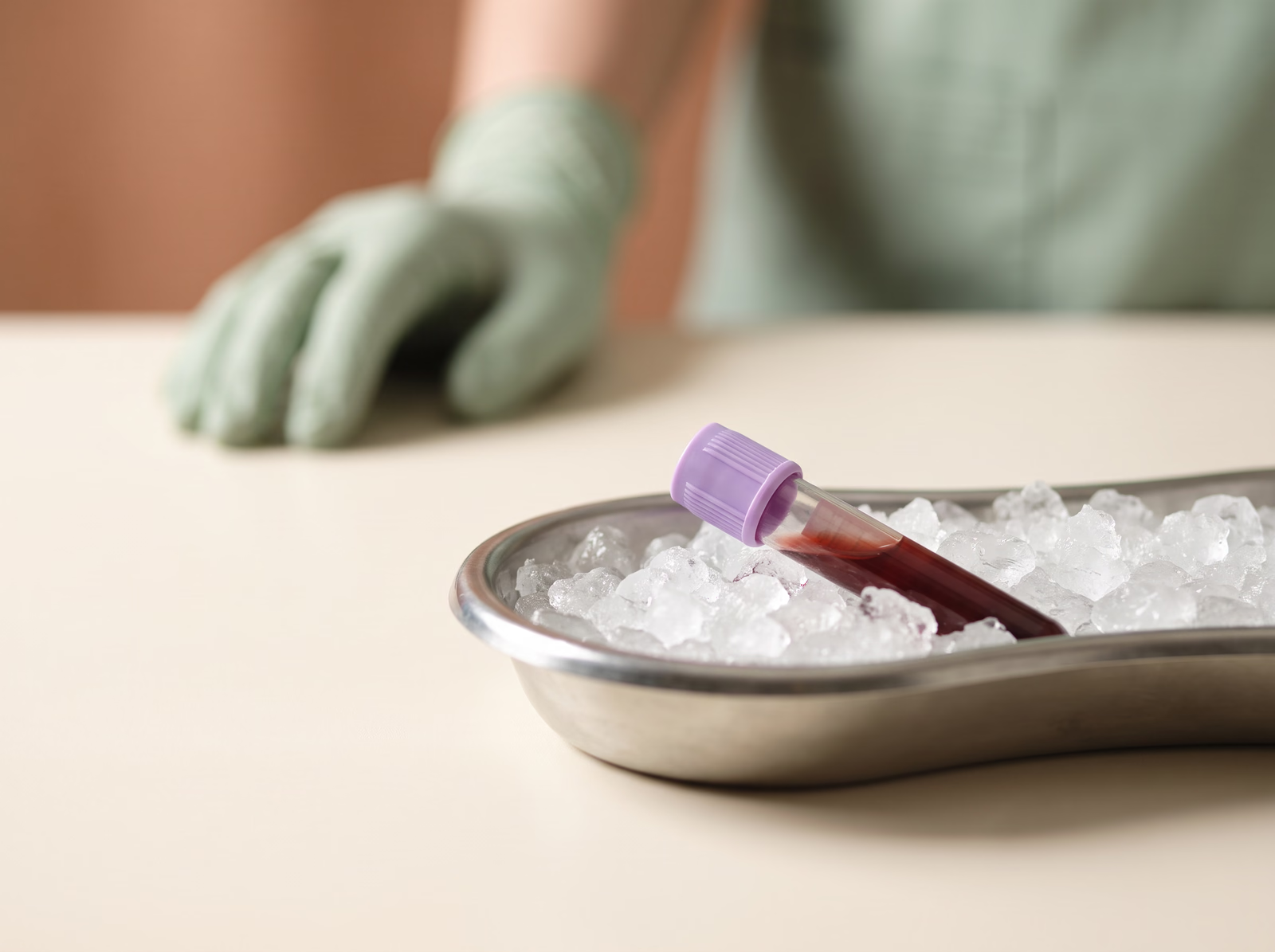
Tube colour. Plasma is preferred. Accepted tubes include lavender-top EDTA and green-top heparin, and serum tubes are allowed if separated promptly [1][4]. Light blue and yellow tops used for coagulation tests are rejected at Labcorp [1].
Units. Results are in µmol/L in both US and SI reports. A few older papers use mg/L; 3 µmol/L is about 0.41 mg/L [7]. Read the number against the normal range for your age.
Why is a homocysteine test done?
Mainly to confirm B12 or folate deficiency when standard results are unclear, to screen for homocystinuria, and to assess cognitive or vascular risk in selected people. It is not a routine screening test.
Common reasons a clinician orders it:
- Unclear B12 status. British haematology guidelines list methylmalonic acid as a second-line B12 test and homocysteine as a second-line test that is less specific, because low folate also raises it [8]. Serum B12 alone can miss functional deficiency [9].
- People at risk of low B12. Long-term metformin users [10] and vegans who do not supplement [11] are typical examples.
- Inherited disorders. Very high values, often above 100 µmol/L, suggest homocystinuria or other enzyme defects [12][13].
- Cognitive decline in older adults. A consensus statement treats raised homocysteine above about 11 µmol/L as a modifiable dementia risk factor [14].
- Cardiovascular risk. Some longevity clinics include it on panels. The marker predicts risk [7], but lowering it did not prevent heart attacks [15], so it rarely changes cardiovascular treatment.
The test does not need to be paired with an MTHFR gene test. Genetics guidelines advise against routine MTHFR testing [16]; see homocysteine, B12 and MTHFR.
Do you need to fast for a homocysteine test?
Fasting is preferred but not always required. A large protein-rich meal can raise total homocysteine by about 13% for several hours, enough to move a borderline result.
Both Labcorp and ARUP prefer a fasting specimen, especially for a baseline or to monitor treatment [1][4].
The reason is methionine. After a dinner with about 50 g of protein, plasma methionine nearly doubled and total homocysteine rose by 13.5% eight hours later, while a light breakfast with 15 to 18 g of protein changed total homocysteine little [3]. The authors noted that meal effects matter most when judging mildly raised values, not deficiency states with clearly high results.
Practical points for an accurate reading:
- Have the draw in the morning after an overnight fast, or after a light meal if your lab allows.
- Avoid a very large protein meal the evening before.
- Heavy coffee raises fasting homocysteine over weeks [17], so keep your usual intake rather than changing it just before the test.
- Sit for the draw. Lying down for 30 minutes lowered homocysteine by 6.3% [6].
How should a homocysteine sample be handled?
Plasma must be separated from cells quickly. At room temperature homocysteine climbs about 0.7 µmol/L per hour, so labs spin the tube at once or keep it on ice and spin within an hour.
Red blood cells keep making and exporting homocysteine after the draw. In EDTA whole blood at room temperature, homocysteine rose by 0.7 µmol/L per hour, while samples on ice stayed stable for 3 hours [5]. After 6 hours at room temperature the rise reached 38%, and crushed ice prevented it [18]. Once plasma is separated, homocysteine is stable [18].
Lab rules reflect this. Labcorp asks for centrifugation immediately after collection, or ice and centrifugation within an hour [1]. ARUP requires separation immediately, or on ice within one hour [4].
If your result seems out of line with everything else, ask whether the sample was processed in time. A tube that waited at a busy collection site can read falsely high. This is also the main question to ask about at-home or mail-in kits.
How much do homocysteine results vary between tests?
In the same healthy person, homocysteine varies by about 8% between tests, with small extra shifts from posture and season. A change of 1 µmol/L near 10 can be noise.
Within-person variation was 8.1% in healthy adults, larger than the 3.1% imprecision of the lab method [6]. Season adds a small cycle: across 268,877 Korean screening visits, homocysteine peaked in early November with a within-person amplitude of about 0.3 µmol/L, enough to shift some people across the 15 µmol/L line [19].
What this means in practice:
- A change from 11 to 10 µmol/L may be noise. A change from 18 to 11 after starting folic acid is not.
- If you are repeating a test to check a supplement, keep the conditions the same: same time of day, fasting, seated, same lab.
- B-vitamin trials measured changes after 6 to 12 weeks [20][21], which is a reasonable interval to retest after a change, if your clinician agrees.
How much does a homocysteine test cost?
Price depends on country, lab and whether insurance covers it. Coverage usually depends on a documented medical reason, such as suspected B12 deficiency, rather than wellness screening.
We do not list prices, because they change often and differ by lab, region and insurer. A few points help you compare:
- Ordered for a medical reason. When a clinician orders the test to work up anaemia, neuropathy or suspected B12 deficiency [8], insurers are more likely to cover it.
- Wellness panels. Direct-to-consumer panels often include homocysteine. Check that the provider follows the handling rules above [1][4].
- Pairing tests. If the question is B12 status, methylmalonic acid is more specific than homocysteine [8], so the more useful test may be MMA, or both.
AumniVIDA can store your homocysteine results alongside other markers such as hsCRP, ApoB and ferritin, so you can see trends instead of single values.
More about Homocysteine
- Homocysteine: the full guideHomocysteine is an amino acid your body makes when it uses methionine from protein.
- How to lower homocysteineFolic acid is the strongest lever: 0.4 mg a day lowers homocysteine by about 20% and 0.8 mg by about 23%.
- What does high homocysteine mean?High homocysteine, above about 15 µmol/L, usually means a folate or B12 shortfall, reduced kidney function, hypothyroidism, a drug effect or the MTHFR TT genotype with low folate.
- What is a normal homocysteine level?A normal homocysteine level in adults is about 5 to 15 µmol/L, with lab upper limits that rise with age, from 14.5 at 18 to 60 years to 21.3 after 80 at one large US lab.
- Homocysteine, B12 and MTHFRVitamin B12 and folate recycle homocysteine, so low B12 raises homocysteine and methylmalonic acid, while low folate raises homocysteine only.
Protocols that act on Homocysteine
- Plant-based and vegan dietsA plant-based diet gets most or all of its food from plants: vegan diets exclude all animal foods, vegetarian diets exclude meat and fish.
- Mediterranean dietThe Mediterranean diet is an eating pattern built on vegetables, fruit, legumes, whole grains, nuts, fish and olive oil as the main fat, with little red or processed meat, butter or sweets.
- MIND dietThe MIND diet (Mediterranean-DASH Intervention for Neurodegenerative Delay) is a brain-focused hybrid of the Mediterranean and DASH diets that scores 15 food groups: more leafy greens, berries, nuts, beans, whole grains, fish and olive oil, and less red meat, butter, cheese, sweets and fried food.
Common questions
What colour tube is used for a homocysteine test?
What is the best time for a homocysteine test?
Morning after an overnight fast, seated, with prompt processing. A large protein meal can raise the result by about 13% [3].
Is the test at Labcorp or Quest different?
The measurement is the same, but reference intervals differ by lab. Labcorp uses age-specific upper limits from 14.5 to 21.3 µmol/L in adults [1].
What are the requirements before a homocysteine test?
Fasting is preferred, and the sample must be centrifuged promptly or kept on ice [4].
What is the homocysteine test used for?
Mostly to check B12 and folate function and to find inherited disorders; it is a second-line test for B12 deficiency [8].
Sources
- 1.Labcorp. Homocyst(e)ine, Plasma (test 706994). Labcorp test menu, 2026. Link
- 2.Refsum H, Smith AD, Ueland PM, et al. Facts and recommendations about total homocysteine determinations: an expert opinion. Clin Chem, 2004. doi:10.1373/clinchem.2003.021634
- 3.Guttormsen AB, Schneede J, Fiskerstrand T, et al. Plasma concentrations of homocysteine and other aminothiol compounds are related to food intake in healthy human subjects. J Nutr, 1994. doi:10.1093/jn/124.10.1934
- 4.ARUP Laboratories. Homocysteine, Total (test 0099869). ARUP Laboratory Test Directory, 2026. Link
- 5.Korzun WJ, Ho QV. Stability of plasma total homocysteine concentrations in EDTA-whole blood kept on ice. Clin Lab Sci, 2000. PubMed 11586504
- 6.Rasmussen K, Moller J, Lyngbak M. Within-person variation of plasma homocysteine and effects of posture and tourniquet application. Clin Chem, 1999. doi:10.1093/clinchem/45.10.1850
- 7.Homocysteine Studies Collaboration. Homocysteine and risk of ischemic heart disease and stroke: a meta-analysis. JAMA, 2002. doi:10.1001/jama.288.16.2015
- 8.Devalia V, Hamilton MS, Molloy AM. Guidelines for the diagnosis and treatment of cobalamin and folate disorders. Br J Haematol, 2014. doi:10.1111/bjh.12959
- 9.Hannibal L, Lysne V, Bjørke-Monsen AL, et al. Biomarkers and Algorithms for the Diagnosis of Vitamin B12 Deficiency. Front Mol Biosci, 2016. doi:10.3389/fmolb.2016.00027
- 10.de Jager J, Kooy A, Lehert P, et al. Long term treatment with metformin in patients with type 2 diabetes and risk of vitamin B-12 deficiency: randomised placebo controlled trial. BMJ, 2010. doi:10.1136/bmj.c2181
- 11.Obersby D, Chappell DC, Dunnett A, et al. Plasma total homocysteine status of vegetarians compared with omnivores: a systematic review and meta-analysis. Br J Nutr, 2013. doi:10.1017/S000711451200520X
- 12.Son P, Lewis L. Hyperhomocysteinemia. StatPearls, 2022. PubMed 32119295
- 13.Levy J, Rodriguez-Guéant RM, Oussalah A, et al. Cardiovascular manifestations of intermediate and major hyperhomocysteinemia due to vitamin B12 and folate deficiency and/or inherited disorders of one-carbon metabolism: a 3.5-year retrospective cross-sectional study of consecutive patients. Am J Clin Nutr, 2021. doi:10.1093/ajcn/nqaa432
- 14.Smith AD, Refsum H, Bottiglieri T, et al. Homocysteine and Dementia: An International Consensus Statement. J Alzheimers Dis, 2018. doi:10.3233/JAD-171042
- 15.Martí-Carvajal AJ, Solà I, Lathyris D, et al. Homocysteine-lowering interventions for preventing cardiovascular events. Cochrane Database Syst Rev, 2017. doi:10.1002/14651858.CD006612.pub5
- 16.Hickey SE, Curry CJ, Toriello HV. ACMG Practice Guideline: lack of evidence for MTHFR polymorphism testing. Genet Med, 2013. doi:10.1038/gim.2012.165
- 17.Urgert R, van Vliet T, Zock PL, et al. Heavy coffee consumption and plasma homocysteine: a randomized controlled trial in healthy volunteers. Am J Clin Nutr, 2000. doi:10.1093/ajcn/72.5.1107
- 18.Zighetti ML, Chantarangkul V, Lombardi R, et al. Effects of some pre-analytical conditions on the measurement of homocysteine and cysteine in plasma. Clin Chem Lab Med, 2004. doi:10.1515/CCLM.2004.037
- 19.Kim SH, Chae JH, Chae CH. Season of sampling and the interpretation of serum homocysteine results: a within-person analysis of 268,877 health-screening examinations. Clin Chem Lab Med, 2026. doi:10.1515/cclm-2026-1304
- 20.Steenge GR, Verhoef P, Katan MB. Betaine supplementation lowers plasma homocysteine in healthy men and women. J Nutr, 2003. doi:10.1093/jn/133.5.1291
- 21.McNulty H, Dowey le RC, Strain JJ, et al. Riboflavin lowers homocysteine in individuals homozygous for the MTHFR 677C->T polymorphism. Circulation, 2006. doi:10.1161/CIRCULATIONAHA.105.580332