
How to lower hs-CRP
Updated October 31, 2026 · 22 sources · Written by the AumniVIDA team
UnitsShort answer
The biggest lifestyle lever is weight loss: about 0.13 mg/L lower hs-CRP per kilogram lost, and 29% to 44% lower in intensive lifestyle programs. A Mediterranean diet lowers it by about 1 mg/L, regular exercise and not smoking help more slowly, and statins cut it by 17% to 37%.
How much each lever lowered hs-CRP in trials
- Intensive lifestyle, weight loss (Look AHEAD)43.6 % lower hs-CRP
Median change at 1 year; usual care fell 16.7%
- Rosuvastatin 20 mg (JUPITER)37 % lower hs-CRP
Versus placebo, healthy people with hsCRP 2 mg/L or more
- Canakinumab, IL-1 beta antibody (CANTOS)37 % lower hs-CRP
Percentage points beyond placebo, by dose; after a heart attack
- Intensive lifestyle (Diabetes Prevention Program)33 % lower hs-CRP
33% in men, 29% in women at 1 year
- Pravastatin 40 mg (PRINCE)16.9 % lower hs-CRP
Versus placebo at 24 weeks
Show the data
| Item | Value (% lower hs-CRP) | Low | High | Note |
|---|---|---|---|---|
| Intensive lifestyle, weight loss (Look AHEAD) | 43.6 | Median change at 1 year; usual care fell 16.7% | ||
| Rosuvastatin 20 mg (JUPITER) | 37 | Versus placebo, healthy people with hsCRP 2 mg/L or more | ||
| Canakinumab, IL-1 beta antibody (CANTOS) | 37 | 26 | 41 | Percentage points beyond placebo, by dose; after a heart attack |
| Intensive lifestyle (Diabetes Prevention Program) | 33 | 29 | 33 | 33% in men, 29% in women at 1 year |
| Pravastatin 40 mg (PRINCE) | 16.9 | Versus placebo at 24 weeks |
Key takeaways
What lowers hs-CRP the most?
Weight loss through an intensive lifestyle program had the largest sourced effect, 29% to 44% lower CRP in a year. High-intensity statins and the IL-1 beta antibody canakinumab reached similar sizes; a Mediterranean diet and colchicine each lowered it by about 1 mg/L.
The table ranks each lever by the size of its effect in the best source we found. Studies used different people and units, so treat the order as approximate.
| Lever | Effect on hs-CRP | How fast | Source |
|---|---|---|---|
| Intensive lifestyle with weight loss | 43.6% lower (Look AHEAD), 29% to 33% lower (DPP) | 1 year | [3] [2] |
| Weight loss, any method | 0.13 mg/L lower per kg lost | Tracks the weight | [1] |
| Rosuvastatin 20 mg | 37% lower | Sustained through the trial | [7] |
| Canakinumab (IL-1 beta antibody) | 26 to 41 percentage points beyond placebo | Sustained to 48 months | [9] |
| Colchicine | 1.28 mg/L lower than placebo | 3 months | [10] |
| Mediterranean diet | 0.98 mg/L lower | Trials of 12 weeks or more | [4] |
| Pravastatin 40 mg | 16.9% lower | 12 to 24 weeks | [6] |
| Exercise training | Lower (effect size 0.26), more with fat loss | Trials of 2 weeks or more | [5] |
| Fish oil supplements | Lower, weaker when BMI is over 30 | Longer use works better | [11] |
| Quitting smoking | Falls gradually | Years | [12] [13] |
| Better sleep | Disturbed sleep linked to slightly higher CRP | Habitual | [14] |
The drugs in this table are prescribed for heart risk, not to change a lab value. A clinician decides whether they fit you.
How much each lever lowered hs-CRP in trials
- Intensive lifestyle, weight loss (Look AHEAD)43.6 % lower hs-CRP
Median change at 1 year; usual care fell 16.7%
- Rosuvastatin 20 mg (JUPITER)37 % lower hs-CRP
Versus placebo, healthy people with hsCRP 2 mg/L or more
- Canakinumab, IL-1 beta antibody (CANTOS)37 % lower hs-CRP
Percentage points beyond placebo, by dose; after a heart attack
- Intensive lifestyle (Diabetes Prevention Program)33 % lower hs-CRP
33% in men, 29% in women at 1 year
- Pravastatin 40 mg (PRINCE)16.9 % lower hs-CRP
Versus placebo at 24 weeks
Show the data
| Item | Value (% lower hs-CRP) | Low | High | Note |
|---|---|---|---|---|
| Intensive lifestyle, weight loss (Look AHEAD) | 43.6 | Median change at 1 year; usual care fell 16.7% | ||
| Rosuvastatin 20 mg (JUPITER) | 37 | Versus placebo, healthy people with hsCRP 2 mg/L or more | ||
| Canakinumab, IL-1 beta antibody (CANTOS) | 37 | 26 | 41 | Percentage points beyond placebo, by dose; after a heart attack |
| Intensive lifestyle (Diabetes Prevention Program) | 33 | 29 | 33 | 33% in men, 29% in women at 1 year |
| Pravastatin 40 mg (PRINCE) | 16.9 | Versus placebo at 24 weeks |
How much does weight loss lower hs-CRP?
Each kilogram lost lowers CRP by about 0.13 mg/L, so losing 10 kg lowers it by roughly 1.3 mg/L. Programs that combined diet and activity cut median CRP by 29% to 44% in a year, mostly through the weight lost.
A review of 33 weight-loss studies found a roughly linear link: each kilogram lost lowered CRP by a mean of 0.13 mg/L [1]. Two large trials put that into practice:
- Diabetes Prevention Program: intensive lifestyle change lowered median CRP by 33% in men and 29% in women at one year. Weight loss, rather than activity, explained most of the change [2].
- Look AHEAD: a one-year program that cut weight by 8.8% lowered median hs-CRP by 43.6%, against 16.7% with usual care. Improved glucose control and fat loss each contributed [3].
Fat tissue releases IL-6, the signal that drives CRP production in the liver [15] [16]. That is why waist size tracks CRP even in young adults [15].
Absolute hs-CRP drop by lever, in mg/L
- Weight loss of 10 kg1.3 mg/L lower hs-CRP
0.13 mg/L per kg across 33 studies, scaled to 10 kg
- Colchicine after a heart attack (CLEAR SYNERGY)1.28 mg/L lower hs-CRP
Versus placebo at 3 months
- Mediterranean diet0.98 mg/L lower hs-CRP
17 trials, 2,300 people, versus control diets
Show the data
| Item | Value (mg/L lower hs-CRP) | Low | High | Note |
|---|---|---|---|---|
| Weight loss of 10 kg | 1.3 | 0.13 mg/L per kg across 33 studies, scaled to 10 kg | ||
| Colchicine after a heart attack (CLEAR SYNERGY) | 1.28 | 0.75 | 1.81 | Versus placebo at 3 months |
| Mediterranean diet | 0.98 | 0.49 | 1.48 | 17 trials, 2,300 people, versus control diets |
Which foods and diets lower hs-CRP?
A Mediterranean diet lowered hs-CRP by about 1 mg/L (0.1 mg/dL) across 17 trials. Fish oil supplements lowered CRP modestly in 68 trials, less so in people with a BMI over 30.
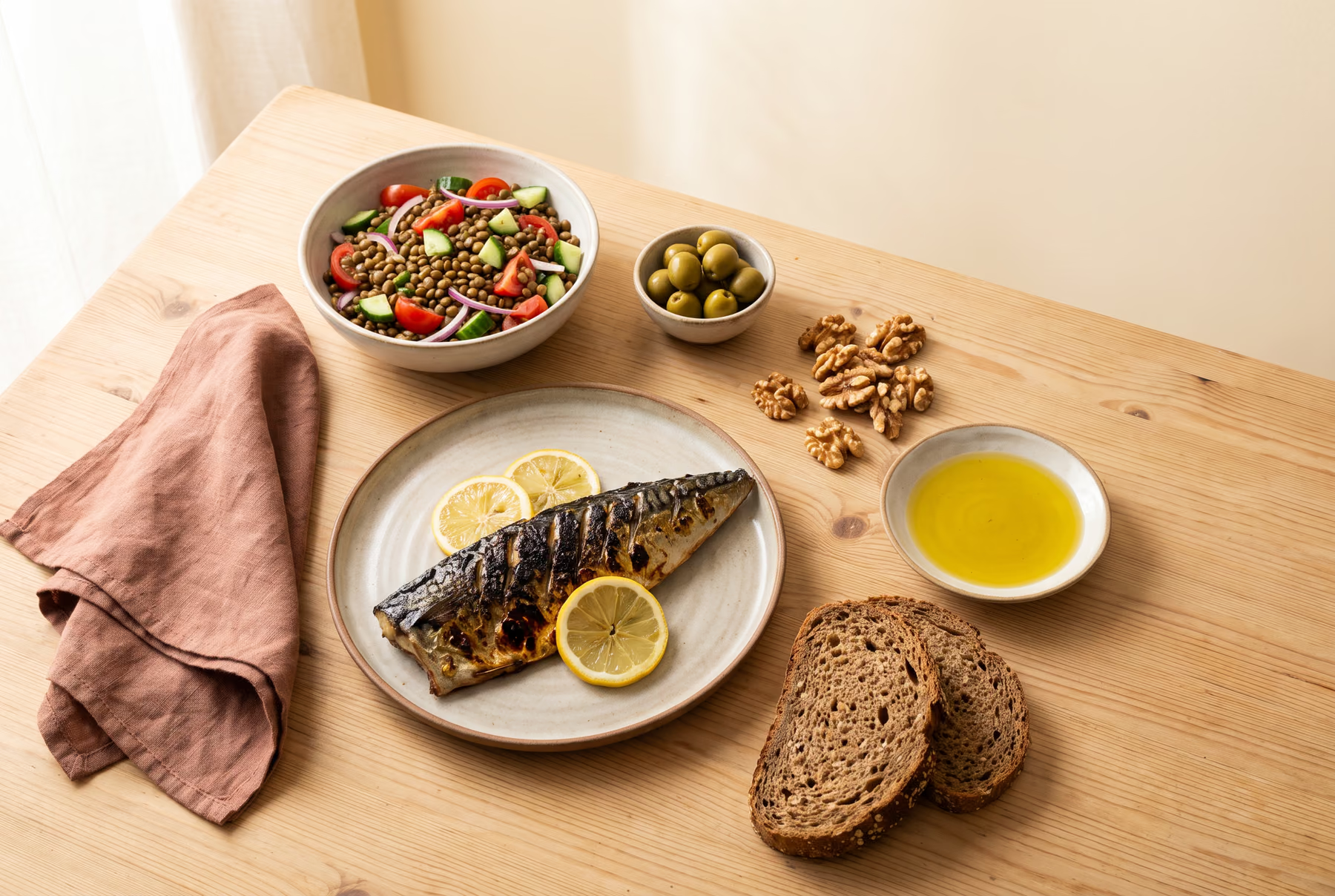
The Mediterranean pattern, built on olive oil, vegetables, legumes, fish, nuts and whole grains, lowered hs-CRP by 0.98 mg/L (95% CI 0.49 to 1.48) and IL-6 compared with control diets in trials lasting at least 12 weeks [4]. The Mediterranean diet protocol turns the pattern into weekly targets, and the anti-inflammatory diet protocol tracks oily fish, fiber and plant variety against your hs-CRP.
On supplements, marine omega-3 fats lowered CRP in a pooled analysis of 68 trials. The effect was weaker in people with a BMI over 30 and grew with longer use; fish eaten as food did not lower CRP in the trials that tested it [11]. We did not find strong trial evidence for other single foods or supplements, so we leave them out.
Diet works partly through weight. A pattern you can keep, and that helps you lose fat, will do more for hs-CRP than any single ingredient [1].
Does exercise lower hs-CRP?
Yes. Across 83 trials, exercise training lowered CRP, with the biggest drops when training also reduced body fat. A single very hard session raises CRP for a few days, so do not test right after a race.
A meta-analysis of 83 trials and 3,769 people found that exercise training lowered CRP (effect size 0.26) regardless of age or sex. The effect was larger when BMI fell (0.38) but still present without weight loss (0.19) [5].
The short-term response runs the other way. A single strenuous bout triggers a brief inflammatory response, while regular training is linked to lower CRP over time [17]. After a marathon, CRP peaked the next day and stayed raised for 3 days [18].
Steady aerobic work is the easiest way to build volume without big inflammatory spikes. The Zone 2 training protocol is built around it.
Do quitting smoking and better sleep lower hs-CRP?
Quitting smoking lowers CRP, but slowly: levels stay raised for up to 5 years after stopping. Disturbed sleep is linked to slightly higher CRP, so regular sleep is a small, steady lever.
Among smokers, CRP rises with the number of pack-years smoked. After quitting it falls with time, but it was still raised up to 5 years later [12]. In heavy smokers followed for about 3 years, the benefit of quitting was not yet visible; former smokers who had quit for over 8 years were clearly less likely to have a CRP of 2 mg/L or more [13]. That makes quitting a long-term lever, and the earlier the better.
For sleep, pooled data from 72 studies linked sleep disturbance (effect size 0.12) and very long sleep (0.17) to higher CRP. Short-term experimental sleep loss did not raise CRP [14]. The sleep consistency protocol focuses on regular timing first.

Which medicines lower hs-CRP?
Statins lower hs-CRP by about 17% to 37% depending on the drug and dose. Anti-inflammatory drugs such as colchicine and canakinumab lower it further and have reduced heart events in people with coronary disease, but they carry their own risks.
- Statins. Pravastatin 40 mg lowered median CRP by 16.9% versus placebo, independent of its effect on LDL [6]. Rosuvastatin 20 mg lowered hs-CRP by 37% in JUPITER [7].
- Colchicine. Low-dose colchicine lowered events after a heart attack in COLCOT [19] and in chronic coronary disease in LoDoCo2 [8]; in CLEAR SYNERGY it lowered CRP by 1.28 mg/L but not events [10]. The ESC lists it as an option for some very high risk patients [20].
- Canakinumab. This IL-1 beta antibody lowered hs-CRP by 26 to 41 percentage points beyond placebo and cut recurrent events, but raised fatal infections [9].
These medicines are prescribed for cardiovascular risk, not to change a lab value, and only a clinician who knows your history can weigh them.
How quickly can you lower hs-CRP?
If an infection or injury raised it, hs-CRP falls within days to 2 weeks because its half-life is about 19 hours. A chronically raised level takes longer: statins act within 12 weeks, while diet, exercise and weight loss take months.
The quickest drop comes from removing a trigger. With a 19 hour half-life, CRP falls quickly once the liver stops being stimulated [16], which is why a value over 10 mg/L is retested after about 2 weeks [21].
For baseline levels:
- Weeks: pravastatin's effect was clear by 12 weeks (14.7% lower) [6]; colchicine's by 3 months [10].
- Months: Mediterranean diet trials lasted at least 12 weeks [4]; exercise trials at least 2 weeks [5].
- A year: lifestyle programs reached 29% to 44% reductions at one year [2] [3].
- Years: the benefit of quitting smoking builds over several years [12].
Because single values vary by about 42% [22], wait at least a few months before retesting to judge a lifestyle change, and compare averages rather than single results.
More about hs-CRP
- hs-CRP: the full guidehs-CRP is a blood test that measures C-reactive protein, an inflammation protein made by the liver, at very low levels.
- What does a high hs-CRP mean?A high hs-CRP means more inflammation than average.
- What is a normal hs-CRP level?A normal hs-CRP for heart risk is under 3 mg/L (0.3 mg/dL), and under 1 mg/L (0.1 mg/dL) is the lowest-risk group.
- hs-CRP vs CRP: what is the difference?hs-CRP and CRP measure the same protein.
- hs-CRP test: fasting, timing and what affects itThe hs-CRP test is an ordinary blood draw and does not need fasting.
Protocols that act on hs-CRP
- Anti-inflammatory dietAn anti-inflammatory diet is an eating pattern meant to lower chronic low-grade inflammation: more oily fish, olive oil, vegetables, fruit, legumes, nuts and whole grains, and less processed meat, refined carbohydrate and sugary drinks.
- Mediterranean dietThe Mediterranean diet is an eating pattern built on vegetables, fruit, legumes, whole grains, nuts, fish and olive oil as the main fat, with little red or processed meat, butter or sweets.
- Zone 2 cardioZone 2 cardio is steady aerobic exercise held just below the first lactate threshold, where blood lactate stays near 2 mmol/L and you can still talk in full sentences.
- Sleep consistencySleep consistency means going to bed and waking up at about the same times every day, weekends included.
Common questions
Can you lower hs-CRP naturally?
What are the best foods to lower hs-CRP?
The best evidence is for a whole pattern, not single foods: a Mediterranean diet lowered hs-CRP by 0.98 mg/L across 17 trials [4].
What supplements lower hs-CRP?
Marine omega-3 (fish oil) supplements lowered CRP modestly in 68 trials, with weaker effects when BMI was over 30 [11]. We found no comparably strong evidence for other supplements.
Can hs-CRP be reduced quickly?
Do statins lower hs-CRP?
Does alcohol lower hs-CRP?
The CDC/AHA statement lists moderate alcohol use among factors associated with lower hs-CRP [21], but that is an observational link, not a reason to start drinking.
Sources
- 1.Selvin E, Paynter NP, Erlinger TP. The effect of weight loss on C-reactive protein: a systematic review. Archives of Internal Medicine, 2007. doi:10.1001/archinte.167.1.31
- 2.Haffner S, Temprosa M, Crandall J, et al. Intensive lifestyle intervention or metformin on inflammation and coagulation in participants with impaired glucose tolerance. Diabetes, 2005. doi:10.2337/diabetes.54.5.1566
- 3.Belalcazar LM, Reboussin DM, Haffner SM, et al. A 1-year lifestyle intervention for weight loss in individuals with type 2 diabetes reduces high C-reactive protein levels and identifies metabolic predictors of change: from the Look AHEAD (Action for Health in Diabetes) study. Diabetes Care, 2010. doi:10.2337/dc10-0728
- 4.Schwingshackl L, Hoffmann G. Mediterranean dietary pattern, inflammation and endothelial function: a systematic review and meta-analysis of intervention trials. Nutrition, Metabolism and Cardiovascular Diseases, 2014. doi:10.1016/j.numecd.2014.03.003
- 5.Fedewa MV, Hathaway ED, Ward-Ritacco CL. Effect of exercise training on C reactive protein: a systematic review and meta-analysis of randomised and non-randomised controlled trials. British Journal of Sports Medicine, 2017. doi:10.1136/bjsports-2016-095999
- 6.Albert MA, Danielson E, Rifai N, Ridker PM. Effect of statin therapy on C-reactive protein levels: the pravastatin inflammation/CRP evaluation (PRINCE): a randomized trial and cohort study. JAMA, 2001. doi:10.1001/jama.286.1.64
- 7.Ridker PM, Danielson E, Fonseca FA, et al. Rosuvastatin to prevent vascular events in men and women with elevated C-reactive protein. New England Journal of Medicine, 2008. doi:10.1056/NEJMoa0807646
- 8.Nidorf SM, Fiolet ATL, Mosterd A, et al. Colchicine in Patients with Chronic Coronary Disease. New England Journal of Medicine, 2020. doi:10.1056/NEJMoa2021372
- 9.Ridker PM, Everett BM, Thuren T, et al. Antiinflammatory Therapy with Canakinumab for Atherosclerotic Disease. New England Journal of Medicine, 2017. doi:10.1056/NEJMoa1707914
- 10.Jolly SS, d'Entremont MA, Lee SF, et al. Colchicine in Acute Myocardial Infarction. New England Journal of Medicine, 2025. doi:10.1056/NEJMoa2405922
- 11.Li K, Huang T, Zheng J, Wu K, Li D. Effect of marine-derived n-3 polyunsaturated fatty acids on C-reactive protein, interleukin 6 and tumor necrosis factor α: a meta-analysis. PLoS One, 2014. doi:10.1371/journal.pone.0088103
- 12.Hastie CE, Haw S, Pell JP. Impact of smoking cessation and lifetime exposure on C-reactive protein. Nicotine & Tobacco Research, 2008. doi:10.1080/14622200801978722
- 13.Gallus S, Lugo A, Suatoni P, et al. Effect of Tobacco Smoking Cessation on C-Reactive Protein Levels in A Cohort of Low-Dose Computed Tomography Screening Participants. Scientific Reports, 2018. doi:10.1038/s41598-018-29867-9
- 14.Irwin MR, Olmstead R, Carroll JE. Sleep Disturbance, Sleep Duration, and Inflammation: A Systematic Review and Meta-Analysis of Cohort Studies and Experimental Sleep Deprivation. Biological Psychiatry, 2016. doi:10.1016/j.biopsych.2015.05.014
- 15.Visser M, Bouter LM, McQuillan GM, Wener MH, Harris TB. Elevated C-reactive protein levels in overweight and obese adults. JAMA, 1999. doi:10.1001/jama.282.22.2131
- 16.Pepys MB, Hirschfield GM. C-reactive protein: a critical update. Journal of Clinical Investigation, 2003. doi:10.1172/JCI18921
- 17.Kasapis C, Thompson PD. The effects of physical activity on serum C-reactive protein and inflammatory markers: a systematic review. Journal of the American College of Cardiology, 2005. doi:10.1016/j.jacc.2004.12.077
- 18.Takayama F, Aoyagi A, Takahashi K, Nabekura Y. Relationship between oxygen cost and C-reactive protein response to marathon running in college recreational runners. Open Access Journal of Sports Medicine, 2018. doi:10.2147/OAJSM.S183274
- 19.Tardif JC, Kouz S, Waters DD, et al. Efficacy and Safety of Low-Dose Colchicine after Myocardial Infarction. New England Journal of Medicine, 2019. doi:10.1056/NEJMoa1912388
- 20.Visseren FLJ, Mach F, Smulders YM, et al. 2021 ESC Guidelines on cardiovascular disease prevention in clinical practice. European Heart Journal, 2021. doi:10.1093/eurheartj/ehab484
- 21.Pearson TA, Mensah GA, Alexander RW, et al. Markers of inflammation and cardiovascular disease: application to clinical and public health practice: A statement for healthcare professionals from the Centers for Disease Control and Prevention and the American Heart Association. Circulation, 2003. doi:10.1161/01.cir.0000052939.59093.45
- 22.Macy EM, Hayes TE, Tracy RP. Variability in the measurement of C-reactive protein in healthy subjects: implications for reference intervals and epidemiological applications. Clinical Chemistry, 1997. PubMed 8990222