
TSH vs free T4: how they work together
Updated October 31, 2026 · 14 sources · Written by the AumniVIDA team
UnitsShort answer
TSH is the pituitary's signal to the thyroid; free T4 is the unbound hormone the thyroid releases in response. They move in opposite directions on a log-linear curve, so a small fall in free T4 raises TSH sharply . TSH is the better screen for thyroid disease; free T4 shows severity and catches pituitary problems .
Why small T4 changes move TSH a lot
- Negative feedback
- 1HypothalamusSenses thyroid hormone and releases TRH.
- 2PituitaryTRH tells it to release TSH.
- 3ThyroidTSH drives it to make T4 and some T3; tissues convert T4 to T3.
- 4T4 and T3 signal backRising levels tell the pituitary and hypothalamus to release less TRH and TSH.
- Back to step 1
TSH responds to free T4 on a logarithmic scale (Spencer 1990): a small change in free T4 within its range can move TSH several fold.
Key takeaways
How do TSH, T4 and T3 relate?
The hypothalamus releases TRH, the pituitary responds with TSH, and the thyroid responds with T4 and a smaller amount of T3. Tissues convert T4 into active T3. Rising T4 and T3 switch TRH and TSH down.
This is the hypothalamic-pituitary-thyroid axis. Most thyroid hormone in blood is bound to carrier proteins; the free fraction is what tissues can use, which is why labs measure free T4 rather than total T4 in most cases.
- TSH comes from the pituitary and is measured in mIU/L.
- Free T4 is the main thyroid hormone, reported in ng/dL or pmol/L (1 ng/dL is about 12.9 pmol/L) [5]. In one large outpatient study, mean free T4 was 17.5 to 18.3 pmol/L, about 1.4 ng/dL [6].
- T3 is the active hormone, mostly made from T4 in tissues.
When the axis is intact, TSH is a sensitive mirror of free T4. When the pituitary or hypothalamus is unwell, or someone is critically ill, the mirror breaks and TSH can mislead [7][8].
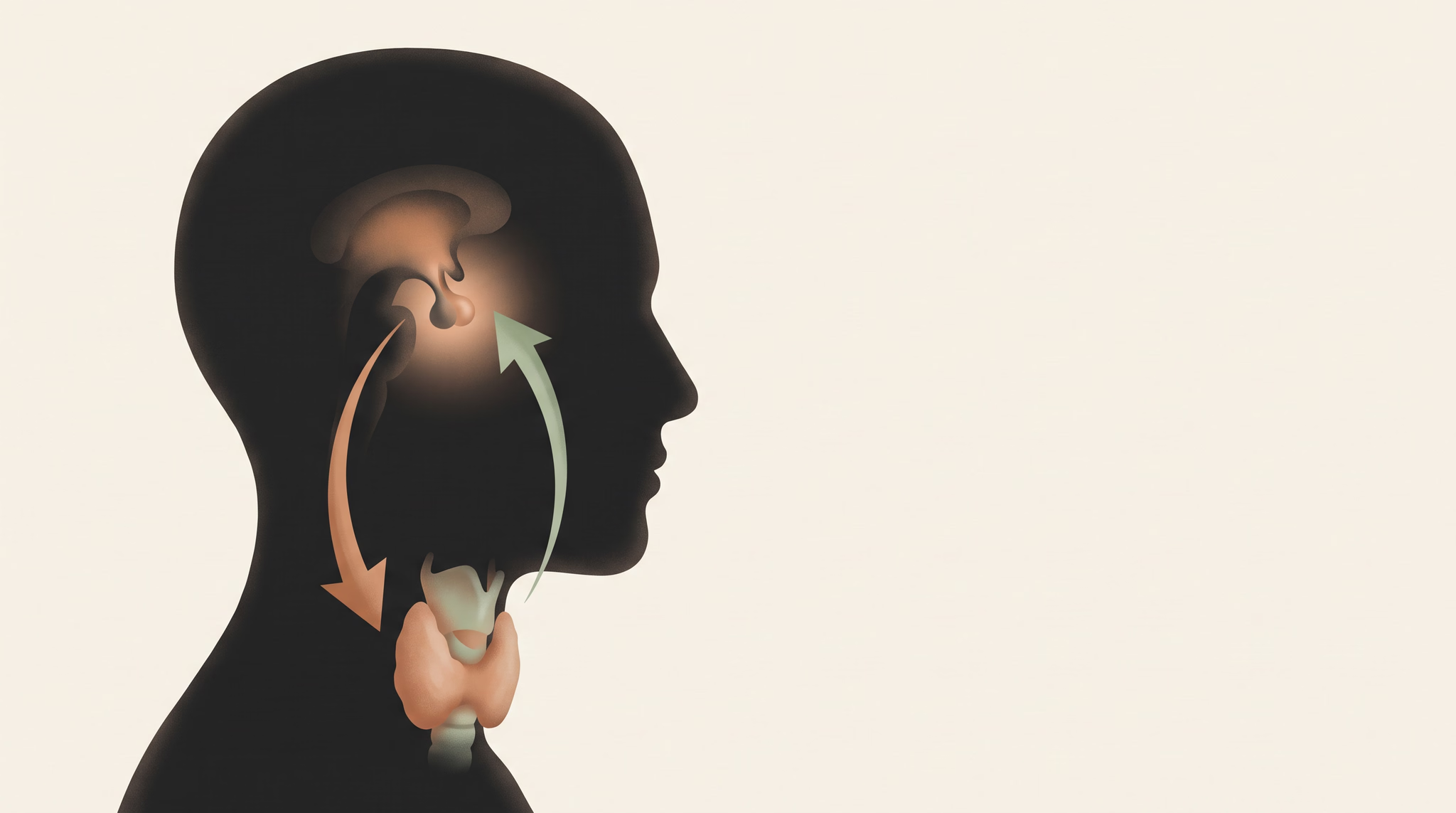
Why does TSH change more than free T4?
Because the relationship is log-linear. A straight-line change in free T4 matches a logarithmic change in TSH, so a small shift in free T4 within its normal range can multiply TSH several times. TSH therefore turns abnormal first.
Spencer and colleagues described the relationship in 1990 as log TSH = 2.56 minus 0.022 times the free T4 index, with a correlation of 0.84 [1]. After T4 was given to healthy volunteers, TSH fell in parallel with that slope and then plateaued, which suggests each person has a pituitary set point [1].
Andersen and colleagues found that TSH responds with logarithmically amplified variation to minor changes in T4 and T3 [9]. A person whose normal free T4 sits high in the lab range can have a raised TSH after a drop that still leaves free T4 in range, which is why subclinical hypothyroidism exists as a category [9].
When do you need free T4 as well as TSH?
When TSH is abnormal, when pituitary disease is suspected, in children, during pregnancy, and when someone on levothyroxine still has symptoms. Otherwise a TSH alone is usually enough to rule out primary thyroid disease.
NICE recommends TSH alone for adults when pituitary disease is not suspected, adding free T4 in the same sample if TSH is high and free T4 plus free T3 if TSH is low [2]. It recommends both TSH and free T4 from the start when pituitary disease is suspected and for children [2], and free T4 as well as TSH for adults on levothyroxine with ongoing symptoms [2].
In pregnancy, both TSH and free T4 have trimester-specific ranges [10][5]. Many labs offer "TSH with reflex to free T4", which automates the cascade. More on the practical side is in the TSH test.
What do mismatched TSH and free T4 results mean?
Mismatches point away from a simple thyroid problem. Low TSH with low free T4 suggests pituitary disease or illness; high TSH with high free T4 suggests assay interference or a rare pituitary cause; normal TSH with abnormal free T4 often reflects interference, illness or medicines.
- Low TSH, low free T4: central hypothyroidism or non-thyroidal illness, where low T3, low T4 and normal or slightly low TSH are typical [7].
- Normal TSH, high free T4: biotin can push competitive assays such as free T4 falsely high [11].
- Low TSH, normal free T4, high T3: T3 toxicosis, which the NICE cascade detects by adding free T3 when TSH is low [2].
- High TSH, normal free T4: subclinical hypothyroidism or recovery from illness [12][13].
- High TSH, high free T4: uncommon; repeat testing on another assay and a specialist review are usual.
The full grid is on the TSH hub.
TSH and free T4 patterns
Free T4 down, TSH across
Free T4 high
- TSH lowOvert hyperthyroidism
- TSH normalAssay interference, biotin, or a recent levothyroxine dose
- TSH highRare: assay interference, inconsistent levothyroxine, or a TSH-secreting pituitary tumour
Free T4 normal
- TSH lowSubclinical hyperthyroidism; T3 toxicosis if T3 is high; or illness, steroids or biotin
- TSH normalNormal thyroid function
- TSH highSubclinical hypothyroidism, or recovery from illness
Free T4 low
- TSH lowCentral hypothyroidism or non-thyroidal illness
- TSH normalCentral hypothyroidism or illness: needs pituitary review
- TSH highOvert primary hypothyroidism
| TSH low | TSH normal | TSH high | |
|---|---|---|---|
| Free T4 high | Overt hyperthyroidism | Assay interference, biotin, or a recent levothyroxine dose | Rare: assay interference, inconsistent levothyroxine, or a TSH-secreting pituitary tumour |
| Free T4 normal | Subclinical hyperthyroidism; T3 toxicosis if T3 is high; or illness, steroids or biotin | Normal thyroid function | Subclinical hypothyroidism, or recovery from illness |
| Free T4 low | Central hypothyroidism or non-thyroidal illness | Central hypothyroidism or illness: needs pituitary review | Overt primary hypothyroidism |
Darker cells are overt patterns, lighter ones mild or uncertain. A clinician confirms the cause.
When does T3 matter?
T3 matters mainly when TSH is low, because some hyperthyroidism raises T3 before T4. It adds little to the workup of a high TSH, and T3 testing on levothyroxine remains an area of research rather than routine practice.
Overt hyperthyroidism is defined by a suppressed TSH with high T3 and/or free T4 [14], so T3 is part of the workup of a low TSH [2]. In hypothyroidism, TSH and free T4 drive the diagnosis [4].
Some thyroid experts argue that TSH and T4 alone miss tissue-level effects of thyroid hormone, especially in people who feel unwell on levothyroxine despite normal TSH. That debate, including combination T4 and T3 treatment, is ongoing; any change to thyroid medication belongs to a clinician.
More about TSH
- TSH: the full guideTSH (thyroid-stimulating hormone) is the pituitary hormone that tells the thyroid how much T4 and T3 to make .
- What does a low TSH mean?A low TSH, below about 0.4 mIU/L, usually means the thyroid is making too much hormone or a person takes more thyroid hormone than needed .
- What does a high TSH mean?A high TSH, above about 4.0 to 4.5 mIU/L, usually means the thyroid is underactive and the pituitary is pushing harder .
- What is a normal TSH level?Most labs use a normal adult TSH range of about 0.4 to 4.0 or 4.5 mIU/L, but the upper limit rises with age: in NHANES III it was 3.56 mIU/L at age 20 to 29 and 7.49 at 80 and over .
- TSH test: fasting, timing and reflex testingA TSH test is a routine blood draw that usually needs no fasting, but TSH is higher in the morning and falls after a meal .
Common questions
Which is more important, TSH or free T4?
Can TSH be normal and T4 abnormal?
Can TSH be normal and T3 abnormal?
Low T3 with normal TSH is common in illness [7]. A high T3 with normal TSH is unusual and worth a repeat test.
What is the difference between TSH and TRH?
TRH is released by the hypothalamus and tells the pituitary to make TSH; TSH then tells the thyroid to make T4 and T3.
Sources
- 1.Spencer CA, LoPresti JS, Patel A, et al. Applications of a new chemiluminometric thyrotropin assay to subnormal measurement. J Clin Endocrinol Metab, 1990. doi:10.1210/jcem-70-2-453
- 2.National Institute for Health and Care Excellence. Thyroid disease: assessment and management (NICE guideline NG145). NICE, 2019. Link
- 3.Garber JR, Cobin RH, Gharib H, et al. Clinical practice guidelines for hypothyroidism in adults: cosponsored by the American Association of Clinical Endocrinologists and the American Thyroid Association. Thyroid, 2012. doi:10.1089/thy.2012.0205
- 4.Chaker L, Papaleontiou M. Hypothyroidism: A Review. JAMA, 2025. doi:10.1001/jama.2025.13559
- 5.Osinga JAJ, Derakhshan A, Palomaki GE, et al. TSH and FT4 Reference Intervals in Pregnancy: A Systematic Review and Individual Participant Data Meta-Analysis. J Clin Endocrinol Metab, 2022. doi:10.1210/clinem/dgac425
- 6.Boucai L, Surks MI. Reference limits of serum TSH and free T4 are significantly influenced by race and age in an urban outpatient medical practice. Clin Endocrinol (Oxf), 2009. doi:10.1111/j.1365-2265.2008.03390.x
- 7.Fliers E, Bianco AC, Langouche L, et al. Thyroid function in critically ill patients. Lancet Diabetes Endocrinol, 2015. doi:10.1016/S2213-8587(15)00225-9
- 8.Haugen BR. Drugs that suppress TSH or cause central hypothyroidism. Best Pract Res Clin Endocrinol Metab, 2009. doi:10.1016/j.beem.2009.08.003
- 9.Andersen S, Pedersen KM, Bruun NH, et al. Narrow individual variations in serum T(4) and T(3) in normal subjects: a clue to the understanding of subclinical thyroid disease. J Clin Endocrinol Metab, 2002. doi:10.1210/jcem.87.3.8165
- 10.Alexander EK, Pearce EN, Brent GA, et al. 2017 Guidelines of the American Thyroid Association for the Diagnosis and Management of Thyroid Disease During Pregnancy and the Postpartum. Thyroid, 2017. doi:10.1089/thy.2016.0457
- 11.Li D, Radulescu A, Shrestha RT, et al. Association of Biotin Ingestion With Performance of Hormone and Nonhormone Assays in Healthy Adults. JAMA, 2017. doi:10.1001/jama.2017.13705
- 12.Pearce SH, Brabant G, Duntas LH, et al. 2013 ETA Guideline: Management of Subclinical Hypothyroidism. Eur Thyroid J, 2013. doi:10.1159/000356507
- 13.Hamblin PS, Dyer SA, Mohr VS, et al. Relationship between thyrotropin and thyroxine changes during recovery from severe hypothyroxinemia of critical illness. J Clin Endocrinol Metab, 1986. doi:10.1210/jcem-62-4-717
- 14.Lee SY, Pearce EN. Hyperthyroidism: A Review. JAMA, 2023. doi:10.1001/jama.2023.19052