
TSH test: fasting, timing and reflex testing
Updated October 31, 2026 · 15 sources · Written by the AumniVIDA team
UnitsShort answer
A TSH test is a routine blood draw that usually needs no fasting, but TSH is higher in the morning and falls after a meal . Test at a similar time each visit, avoid testing during acute illness and stop high-dose biotin first if your clinician agrees . Reflex testing adds free T4 only when TSH is abnormal .
Key takeaways
What does a TSH blood test measure?
It measures the amount of thyroid-stimulating hormone in a blood sample, reported in mIU/L or µIU/mL. Because TSH reflects how hard the pituitary drives the thyroid, it is the most sensitive single screening test for primary thyroid disease.
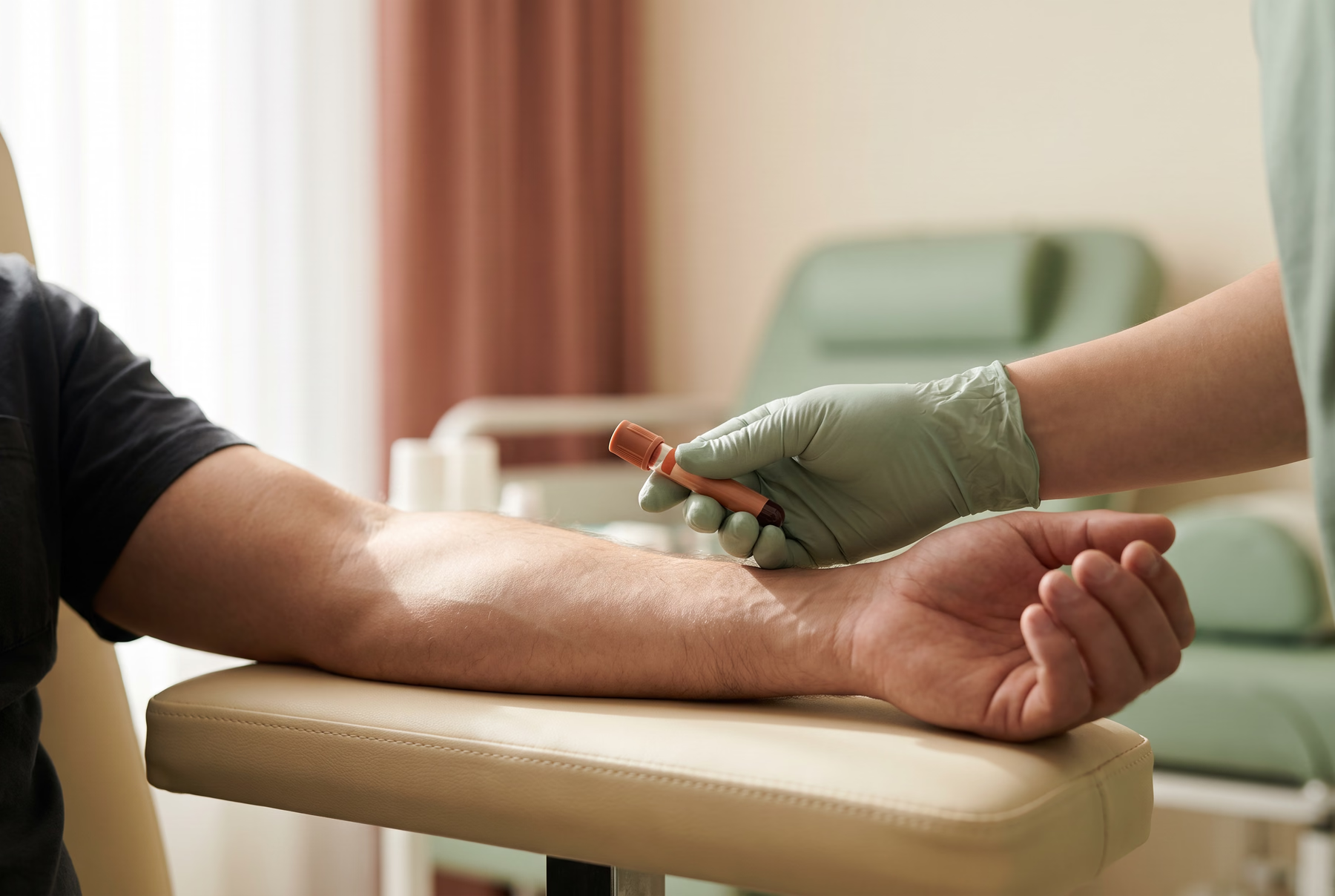
A TSH test is a standard venous blood draw. Modern labs use third-generation immunoassays that can measure values near 0.02 mU/L, low enough to tell a suppressed TSH from a low-normal one [7].
The AACE and ATA call TSH the single best screening test for primary thyroid dysfunction in most outpatient situations [4]. NICE recommends testing when there is clinical suspicion of thyroid disease, and offering it to people with type 1 diabetes, other autoimmune diseases or new atrial fibrillation [3]. Routine screening of people without symptoms is not recommended [8].
Do you need to fast for a TSH test?
Usually not; TSH is not a fasting test in standard guidance. One small study found TSH fell about two hours after a meal, so if you track TSH over time, test under the same conditions each time, for example in the morning before breakfast.
In 57 adults tested fasting and 2 hours after food, TSH fell after eating in every participant while free T4 did not change; 15 of 20 people classed as subclinical hypothyroid on the fasting sample were in range after the meal [2]. It was a small study, but it shows why conditions matter for borderline values.
If your blood draw also includes fasting tests, such as glucose or fasting insulin, fasting covers both. If you take levothyroxine, ask your clinician whether to take it before or after the draw, and keep that consistent.
What time of day is best for a TSH test?
There is no single correct time, but consistency matters. TSH peaks at night, runs higher early in the morning and falls later in the day, so comparing a 7 a.m. result with a 4 p.m. result can show a change that is only timing.
In 465,593 TSH results from one lab, the upper reference limit changed with the hour of the day, and the nighttime TSH surge grew with age [5]. Surks and colleagues note that early morning values are higher than later ones, and that sleep deprivation, strenuous exercise and night or evening shift work accentuate the effect [1].
Practical points:
- Book repeat tests at a similar time of day.
- Avoid a test straight after a night shift or a sleepless night when you can.
- Keep a regular sleep schedule in the days before; the sleep consistency protocol shows how.
Even with perfect timing, a person's TSH varies from month to month; a change of about 0.75 mU/L was needed to be confident a repeat result had really changed [9].
What does TSH with reflex to free T4 mean?
The lab measures TSH first and adds free T4 automatically only if TSH is outside the reference range. It saves cost and blood draws when TSH is normal, while still catching overt disease.
NICE describes the same approach as cascading: measure TSH alone for adults when pituitary disease is not suspected, then add free T4 in the same sample if TSH is high, and free T4 plus free T3 if TSH is low [3].
Reflex testing has one weak spot. When the pituitary itself is the problem (central hypothyroidism), TSH can look normal while free T4 is low. NICE therefore recommends measuring both TSH and free T4 when pituitary disease is suspected, and in children [3]. TSH alone can also mislead in critical illness [10].
If you take levothyroxine and still have symptoms, NICE suggests measuring free T4 as well as TSH [3]. Read how the two hormones fit together in TSH vs free T4.
What can make a TSH test wrong?
High-dose biotin, acute illness, recent changes to thyroid medication and some other medicines are the main causes of misleading results. Tell the lab about supplements, and ask your clinician before stopping any prescription medicine.
- Biotin: after 7 days of 10 mg a day, 9 of 23 biotin-based immunoassays gave wrong results; competitive assays such as free T4 read falsely high and sandwich assays such as TSH falsely low [6]. NICE asks clinicians to check biotin intake [3]. Ask your clinician or the lab how long to pause biotin before a draw.
- Acute illness: NICE advises not testing during an acute illness unless the illness may be thyroid-related [3]. TSH can rise above normal during recovery [11].
- Medicines: glucocorticoids and dopamine agonists can lower TSH [12]; lithium raises it [13].
- Levothyroxine changes: TSH takes weeks to settle, so it is usually checked 6 to 8 weeks after a dose change [8].
- Different assays: labs can differ by about 1 mU/L near 4.0 [14].
How often should TSH be tested?
There is no routine schedule for healthy people without symptoms. Guidelines suggest repeat testing after a mildly abnormal result, every 6 to 12 months while monitoring untreated mild disease, and 6 to 8 weeks after any levothyroxine change.
- After a mildly raised result: repeat TSH and free T4 with TPO antibodies after 2 to 3 months [15].
- Untreated subclinical hypothyroidism: NICE suggests TSH and free T4 once a year if there are features of thyroid disease, and once every 3 years if not [3].
- Untreated subclinical hyperthyroidism: TSH every 6 months [3].
- On levothyroxine: every 3 months until stable, then yearly [3]; 6 to 8 weeks after any dose change [8].
- New or worse symptoms: NICE suggests a repeat test, but no sooner than 6 weeks from the last one [3].
Your clinician may choose a different schedule for pregnancy, heart disease or other conditions.
More about TSH
- TSH: the full guideTSH (thyroid-stimulating hormone) is the pituitary hormone that tells the thyroid how much T4 and T3 to make .
- What does a low TSH mean?A low TSH, below about 0.4 mIU/L, usually means the thyroid is making too much hormone or a person takes more thyroid hormone than needed .
- What does a high TSH mean?A high TSH, above about 4.0 to 4.5 mIU/L, usually means the thyroid is underactive and the pituitary is pushing harder .
- What is a normal TSH level?Most labs use a normal adult TSH range of about 0.4 to 4.0 or 4.5 mIU/L, but the upper limit rises with age: in NHANES III it was 3.56 mIU/L at age 20 to 29 and 7.49 at 80 and over .
- TSH vs free T4: how they work togetherTSH is the pituitary's signal to the thyroid; free T4 is the unbound hormone the thyroid releases in response.
Common questions
Is TSH a fasting blood test?
No, TSH does not require fasting, though one small study found it fell about 2 hours after food [2]. Test under the same conditions each time.
Should I take my thyroid medication before a TSH test?
Ask your clinician and follow the same routine every time. What matters most is consistency and testing 6 to 8 weeks after any dose change [8].
What is the difference between TSH and TSH with reflex?
A TSH test reports TSH only. TSH with reflex adds free T4 automatically when TSH is out of range [3].
Can I take biotin before a thyroid test?
Sources
- 1.Surks MI, Goswami G, Daniels GH. The thyrotropin reference range should remain unchanged. J Clin Endocrinol Metab, 2005. doi:10.1210/jc.2005-0170
- 2.Nair R, Mahadevan S, Muralidharan RS, et al. Does fasting or postprandial state affect thyroid function testing?. Indian J Endocrinol Metab, 2014. doi:10.4103/2230-8210.139237
- 3.National Institute for Health and Care Excellence. Thyroid disease: assessment and management (NICE guideline NG145). NICE, 2019. Link
- 4.Garber JR, Cobin RH, Gharib H, et al. Clinical practice guidelines for hypothyroidism in adults: cosponsored by the American Association of Clinical Endocrinologists and the American Thyroid Association. Thyroid, 2012. doi:10.1089/thy.2012.0205
- 5.Ehrenkranz J, Bach PR, Snow GL, et al. Circadian and Circannual Rhythms in Thyroid Hormones: Determining the TSH and Free T4 Reference Intervals Based Upon Time of Day, Age, and Sex. Thyroid, 2015. doi:10.1089/thy.2014.0589
- 6.Li D, Radulescu A, Shrestha RT, et al. Association of Biotin Ingestion With Performance of Hormone and Nonhormone Assays in Healthy Adults. JAMA, 2017. doi:10.1001/jama.2017.13705
- 7.Spencer CA, LoPresti JS, Patel A, et al. Applications of a new chemiluminometric thyrotropin assay to subnormal measurement. J Clin Endocrinol Metab, 1990. doi:10.1210/jcem-70-2-453
- 8.Chaker L, Papaleontiou M. Hypothyroidism: A Review. JAMA, 2025. doi:10.1001/jama.2025.13559
- 9.Andersen S, Pedersen KM, Bruun NH, et al. Narrow individual variations in serum T(4) and T(3) in normal subjects: a clue to the understanding of subclinical thyroid disease. J Clin Endocrinol Metab, 2002. doi:10.1210/jcem.87.3.8165
- 10.Fliers E, Bianco AC, Langouche L, et al. Thyroid function in critically ill patients. Lancet Diabetes Endocrinol, 2015. doi:10.1016/S2213-8587(15)00225-9
- 11.Hamblin PS, Dyer SA, Mohr VS, et al. Relationship between thyrotropin and thyroxine changes during recovery from severe hypothyroxinemia of critical illness. J Clin Endocrinol Metab, 1986. doi:10.1210/jcem-62-4-717
- 12.Haugen BR. Drugs that suppress TSH or cause central hypothyroidism. Best Pract Res Clin Endocrinol Metab, 2009. doi:10.1016/j.beem.2009.08.003
- 13.McKnight RF, Adida M, Budge K, et al. Lithium toxicity profile: a systematic review and meta-analysis. Lancet, 2012. doi:10.1016/S0140-6736(11)61516-X
- 14.Kahapola-Arachchige KM, Hadlow N, Wardrop R, et al. Age-specific TSH reference ranges have minimal impact on the diagnosis of thyroid dysfunction. Clin Endocrinol (Oxf), 2012. doi:10.1111/j.1365-2265.2012.04463.x
- 15.Pearce SH, Brabant G, Duntas LH, et al. 2013 ETA Guideline: Management of Subclinical Hypothyroidism. Eur Thyroid J, 2013. doi:10.1159/000356507