
Rucking
What is rucking?
Rucking is walking with a weighted backpack or vest, a practice taken from military foot marches. Most guides start at about 10% of body weight and stay below one third. A pack of 20% of body weight raises the predicted energy cost of walking by about 15%, but health trials of rucking itself barely exist.
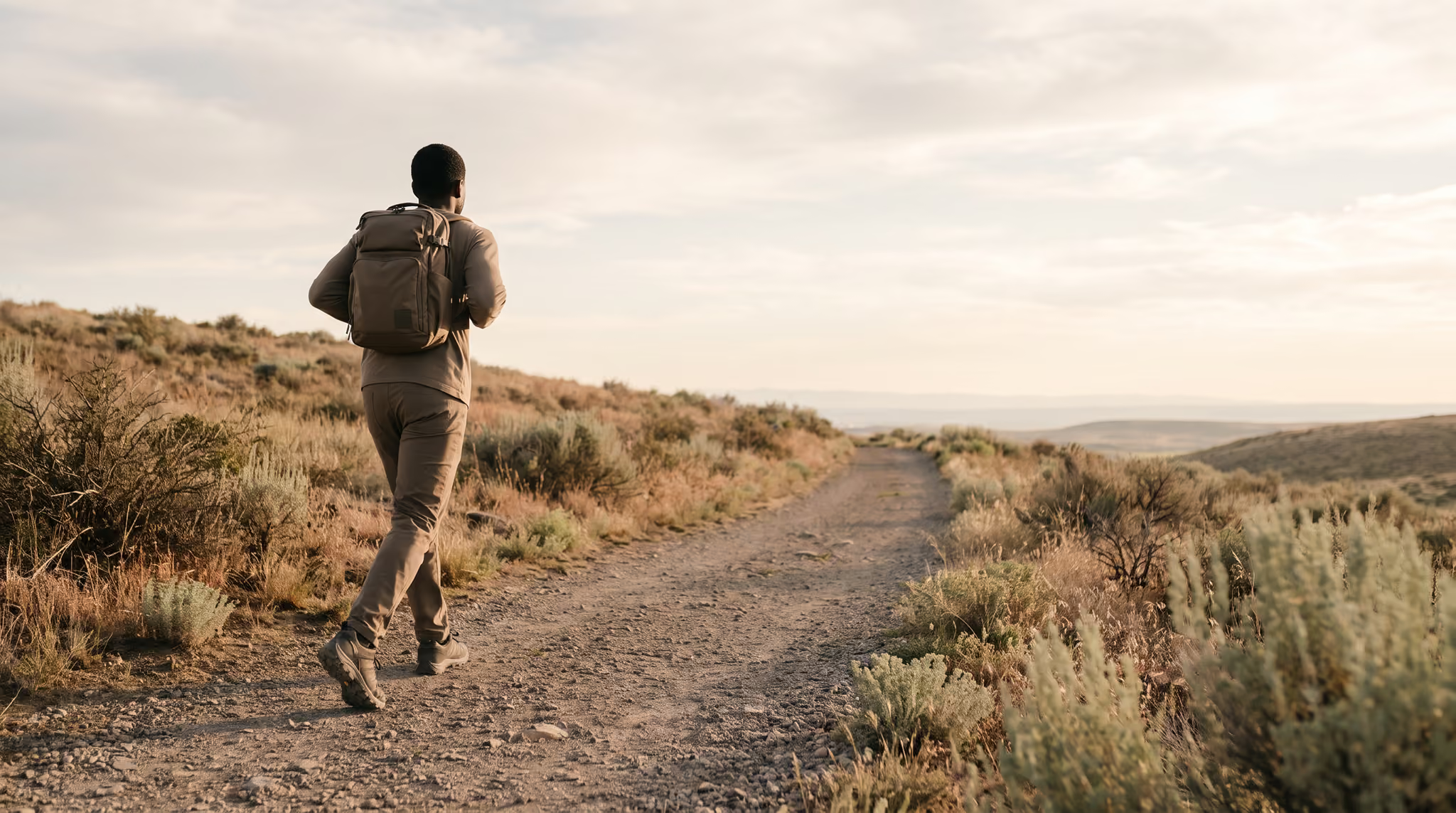
Walking is one of the best-supported health habits, and adding load clearly raises its energy cost. But there are no long-term trials of rucking for health outcomes, the one large randomized trial of weighted vests found no bone or muscle benefit during weight loss, and most of the injury data come from soldiers. Its benefits are plausible and mostly untested.
The rules
The rules ofRucking
- 1Walk at a brisk, steady pace while carrying a load on your back or torso.
- 2Choose a load as a share of body weight: start empty or near 10%, and stay below one third.
- 3Keep the load high and tight against the upper back, in a pack with padded shoulder straps.
- 4Increase distance first, then terrain and hills, then load in small steps.
- 5Ruck 1 to 3 times a week with at least a day between hard sessions.
Share these rules as an image or a link.
| Beginner ruck | Empty pack or about 10% of body weight, 20 to 45 minutes on flat ground. |
|---|---|
| Standard ruck | About 20% of body weight at 15 to 20 minutes per mile, 30 to 90 minutes. |
| Hill or stair ruck | A lighter load on steep terrain, which raises energy cost more than extra weight. |
| Weighted vest walking | Load worn evenly on the torso in a vest, often lighter and closer to the body than a pack. |
| Military foot march | Set distance against the clock, such as the US Army 12 miles in 3 hours with 35 lb. |
| GORUCK events | Team endurance events over hours with packs and extra carried items, led by cadre. |
What it aims to do
- Make walking harder, so it burns more energy and challenges the heart more, without running.
- Strengthen the legs, hips, back and trunk by carrying a load.
- Load the skeleton with more weight on each step.
- Build the capacity to carry things, a practical skill for hiking, work and later life.
- Get people outdoors and walking more often.
What it claims, and what the evidence shows
Grades reflect evidence in people. Animal and cell results alone never earn more than limited.
Body fat and weight
Limited evidenceCardiorespiratory fitness
Not enough evidenceMuscle and strength
Limited evidenceBone health
Mixed evidenceAthletic performance
Moderate evidenceLifespan and mortality
Not enough evidenceHelps you live longer
Walking more is linked to lower mortality in large cohorts, but there are no data on whether adding a load changes that benefit. [12]
Key takeaways
- 1
Rucking is walking with a load, a practice from military foot marches; soldiers have carried 15 kg or more for centuries [1].
- 2
A pack of 20% of body weight raises the predicted energy cost of a flat 3 mph walk by about 15%, and hills add more than extra weight [2].
- 3
Light loads on flat ground barely raise effort; a 6 to 9 kg vest only mattered on a 10% gradient [3].
- 4
A 12-month randomized trial found daily weighted vest wear did not protect hip bone during weight loss [4].
- 5
- 6
Start light, add load slowly, stay below one third of body weight, and keep lifting for muscle and bone.
What is rucking?
Rucking is walking with weight on your back, in a rucksack, a weighted backpack or a vest. It comes from military foot marches, where soldiers carry gear over long distances, and became a civilian workout through companies such as GORUCK and books such as Michael Easter's.
Carrying loads on foot is as old as armies. A review of soldier load carriage found that foot soldiers seldom carried more than 15 kg before the 18th century, and loads have risen steadily since as weapons and protective gear got heavier [1]. The US Army still tests it: candidates for the Expert Infantryman Badge must complete a 12-mile foot march in 3 hours or less wearing a 35-pound ruck.
The civilian version is gentler. Jason McCarthy, a former Green Beret, co-founded the pack maker GORUCK with his wife Emily in 2008, and its events and training guides spread the word. Writers such as Michael Easter and physicians such as Peter Attia now promote it as a way to make walking harder without running.
What sets rucking apart from hiking with a daypack is intent. The load is chosen as a training stimulus, it is increased over time, and the walk is done at a brisk, steady pace. Rucking is not the same as rucking in rugby, the contest for the ball after a tackle, which accounts for many of the searches for the word.
How much weight should you ruck with?
Most guides start with an empty or light pack, about 10% of body weight, build to around 20%, and stay below one third of body weight. Add weight in small steps, about 5 pounds at a time, and only when the previous load causes no lingering pain.
There is no trial that sets the right load for health, so the numbers come from military practice and coaching experience:
| Source | Starting load | Working load | Ceiling |
|---|---|---|---|
| GORUCK training guide | Light, 15 to 20 minutes per mile | Add about 5 lb a week, to 40 to 50 lb | Under one third of body weight |
| Michael Easter (author) | Light | About 20% of body weight | One third of body weight |
| Mark Stephenson (Mass General Brigham) | Empty pack, then about 10% | Increase gradually | Stop if it hurts |
| US Army EIB test | Not applicable | 35 lb for 12 miles in 3 hours | Combat loads can be far heavier |
For a 180 lb (82 kg) person, 10% is about 18 lb (8 kg), 20% about 36 lb (16 kg) and one third about 60 lb (27 kg).
Heavier is not automatically better. Military data tie heavier loads to more injuries and faster fatigue [13][14], and a meta-analysis of foot marches found that strength, power and balance all drop right after a loaded march [15]. Many people get more from a moderate load carried farther, uphill, or more often than from a heavy load carried a short way.
How to build up pack weight
Step 1
Empty pack
0 lb
Weeks 1 to 2, on your usual walking route for 20 to 30 minutes.
Step 2
About 10% of body weight
18 lb (8 kg)
First loaded rucks, on flat routes 2 to 3 times a week.
Step 3
About 20% of body weight
36 lb (16 kg)
A common working load, close to the 35 lb of the Army test march.
Step 4
One third of body weight
60 lb (27 kg)
The ceiling most guides give. Stay below it.
Pounds are for a 180 lb (82 kg) person. Add about 5 lb at a time, and only when the last load caused no lingering pain. The Army Expert Infantryman Badge test is 35 lb for 12 miles in 3 hours.
How many calories does rucking burn?
More than walking, and the cost climbs faster than the load. For an 80 kg person at 3 mph on flat ground, the Pandolf equation predicts about 289 kcal an hour with no pack, 332 with 20% of body weight and 360 with 30%. Hills and speed add far more than load alone.
The standard tool for these estimates is the Pandolf equation, which predicts energy cost from body mass, load, speed, grade and terrain [2]. Its load term rises with the square of the load as a fraction of body mass, so each extra kilogram costs a little more than the last. Our chart shows its predictions for an 80 kg walker at 1.34 m/s, close to the most economical walking speed of 1.39 m/s that US Army researchers found across 48 studies [16].
Three caveats keep these numbers honest:
- Predictions are approximate. In infantry soldiers carrying 25 to 70 kg, four of five standard equations underpredicted measured cost, and Pandolf itself was off at slow speeds and very heavy loads [7].
- Light loads on flat ground add little. A CrossFit-style vest of 6 to 9 kg raised physiological demand only when walking up a 10% gradient, not on the flat or at 5% [3].
- Grade and terrain matter more than load. The Pandolf grade and terrain terms multiply the whole carried mass, so at 3 mph a 10% grade roughly doubles the predicted cost of the same walk [2][1].
Where you carry the load changes the cost. Load close to the body's center of mass is cheapest, and each kilogram added at the feet raises energy cost by 7 to 10% [1]. Vests and backpacks differ too: a model built for vests needed its own term [8], and in one small study women lasted longer on a treadmill test with a vest than with a rucksack [17].
A higher calorie burn per walk is not the same as fat loss. No randomized trial has tested rucking for weight loss; food intake decides most of the outcome.
Predicted calories per hour by pack load
- No pack289 kcal per hour (predicted)
Baseline walk
- 10% of body weight (8 kg)309 kcal per hour (predicted)
+7% versus no pack
- 20% of body weight (16 kg)332 kcal per hour (predicted)
+15% versus no pack
- 30% of body weight (24 kg)360 kcal per hour (predicted)
+25% versus no pack
- 40% of body weight (32 kg)394 kcal per hour (predicted)
+36% versus no pack
Show the data
| Item | Value (kcal per hour (predicted)) | Low | High | Note |
|---|---|---|---|---|
| No pack | 289 | Baseline walk | ||
| 10% of body weight (8 kg) | 309 | +7% versus no pack | ||
| 20% of body weight (16 kg) | 332 | +15% versus no pack | ||
| 30% of body weight (24 kg) | 360 | +25% versus no pack | ||
| 40% of body weight (32 kg) | 394 | +36% versus no pack |
Does rucking build muscle and bone?
Probably a little, but less than lifting. Training that combined weighted walking with resistance work improved strength in a small study, while a 12-month randomized trial found that wearing a weighted vest during weight loss did not protect hip bone density or muscle.
The most direct civilian evidence is thin. In a 10-week program that mixed resistance training with weighted walking, 15 young men raised squat jump force, push-ups and sit-ups and found a 5 km march in a 23 kg vest easier [9]. With no control group and lifting in the mix, it cannot show what the walking alone did.
The best trial points the other way. INVEST in Bone Health randomized 150 older adults with obesity to weight loss alone, weight loss plus a weighted vest worn about 7 hours a day to replace the lost weight, or weight loss plus resistance training [4]. After 12 months:
| Outcome | Weight loss plus vest versus weight loss alone |
|---|---|
| Total hip trabecular bone density | No significant difference; all groups lost 1.2 to 1.9% |
| Thigh and trunk muscle | No significant difference; only resistance training improved thigh muscle [10] |
An older, non-randomized study is more encouraging: 9 postmenopausal women who did weighted vest exercise plus jumping three times a week for 5 years kept their hip bone density, while active controls lost 3.8% at the total hip [11]. The jumping, not the vest alone, may have done the work, since bone responds best to high, fast strains.
If muscle and bone are the goal, strength training has far stronger evidence. Rucking fits best as a way to load walking, alongside lifting rather than instead of it.
Is rucking better than walking or running?
Rucking makes walking harder without adding the flight phase of running, which is why people choose it. No trial has compared the health effects of rucking with walking or running, so its advantage is intensity and convenience, not proven extra benefit.
Walking itself has strong evidence. In a meta-analysis of 15 cohorts with 47,471 adults, more daily steps went with lower mortality, levelling off at 6,000 to 8,000 steps a day in people over 60 and 8,000 to 10,000 in younger adults [12]. Rucking keeps everything that walking offers and raises the effort of each step.
Compared with running, rucking keeps a walking gait, and a trial of light vests found no change in stride length or frequency [3]. That makes it attractive to people who cannot or do not want to run. It is not a substitute for higher intensity work: if the goal is VO2 max, intervals such as the Norwegian 4x4 push the heart much harder, and for most fit people a loaded walk is steady, moderate work of the kind covered in zone 2 cardio.
| Walking | Rucking | Running | |
|---|---|---|---|
| Gait | Walking | Walking, unchanged by light vests | Flight phase between steps |
| Effort | Lowest | Higher, rises with load and hills | Highest at most paces |
| Health evidence on this page | Large cohorts [12] | No long-term trials | Not reviewed here |
| Equipment | Shoes | Pack, load, shoes | Shoes |
What are the injury risks of rucking?
Military data show that load carriage mostly injures the feet, knees, lower legs and back, through blisters, stress fractures and muscle strain, and that shoulder straps can compress nerves. Most risk comes from too much load, too fast, over too long a distance.
Everything we know about rucking injuries comes from soldiers, who carry heavier loads over longer distances than most civilians. In Australian Army records, 404 of 1,954 injuries were attributed to load carriage, mostly to the lower limb and back, and muscular stress caused more than half [5]. Women and men had similar injury rates, with the back the most common site for both [18]. Reviews list blisters, metatarsalgia, stress fractures, knee pain and low back problems as the usual problems [14][13].
Rucksack palsy
Shoulder straps can stretch or compress the brachial plexus, the nerve bundle that runs to the arm, causing numbness, tingling and weakness. This rucksack palsy is more likely with heavier loads and longer distances, and hip belts, wider padded straps and lighter, balanced loads reduce it [6]. A case series described three soldiers with isolated nerve injuries, including to the long thoracic nerve that holds the shoulder blade in place [19]. Numbness or weakness in the arm during or after a ruck is a reason to stop and get checked.
Fatigue and balance
A loaded march leaves you weaker and less steady for a while: lower-body strength, trunk strength, power and postural stability all fall straight after [15]. That matters on downhill sections and rough trails, where most falls happen.
How do you set up a pack and ruck safely?
Keep the load high and tight against your back, use wide padded straps, and fasten a hip belt if it is more comfortable. Start with an empty pack on a route you already walk, add load slowly, and keep good shoes and socks to prevent blisters.
Load placement is the one variable with clear physiology behind it. Weight close to the body's center of mass costs the least energy and keeps posture closest to normal walking [1]. Use a dedicated weight plate or sandbags that do not shift, rather than loose dumbbells.
Hip belts are about comfort and shoulder relief, not efficiency. A belt reduces pressure on the shoulders [1], but in a crossover study with a pack at 30% of body mass, fastening the hip strap did not change oxygen cost or blood pressure [20].
People adapt to load remarkably well with practice. Nepalese porters carry 100 to 200% of their body weight on mountain paths at a lower metabolic cost than other groups who carry much less [21]. That adaptation took years; the safe civilian path is weeks to months of gradual progression.
A practical progression:
- Weeks 1 to 2: an empty pack on your usual walking route, 20 to 30 minutes.
- Then about 10% of body weight on flat routes, 2 to 3 times a week.
- Add distance first, then hills, then about 5 lb at a time.
- Stay below one third of body weight and keep at least a day between hard rucks.
Set up the pack before you add weight
Load
Placement is the one variable with clear physiology behind it.
- A weight plate or sandbag, not loose dumbbells
- High and tight against the back
- Close to the body's center of mass, which costs the least energy
Straps and belt
Strap pressure on the brachial plexus causes rucksack palsy.
- Wide, padded shoulder straps
- A hip belt to take pressure off the shoulders
- The belt did not change oxygen cost at 30% of body mass
Feet
Most load carriage injuries hit the feet, knees and back.
- Broken-in shoes, not new or worn out
- Good socks, not cotton, against blisters
- No weight on the feet: each kilogram there adds 7 to 10% to energy cost
Set the pack up empty first, then add load in small steps. Numbness, tingling or weakness in the arm means the straps need adjusting or the load is too heavy.
The studies, by type
Strongest designs first. Scroll each row; every card links to the paper and says whether it supports the protocol.
Systematic reviews and meta-analyses (3)
Randomized controlled trials (2)
Large observational studies in people (3)
Mechanistic studies in people (8)
Case reports and N-of-1 experiments (1)
Hypotheses and expert reviews (4)
Who follows it, who backs it, who doubts it
Public positions summarized in our words. Follow each link for the full context.
Follow it
Jason McCarthyFormer Green Beret and co-founder of GORUCK
Built a company around rucking after Special Forces service and argues that people are built to move and carry weight; on The Drive he covered rucking's benefits, gear, load choices and how to avoid injuries.
Peter AttiaPhysician, host of The Drive podcast and author of Outlive
Rucks regularly and says he enjoys it for both its physical and mental benefits; he has discussed it with Michael Easter and hosted GORUCK founder Jason McCarthy on his podcast.
Support it
Michael EasterJournalist and author of Walk with Weight and The Comfort Crisis
Presents rucking as an easy middle ground between cardio and strength that burns more calories per mile than walking and suits most fitness levels. He suggests carrying about 20% of body weight, about 35 lb in his case, and never more than a third.
Mixed or cautious
Mark StephensonSenior director, Center for Sports Performance and Research, Mass General Brigham
Supports rucking but stresses that it is not for everyone: start with an empty pack, add about 10% of body weight gradually, skip it with shoulder problems or tendinitis, and stop if it hurts.
Joseph KnapikMilitary injury epidemiologist and load carriage researcher
His review of soldier load carriage shows that energy cost rises with load, speed and grade, that loads kept close to the body cost least, and that hip belts and training that includes regular road marching make carrying easier; his later work ties heavier loads to more foot, knee and back injuries.
Public examples
- US Army Expert Infantryman Badge foot march
The test march behind the military practice: 12 miles in 3 hours or less wearing a 35-pound ruck.
- GORUCK ruck march standards
Civilian training guidance from the pack maker: 15 to 20 minutes per mile, add about 5 lb a week up to 40 to 50 lb, stay under one third of body weight, 1 to 2 rucks a week.
- INVEST in Bone Health weighted vest protocol
A 12-month research protocol in older adults losing weight: a vest worn about 8 hours a day, loaded to replace the weight lost.
How to follow it
- Pick a pack with wide, padded shoulder straps and a way to hold the load high and still, such as a plate pocket.
- Start with an empty or light pack on a route you already walk, 20 to 30 minutes, for 1 to 2 weeks.
- Move to about 10% of body weight on flat ground, 2 to 3 times a week, at a brisk pace.
- Increase distance first, then add hills, then add about 5 lb at a time if the last ruck caused no lingering pain.
- Stay below one third of body weight; most people do well around 20%.
- Keep strength training in your week; rucking adds to it rather than replacing it.
- Stop and get checked if you develop arm numbness or weakness, a sharp foot or shin pain, or back pain that lasts into the next day.
How to know you are following it
Log each ruck with load (as percent of body weight), distance, time and elevation gain. Following the protocol means 1 to 3 rucks a week with load and distance rising slowly over months. Pace at a fixed load and route, or heart rate at a fixed pace, shows whether fitness is improving.
Common mistakes
- Starting with a heavy load because the walking feels easy.
- Adding load and distance in the same week.
- Loose weights that sit low and bounce, which strain the lower back and shoulders.
- Thin straps that dig into the shoulders, the setting for rucksack palsy.
- New or worn-out shoes and cotton socks, which cause blisters.
- Ankle weights, which raise energy cost the most per kilogram.
- Treating rucking as a replacement for lifting or for harder cardio.
Who should be careful
Check with a clinician first if you
- have back, hip, knee or foot pain, or a recent injury in those areas
- have shoulder problems, tendinitis or nerve symptoms in the arms
- have osteoporosis with fractures, or poor balance
- are pregnant
- have heart or lung disease, or high blood pressure that is not controlled
Possible side effects
- Blisters and foot pain, the most common load carriage problems.
- Knee pain, especially on long downhills.
- Low back strain from heavy or poorly placed loads.
- Rucksack palsy: numbness, tingling or weakness in the arm from strap pressure.
- Stress fractures in the feet or shins when load and distance rise too fast.
- Temporary loss of leg strength and balance after long, heavy rucks.
Watch
Talks and explainers worth your time. Nothing loads from YouTube until you press play.
292 ‒ Rucking: benefits, gear, FAQs, and the journey from Special Forces to founding GORUCK
Peter Attia MDPeter Attia MD@peterattiamdSubscribers1MStartedJuly 2015CountryNot statedVideos1.8KTotal views137.4MNew videos, last 30 days7New videos, last year105From YouTube, 2026-10-31Open on YouTube
A long conversation with GORUCK's founder on load choices, gear, injuries and how rucking fits a training week.
How & Why to Ruck for Weight Loss & Strength | Michael Easter & Dr. Andrew Huberman
Huberman Lab ClipsHuberman Lab Clips@hubermanlabclipsSubscribers1.5MStartedJuly 2021CountryUnited StatesVideos574Total views137.5MNew videos, last 30 days22New videos, last year204From YouTube, 2026-10-31Open on YouTube
Michael Easter explains the case for rucking and a simple starting protocol.
Unpacking the Rise of Rucking with Jason McCarthy
WHOOPWHOOP@whoopSubscribers165KStartedFebruary 2017CountryUnited StatesVideos1.2KTotal views83.6MNew videos, last 30 days4New videos, last year252From YouTube, 2026-10-31Open on YouTube
Covers how rucking moved from the military to civilian fitness.
Why I love rucking
Peter Attia MDPeter Attia MD@peterattiamdSubscribers1MStartedJuly 2015CountryNot statedVideos1.8KTotal views137.4MNew videos, last 30 days7New videos, last year105From YouTube, 2026-10-31Open on YouTube
A short clip of a physician explaining what he gets from rucking.
Common questions
Is rucking good for you?
How much weight should a beginner ruck with?
Start with an empty pack or about 10% of body weight, then build toward about 20%, staying below one third. For a 150 lb person, that means about 15 lb to start and no more than 50 lb. Heavier loads raise fatigue and injury risk [13].
How many calories does rucking burn?
Does rucking build muscle?
Some, mainly in the legs and trunk of people who are new to exercise, but the evidence is weak. A randomized trial found weighted vest use did not preserve muscle during weight loss, while resistance training did [10]. Lifting builds muscle far more reliably.
Can rucking replace running or leg day?
Not fully. Rucking is lower intensity than hard running and much lighter on the legs than squats or deadlifts. It works well as a third option between walking and running, with lifting kept for strength and intervals for VO2 max.
Is rucking low impact?
Can rucking cause back pain?
Is a weighted vest or a backpack better?
A vest spreads the load evenly around the torso; in a small study women lasted longer on a treadmill test with a vest than with a rucksack [17]. A backpack carries heavier loads more comfortably and is what most rucking programs use.
How often should you ruck?
Most programs use 1 to 3 rucks a week with a rest day between hard efforts. A loaded march leaves leg strength and balance reduced for a while afterward [15], so back-to-back heavy days add risk without clear gain.
Sources
- 1.Knapik JJ, Reynolds KL, Harman E. Soldier load carriage: historical, physiological, biomechanical, and medical aspects. Mil Med, 2004. doi:10.7205/milmed.169.1.45
- 2.Pandolf KB, Givoni B, Goldman RF. Predicting energy expenditure with loads while standing or walking very slowly. J Appl Physiol Respir Environ Exerc Physiol, 1977. doi:10.1152/jappl.1977.43.4.577
- 3.Gaffney CJ, Cunnington J, Rattley K, et al. Weighted vests in CrossFit increase physiological stress during walking and running without changes in spatiotemporal gait parameters. Ergonomics, 2022. doi:10.1080/00140139.2021.1961876
- 4.Beavers KM, Lynch SD, Fanning J, et al. Weighted Vest Use or Resistance Exercise to Offset Weight Loss-Associated Bone Loss in Older Adults: A Randomized Clinical Trial. JAMA Netw Open, 2025. doi:10.1001/jamanetworkopen.2025.16772
- 5.Orr RM, Johnston V, Coyle J, et al. Reported load carriage injuries of the Australian army soldier. J Occup Rehabil, 2015. doi:10.1007/s10926-014-9540-7
- 6.Knapik JJ, Reynolds KL, Orr R, et al. Load Carriage-Related Paresthesias: Part 1: Rucksack Palsy and Digitalgia Paresthetica. J Spec Oper Med, 2016. doi:10.55460/7HEK-VMKV
- 7.Vine CAJ, Coakley SL, Blacker SD, et al. Accuracy of Metabolic Cost Predictive Equations During Military Load Carriage. J Strength Cond Res, 2022. doi:10.1519/JSC.0000000000003644
- 8.Looney DP, Lavoie EM, Notley SR, et al. Metabolic Costs of Walking with Weighted Vests. Med Sci Sports Exerc, 2024. doi:10.1249/MSS.0000000000003400
- 9.Wills JA, Saxby DJ, Glassbrook DJ, et al. Load-Carriage Conditioning Elicits Task-Specific Physical and Psychophysical Improvements in Males. J Strength Cond Res, 2019. doi:10.1519/JSC.0000000000003243
- 10.Lynch SD, Howard M, Beavers DP, et al. Weighted vest use or resistance exercise to offset muscle loss in older adults: secondary findings from the INVEST in bone health RCT. J Gerontol A Biol Sci Med Sci, 2026. doi:10.1093/gerona/glag062
- 11.Snow CM, Shaw JM, Winters KM, et al. Long-term exercise using weighted vests prevents hip bone loss in postmenopausal women. J Gerontol A Biol Sci Med Sci, 2000. doi:10.1093/gerona/55.9.m489
- 12.Paluch AE, Bajpai S, Bassett DR, et al. Daily steps and all-cause mortality: a meta-analysis of 15 international cohorts. Lancet Public Health, 2022. doi:10.1016/S2468-2667(21)00302-9
- 13.Knapik JJ. Injuries and injury prevention during foot marching. J Spec Oper Med, 2014. doi:10.55460/38TR-TEUP
- 14.Orr RM, Pope R, Johnston V, et al. Soldier occupational load carriage: a narrative review of associated injuries. Int J Inj Contr Saf Promot, 2014. doi:10.1080/17457300.2013.833944
- 15.Sax van der Weyden M, Shaul Y, Merrigan JJ, et al. A Systematic Review and Meta-Analysis on the Impact of Military Foot Marches on Performance-Part 1: Physical Performance. J Strength Cond Res, 2026. doi:10.1519/JSC.0000000000005437
- 16.Looney DP, Potter AW, Pryor JL, et al. Metabolic Costs of Standing and Walking in Healthy Military-Age Adults: A Meta-regression. Med Sci Sports Exerc, 2019. doi:10.1249/MSS.0000000000001779
- 17.Gerhart HD, Pressl R, Storti KL, et al. The effects of a loaded rucksack and weighted vest on metabolic cost and stride frequency in female adults. Ergonomics, 2020. doi:10.1080/00140139.2019.1710266
- 18.Orr RM, Pope R. Gender differences in load carriage injuries of Australian army soldiers. BMC Musculoskelet Disord, 2016. doi:10.1186/s12891-016-1340-0
- 19.McShea JP, Powell JE, Dolomisiewicz EA, et al. Isolated Mononeuropathy From Rucksack Palsy: A Case Series. Mil Med, 2021. doi:10.1093/milmed/usaa232
- 20.Del Vecchio AR, Matthews EL, Sullivan W, et al. Oxygen Consumption and Blood Pressure Are Not Influenced by Use of a Backpack Hip Strap. Wilderness Environ Med, 2022. doi:10.1016/j.wem.2022.05.001
- 21.Bastien GJ, Schepens B, Willems PA, et al. Energetics of load carrying in Nepalese porters. Science, 2005. doi:10.1126/science.1111513
AumniVIDA explains health information for general wellness. Talk to your clinician before changing your diet, training or medication for a health condition.