
How to increase ferritin
Updated October 31, 2026 · 15 sources · Written by the AumniVIDA team
UnitsShort answer
Ferritin rises when you absorb more iron than you lose. The biggest lever is clinician-guided oral iron, best absorbed on alternate days. Food helps more slowly: heme iron from meat and fish, vitamin C with plant iron, and tea or coffee away from meals. Test first, and find why ferritin is low.
Key takeaways
- 1
Test before supplementing: low ferritin needs its cause found, and extra iron harms people with overload [1].
- 2
- 3
Tea with a meal cut iron absorption by 64% and coffee by 39% in an isotope study [4].
- 4
Vitamin C boosts plant iron absorption in single meals, but its effect across a whole diet is small [5].
What raises ferritin the most?
Oral iron prescribed after testing moves ferritin the most. Diet changes help over months. The table ranks each lever by the size of its sourced effect.
Ferritin rises when iron absorption exceeds iron loss. The levers below are ranked by the size of effect in the studies cited.
- Oral iron. In fatigued non-anemic women, 80 mg of iron a day for 12 weeks raised ferritin by 11.4 ng/mL more than placebo [6]. Alternate-day dosing absorbs more per dose [2].
- Keeping tea and coffee away from meals. One cup of tea cut absorption from a meal by 64%, one of coffee by 39%. Coffee one hour before a meal had no effect, but coffee one hour after inhibited absorption as much as coffee with the meal [4].
- Reducing phytate or adding vitamin C. Phytate in grains and legumes cut absorption in a dose-dependent way, and ascorbic acid significantly counteracted it [7].
- Choosing heme iron. Mixed diets deliver iron with about 14% to 18% bioavailability versus 5% to 12% for vegetarian diets [8].
- Intravenous iron. Used when tablets fail, are not tolerated or cannot be absorbed; it replaces stores quickly [9].
Your own iron status changes absorption more than diet does: the body absorbs more when stores are low [8].
| Lever | Effect in the study | Source | Strength of evidence |
|---|---|---|---|
| Oral iron, 80 mg daily for 12 weeks | Ferritin up 11.4 ng/mL versus placebo | Vaucher 2012 | Randomized trial |
| Alternate-day instead of daily iron | Absorption 21.8% versus 16.3% | Stoffel 2017 | Randomized trial, isotope |
| No tea with the meal | Avoids a 64% drop in absorption | Morck 1983 | Isotope study, single meal |
| No coffee with or within an hour after the meal | Avoids a 39% drop in absorption | Morck 1983 | Isotope study, single meal |
| Vitamin C with high-phytate meals | Counteracts phytate inhibition | Hallberg 1989 | Isotope study, single meal |
| Mixed rather than vegetarian diet | Bioavailability 14% to 18% versus 5% to 12% | Hurrell 2010 | Review of isotope and intake data |
| Raising vitamin C across a whole diet | No significant change in absorption | Cook 2001 | Five-day diet study |
Tea and coffee with a meal
- Cup of tea with the meal64 % less iron absorbed from the meal
- Cup of coffee with the meal39 % less iron absorbed from the meal
- Coffee 1 hour before the meal0 % less iron absorbed from the meal
No decrease seen
Show the data
| Item | Value (% less iron absorbed from the meal) | Low | High | Note |
|---|---|---|---|---|
| Cup of tea with the meal | 64 | |||
| Cup of coffee with the meal | 39 | |||
| Coffee 1 hour before the meal | 0 | No decrease seen |
Which foods raise ferritin?
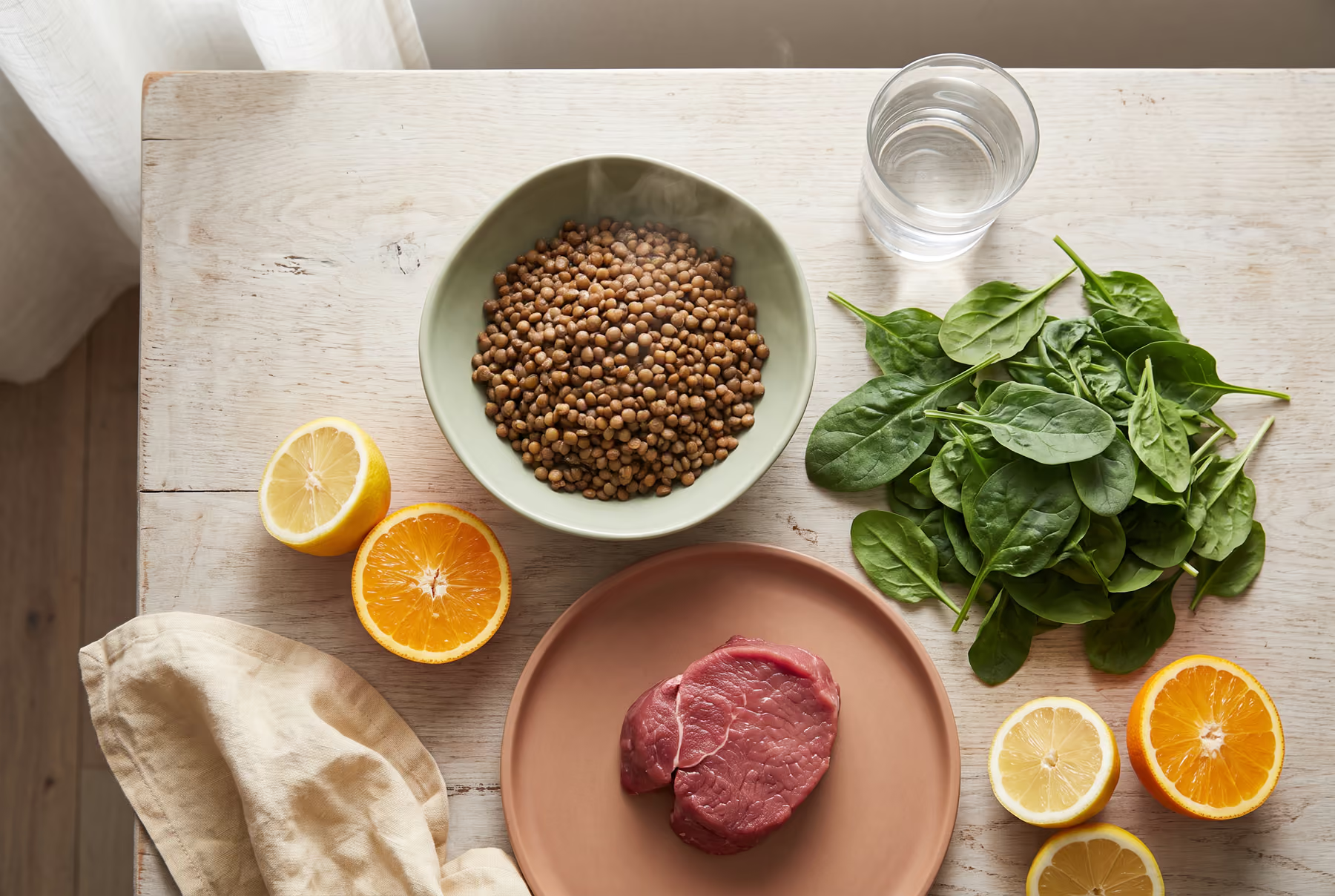
Red meat, poultry, fish and shellfish provide heme iron, the best absorbed form. Lentils, beans, tofu, leafy greens and fortified cereals provide nonheme iron, which absorbs better with vitamin C and worse with tea or coffee.
Food iron comes in two forms:
- Heme iron in meat, poultry and fish. It uses a separate absorption route, and tea does not inhibit iron from cooked hemoglobin the way it inhibits plant iron [10]. Meat in a meal is also linked with better absorption of the nonheme iron eaten alongside it [5].
- Nonheme iron in legumes, greens, nuts, seeds and fortified grains. Its absorption depends strongly on the rest of the meal: phytate lowers it and vitamin C raises it [7].
Eggs contain iron, but searches such as "do eggs have ferritin" mix up two things: foods contain iron, and your body makes ferritin to store it.
On a whole-food plant-based diet, the practical pattern is beans or lentils with a vitamin C source such as peppers or citrus, and tea or coffee between meals instead of with them. On a carnivore diet, heme iron intake is high, so low ferritin is less likely to be dietary and worth investigating.
Does vitamin C help raise ferritin?
Vitamin C clearly increases plant iron absorption from a single meal and counters phytate. Across a whole varied diet the effect is much smaller, so it helps most with high-phytate, plant-based meals.
In single-meal isotope studies, ascorbic acid significantly counteracted the inhibition of iron absorption by phytate [7]. But when researchers changed vitamin C intake across a complete diet for five days, from 51 to 247 mg a day, mean iron absorption did not change significantly [5]. The authors concluded the effect in a full diet is far less pronounced than in single meals.
That fits the broader picture: in varied diets with many enhancers and inhibitors, single components have modest effects [8]. Vitamin C is a sensible habit with plant iron, not a substitute for treating deficiency.
How should oral iron supplements be taken?
Take iron only after a test and with a clinician's plan. Lower doses once a day or on alternate days are absorbed better than large or split doses, and alternate days cause fewer gut side effects.
Each oral dose of 60 mg or more raises hepcidin for about 24 hours, which cuts absorption from the next day's dose by 35% to 45%. A sixfold increase in dose, from 40 to 240 mg, only tripled the iron absorbed, from 6.7 to 18.1 mg [11].
- Alternate days. 60 mg on alternate days was absorbed at 21.8% versus 16.3% with consecutive daily doses, and twice-daily splitting gave no gain [2].
- Fewer side effects. In a 2023 double-blind trial of 150 women with ferritin of 30 µg/L or lower, alternate-day dosing gave the same ferritin at equal total doses, daily dosing caused gut side effects on 1.56 times as many dosing days, and alternate-day dosing left less iron deficiency at 6 months (3.0% versus 11.4%) [3].
- Side effects are common. Ferrous sulfate more than doubled the odds of gut side effects compared with placebo across 43 trials [12].
- Guideline default. BSG recommends one tablet a day of ferrous sulphate, fumarate or gluconate, and every other day if not tolerated [1].
"Ferritin supplements" are a search term, not a product class: supplements contain iron salts, and ferritin is what your body builds from them. The right dose and schedule depend on how low ferritin is, the cause, and other conditions.
Alternate-day versus daily iron
- Alternate days, 28 days21.8 % of iron absorbed (geometric mean)
- Consecutive days, 14 days16.3 % of iron absorbed (geometric mean)
Show the data
| Item | Value (% of iron absorbed (geometric mean)) | Low | High | Note |
|---|---|---|---|---|
| Alternate days, 28 days | 21.8 | 13.7 | 34.6 | |
| Consecutive days, 14 days | 16.3 | 9.3 | 28.8 |
When is intravenous iron used?
Intravenous iron is used when oral iron fails, is not tolerated or cannot be absorbed, such as with inflammatory bowel disease or after some gut surgery. Modern formulations can replace the full deficit in a single short infusion or a few visits.
Hepcidin raised by inflammation limits oral iron absorption, and modern parenteral formulations allow rapid, safe replacement of the full iron deficit [9]. BSG lists parenteral iron among the options for people who cannot tolerate oral iron [1], and one clinical review argues it is underused, with full replacement doses given in minutes to a few hours [13]. In restless legs syndrome, intravenous ferric carboxymaltose is rated effective when ferritin is below 300 µg/L [14].
Intravenous iron is a medical treatment given in a clinic; the choice of product and dose belongs to the treating clinician.
How quickly does ferritin rise?
With oral iron, ferritin usually rises over weeks to months. Clinicians often recheck after about six weeks of treatment, and full recovery after a blood donation can take months without supplements.
In the fatigue trial, ferritin was measured at 6 and 12 weeks, and the authors suggested checking response after six weeks [6]. After a blood donation, low-ferritin donors taking 37.5 mg of iron daily recovered baseline ferritin in a median of 21 days, while most donors not taking iron had not recovered by 168 days [15].
If ferritin does not rise as expected, that is a signal to look again for ongoing blood loss, poor absorption or inflammation, not simply to take more.
Hemoglobin recovery after blood donation
- Low ferritin, no iron158 Days to 80% hemoglobin recovery
Upper range ran past the 168-day study end
- Higher ferritin, no iron78 Days to 80% hemoglobin recovery
- Low ferritin, 37.5 mg iron daily32 Days to 80% hemoglobin recovery
- Higher ferritin, 37.5 mg iron daily31 Days to 80% hemoglobin recovery
Show the data
| Item | Value (Days to 80% hemoglobin recovery) | Low | High | Note |
|---|---|---|---|---|
| Low ferritin, no iron | 158 | 126 | 168 | Upper range ran past the 168-day study end |
| Higher ferritin, no iron | 78 | 66 | 95 | |
| Low ferritin, 37.5 mg iron daily | 32 | 30 | 34 | |
| Higher ferritin, 37.5 mg iron daily | 31 | 29 | 33 |
More about Ferritin
- Ferritin: the full guideFerritin is the protein that stores iron inside your cells, and a blood ferritin test estimates how much iron you have in reserve.
- What does low ferritin mean?Low ferritin means your iron stores are running out.
- What does high ferritin mean?High ferritin usually signals inflammation, fatty liver, alcohol, metabolic syndrome or cell damage rather than too much iron: only about 10% of cases reflect iron overload.
- What is a normal ferritin level?A typical lab ferritin range runs from about 15 to 30 ng/mL at the low end to about 200 ng/mL in women and 300 ng/mL in men.
- Ferritin test: what it measures and how to prepareA ferritin test is a routine blood draw that estimates your iron stores.
- Ferritin vs iron: what is the difference?Ferritin is the protein that stores iron, so the ferritin test estimates your iron reserves.
Protocols that act on Ferritin
- Plant-based and vegan dietsA plant-based diet gets most or all of its food from plants: vegan diets exclude all animal foods, vegetarian diets exclude meat and fish.
- Anti-inflammatory dietAn anti-inflammatory diet is an eating pattern meant to lower chronic low-grade inflammation: more oily fish, olive oil, vegetables, fruit, legumes, nuts and whole grains, and less processed meat, refined carbohydrate and sugary drinks.
- Carnivore dietThe carnivore diet is an animal-foods-only pattern of meat, fish, eggs and animal fat, often under 20 g of carbohydrate a day.
Common questions
How can I raise ferritin without iron supplements?
Eat heme iron sources, pair plant iron with vitamin C, and drink tea and coffee between meals rather than with them [4]. Diet works slowly, and very low ferritin usually needs treatment from a clinician.
Should I take iron with vitamin C?
What is the fastest way to raise ferritin?
Intravenous iron replaces stores fastest and is used when oral iron fails or is not suitable [9]. It is a clinical decision, not a self-treatment.
Sources
- 1.Snook J, Bhala N, Beales ILP, et al. British Society of Gastroenterology guidelines for the management of iron deficiency anaemia in adults. Gut, 2021. doi:10.1136/gutjnl-2021-325210
- 2.Stoffel NU, Cercamondi CI, Brittenham G, et al. Iron absorption from oral iron supplements given on consecutive versus alternate days and as single morning doses versus twice-daily split dosing in iron-depleted women: two open-label, randomised controlled trials. The Lancet Haematology, 2017. doi:10.1016/S2352-3026(17)30182-5
- 3.von Siebenthal HK, Gessler S, Vallelian F, et al. Alternate day versus consecutive day oral iron supplementation in iron-depleted women: a randomized double-blind placebo-controlled study. eClinicalMedicine, 2023. doi:10.1016/j.eclinm.2023.102286
- 4.Morck TA, Lynch SR, Cook JD. Inhibition of food iron absorption by coffee. American Journal of Clinical Nutrition, 1983. doi:10.1093/ajcn/37.3.416
- 5.Cook JD, Reddy MB. Effect of ascorbic acid intake on nonheme-iron absorption from a complete diet. American Journal of Clinical Nutrition, 2001. doi:10.1093/ajcn/73.1.93
- 6.Vaucher P, Druais PL, Waldvogel S, et al. Effect of iron supplementation on fatigue in nonanemic menstruating women with low ferritin: a randomized controlled trial. CMAJ, 2012. doi:10.1503/cmaj.110950
- 7.Hallberg L, Brune M, Rossander L. Iron absorption in man: ascorbic acid and dose-dependent inhibition by phytate. American Journal of Clinical Nutrition, 1989. doi:10.1093/ajcn/49.1.140
- 8.Hurrell R, Egli I. Iron bioavailability and dietary reference values. American Journal of Clinical Nutrition, 2010. doi:10.3945/ajcn.2010.28674F
- 9.Pasricha SR, Tye-Din J, Muckenthaler MU, et al. Iron deficiency. The Lancet, 2021. doi:10.1016/S0140-6736(20)32594-0
- 10.Disler PB, Lynch SR, Charlton RW, et al. The effect of tea on iron absorption. Gut, 1975. doi:10.1136/gut.16.3.193
- 11.Moretti D, Goede JS, Zeder C, et al. Oral iron supplements increase hepcidin and decrease iron absorption from daily or twice-daily doses in iron-depleted young women. Blood, 2015. doi:10.1182/blood-2015-05-642223
- 12.Tolkien Z, Stecher L, Mander AP, et al. Ferrous sulfate supplementation causes significant gastrointestinal side-effects in adults: a systematic review and meta-analysis. PLOS ONE, 2015. doi:10.1371/journal.pone.0117383
- 13.Auerbach M, Adamson JW. How we diagnose and treat iron deficiency anemia. American Journal of Hematology, 2016. doi:10.1002/ajh.24201
- 14.Allen RP, Picchietti DL, Auerbach M, et al. Evidence-based and consensus clinical practice guidelines for the iron treatment of restless legs syndrome/Willis-Ekbom disease in adults and children: an IRLSSG task force report. Sleep Medicine, 2018. doi:10.1016/j.sleep.2017.11.1126
- 15.Kiss JE, Brambilla D, Glynn SA, et al. Oral iron supplementation after blood donation: a randomized clinical trial. JAMA, 2015. doi:10.1001/jama.2015.119