
Lp(a) test: who should get one, cost and preparation
Updated October 31, 2026 · 15 sources · Written by the AumniVIDA team
UnitsShort answer
An Lp(a) test is a routine blood draw that needs no fasting, and most adults need it only once because genes set the level. The EAS, NLA, ESC/EAS and ACC/AHA now advise testing every adult at least once. Ask for a result in nmol/L; 125 nmol/L or more is high.
Key takeaways
What is a lipoprotein(a) blood test?
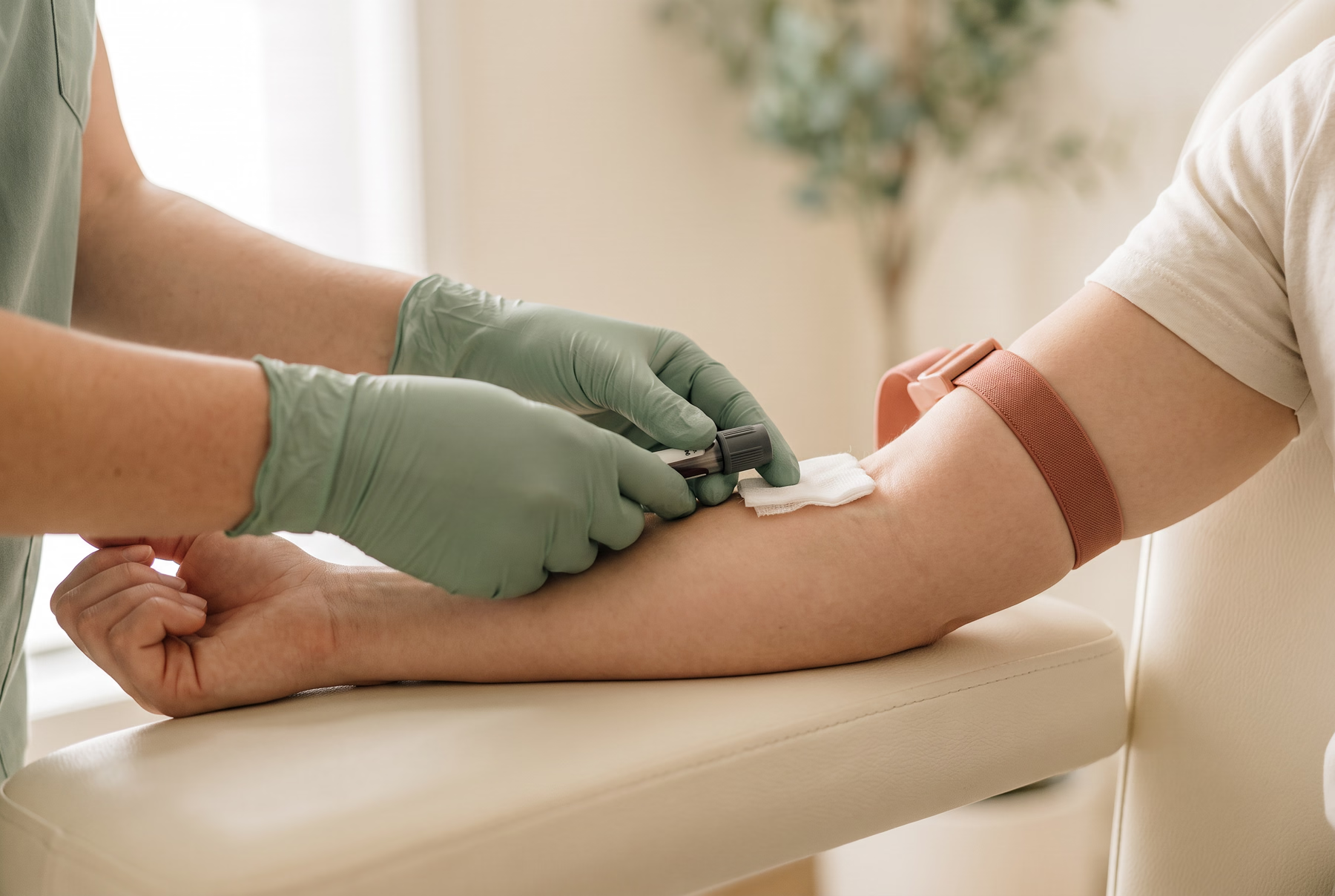
It is a standard blood draw that measures how many Lp(a) particles you have, reported in nmol/L, or how much they weigh, reported in mg/dL. It is ordered on its own, not as part of a routine cholesterol panel.
Labs measure Lp(a) with antibodies against apo(a), the protein that defines the particle. Because apo(a) varies in size, the best assays are built so that large and small forms read the same, and they report particle counts in nmol/L [8]. Guidelines prefer nmol/L but accept mg/dL [3].
The test is separate from LDL cholesterol and ApoB. Many people order both ApoB and Lp(a) together: ApoB counts every artery-clogging particle, while Lp(a) shows how many carry the extra apo(a) protein. Testing remains uncommon: in the University of California health system, only 1.8% of adults who had a lipid panel also had an Lp(a) test [9].
Who should get an Lp(a) test?
Every adult, once, according to most current guidelines. Testing matters most if you or a close relative had heart disease young, if you have familial hypercholesterolemia or aortic stenosis, or if a relative has high Lp(a).
Universal testing is now the majority view. The EAS (2022), the National Lipid Association (2024), the ESC/EAS (2025) and the ACC/AHA (2026) all advise at least one test in every adult [1][2][3][4]. Canada has recommended one test with the first lipid screen since 2021 [10].
HEART UK recommends testing these groups [11]:
- people with early heart disease, or a family history of it
- first-degree relatives of someone with Lp(a) above 200 nmol/L
- people with familial hypercholesterolemia
- people with calcific aortic valve stenosis
- people with a borderline 10-year risk (below 15%)
Children and teenagers
The EAS suggests testing young people with a history of ischemic stroke, or whose parent had early heart disease without another explanation. Levels can still rise until adulthood, so a childhood result may need repeating [1].
Relatives
In UK Biobank, 47% of first-degree relatives and 32% of second-degree relatives of someone with high Lp(a) also had high Lp(a), against 16% of unrelated pairs [7]. One high result is a reason to test parents, siblings and children.
Who should test Lp(a), and when
Every adult: one Lp(a) test, ideally with the first cholesterol test
- Child or teen with an ischemic stroke, or a parent with early heart disease and no other explanationTest young; levels can rise until adulthood, so repeat later (EAS 2022)
- A parent, sibling or child has high Lp(a)Test them: 47% of first-degree relatives also have high levels (Reeskamp 2023)
- Result near a threshold, borderline after menopause, kidney disease, or a treatment decision depends on itRepeat the test (ESC/EAS 2025, Lakkineni 2026)
- None of theseOne test is enough: genes set the level
No fasting needed. Universal testing: EAS 2022, NLA 2024, ESC/EAS 2025, ACC/AHA 2026.
Do you need to fast for an Lp(a) test?
No. Lp(a) does not change after a normal meal, so you can have it drawn at any time of day, fasting or not.
In 34,829 Danish adults, median Lp(a) was 17.3 mg/dL in fasting samples and 19.4 mg/dL three to four hours after a meal, a difference that was not statistically significant. Lp(a) predicted heart disease equally well either way [5]. The EAS lists fasting as having no effect on Lp(a) [1].
If the same draw includes a full lipid panel, nonfasting samples are also accepted for most other lipids. Triglycerides are the main exception; see triglycerides.
How often should you check Lp(a)?
Once is enough for most adults. A second test makes sense if your first result was near a threshold, after menopause if it was borderline, with kidney or liver disease, or before a treatment decision.
Lp(a) is highly consistent within a person over years [12], and the 2026 ACC/AHA guideline summary notes that one early measurement is enough for most people [4]. The EAS says repeating does not improve risk prediction for most people, with exceptions such as kidney or liver disease and acute infection [1].
Repeat tests are not identical. In 250 lipid clinic patients, results varied by about 19% within a person, and 12.4% moved across the NLA cutoffs of 75 or 125 nmol/L on retesting [6]. The ESC/EAS 2025 update adds that levels may rise after menopause, so a second test is reasonable if a premenopausal result was borderline [3].
How much does an Lp(a) test cost?
Prices vary by country, lab and insurance plan, so check with your clinician's lab or your insurer before ordering. Because most people need it only once, the lifetime cost is usually a single test.
We do not quote a price because lab and insurer prices change often and differ widely. A few practical points:
- Ask for it by name. It is not part of a routine cholesterol panel, so the order needs to say lipoprotein(a) or Lp(a).
- Ask about coverage. Coverage often depends on whether there is a medical reason recorded, such as family history of early heart disease, which every guideline lists as a reason to test [11][1].
- Check the unit. If you have a choice, a lab that reports nmol/L with an assay that reads all apo(a) sizes evenly is preferred [8][3].
How do you read Lp(a) test results?
Below 75 nmol/L (30 mg/dL) is low risk, 75 to 125 nmol/L (30 to 50 mg/dL) is a grey zone, and 125 nmol/L (50 mg/dL) or more is high risk under the EAS and NLA cutoffs. The ESC/EAS 2025 update treats above 105 nmol/L as raised.
These cutoffs come from the EAS consensus and the NLA update [1][2]. Risk rises steadily rather than jumping at one line: in UK Biobank it rose 11% for every 50 nmol/L [13], and the ACC/AHA summary links above 250 nmol/L to at least double the risk [4].
A result in mg/dL cannot be converted exactly into nmol/L, because the weight of each particle depends on apo(a) size [8]. The full range chart and a guideline comparison are on what is a good Lp(a) level, and next steps for a high result are on what a high Lp(a) means.
Can an Lp(a) test be wrong?
It can be off, mostly because apo(a) comes in many sizes. Tests that are sensitive to apo(a) size can misread Lp(a), and results from different labs may not match, so compare results from the same lab and unit.
Apo(a) size varies between people and between a person's two gene copies, so antibodies may bind a different number of sites on each particle, and results from different labs may not agree [8]. This is why the ESC/EAS prefers nmol/L [3], and Japan's 2026 consensus calls for assays aligned with international (IFCC) standards [14].
Normal biological variation adds about 19% from one test to the next [6]. If your result sits close to a cutoff, a repeat test at the same lab gives a clearer picture.
More about Lp(a)
- Lp(a): the full guideLp(a), or lipoprotein(a), is an LDL-like particle with an extra protein, apolipoprotein(a), attached.
- What does a high Lp(a) mean?A high Lp(a), usually 125 nmol/L (50 mg/dL) or more, means you inherited a gene variant that raises your lifelong risk of heart attack, stroke and aortic valve stenosis.
- What is a good Lp(a) level?A good Lp(a) level is below 75 nmol/L (about 30 mg/dL), the low-risk cutoff used by the EAS and NLA.
- Can you lower Lp(a)?Not much, with today's tools.
Protocols that act on Lp(a)
Common questions
How long does it take to get Lp(a) blood test results?
It depends on the lab. Many run Lp(a) on the same analyzers as other lipid tests, while others send it out, which can add days; ask when you have blood drawn.
Can I test Lp(a) and ApoB at the same time?
Yes. Both come from the same blood draw and neither needs fasting [5]. Together they show how many artery-clogging particles you have and how many carry apo(a). See the ApoB test guide.
Should children have an Lp(a) test?
Not routinely. The EAS suggests testing young people with a history of ischemic stroke or whose parent had early heart disease without another cause, noting that levels can rise until adulthood [1].
Does a statin change my Lp(a) result?
Possibly a little. Statins raised Lp(a) by 8.5% to 19.6% in a meta-analysis of six trials [15], so a result taken on a statin may read slightly higher than your baseline.
Sources
- 1.Kronenberg F, Mora S, Stroes ESG, et al. Lipoprotein(a) in atherosclerotic cardiovascular disease and aortic stenosis: a European Atherosclerosis Society consensus statement. Eur Heart J, 2022. doi:10.1093/eurheartj/ehac361
- 2.Koschinsky ML, Bajaj A, Boffa MB, et al. A focused update to the 2019 NLA scientific statement on use of lipoprotein(a) in clinical practice. J Clin Lipidol, 2024. doi:10.1016/j.jacl.2024.03.001
- 3.Mach F, Koskinas KC, Roeters van Lennep JE, et al. 2025 Focused Update of the 2019 ESC/EAS Guidelines for the management of dyslipidaemias. Eur Heart J, 2025. doi:10.1093/eurheartj/ehaf190
- 4.American College of Cardiology. Prioritizing Health | Lower Sooner: How the 2026 Dyslipidemia Guideline Changes Practice. ACC.org, 2026. Link
- 5.Langsted A, Kamstrup PR, Nordestgaard BG. Lipoprotein(a): fasting and nonfasting levels, inflammation, and cardiovascular risk. Atherosclerosis, 2014. doi:10.1016/j.atherosclerosis.2014.01.049
- 6.Lakkineni L, Waite M, David A, Jones B, Cegla J. Intraindividual variability in lipoprotein(a). J Clin Lipidol, 2026. doi:10.1016/j.jacl.2026.01.016
- 7.Reeskamp LF, Tromp TR, Patel AP, et al. Concordance of a High Lipoprotein(a) Concentration Among Relatives. JAMA Cardiol, 2023. doi:10.1001/jamacardio.2023.3548
- 8.Marcovina SM, Albers JJ. Lipoprotein (a) measurements for clinical application. J Lipid Res, 2016. doi:10.1194/jlr.R061648
- 9.Bhatia HS, Hurst S, Desai P, Zhu W, Yeang C. Lipoprotein(a) Testing Trends in a Large Academic Health System in the United States. J Am Heart Assoc, 2023. doi:10.1161/JAHA.123.031255
- 10.Pearson GJ, Thanassoulis G, Anderson TJ, et al. 2021 Canadian Cardiovascular Society Guidelines for the Management of Dyslipidemia for the Prevention of Cardiovascular Disease in Adults. Can J Cardiol, 2021. doi:10.1016/j.cjca.2021.03.016
- 11.Cegla J, Neely RDG, France M, et al. HEART UK consensus statement on Lipoprotein(a): A call to action. Atherosclerosis, 2019. doi:10.1016/j.atherosclerosis.2019.10.011
- 12.Emerging Risk Factors Collaboration, Erqou S, Kaptoge S, et al. Lipoprotein(a) concentration and the risk of coronary heart disease, stroke, and nonvascular mortality. JAMA, 2009. doi:10.1001/jama.2009.1063
- 13.Patel AP, Wang M, Pirruccello JP, et al. Lp(a) (Lipoprotein[a]) Concentrations and Incident Atherosclerotic Cardiovascular Disease: New Insights From a Large National Biobank. Arterioscler Thromb Vasc Biol, 2021. doi:10.1161/ATVBAHA.120.315291
- 14.Yoshida M, Ogura M, Tada H, et al. Lipoprotein(a) in Japan: An Expert Consensus Statement. J Atheroscler Thromb, 2026. doi:10.5551/jat.66330
- 15.Tsimikas S, Gordts PLSM, Nora C, Yeang C, Witztum JL. Statin therapy increases lipoprotein(a) levels. Eur Heart J, 2020. doi:10.1093/eurheartj/ehz310