
Red light therapy
What is red light therapy?
Red light therapy, or photobiomodulation, exposes skin to low-power red (about 630 to 670 nm) or near-infrared (about 780 to 950 nm) light, usually from LEDs. Trials support modest gains in pattern hair loss, knee osteoarthritis pain and some skin measures, but claims for fat loss, hormones and longevity lack human evidence.
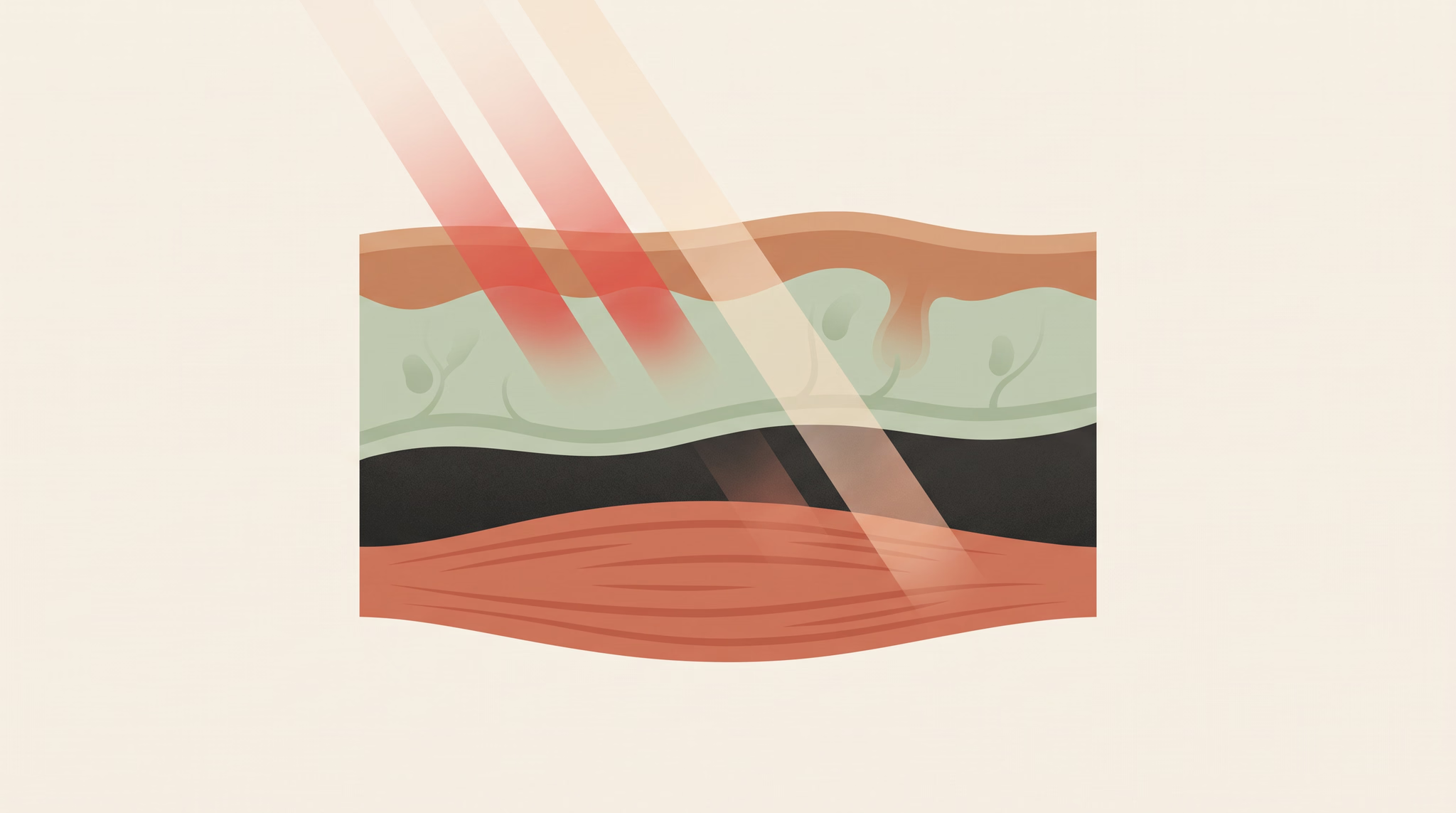
Specific clinical protocols have guideline or meta-analysis support, such as preventing oral mucositis in cancer care and easing knee osteoarthritis pain, and home devices modestly help pattern hair loss. For skin aging and muscle recovery the trials are small, heterogeneous and often industry funded, and most wellness claims have no controlled human data. The mechanism is plausible but not settled.
The rules
The rules ofRed light therapy
- 1Expose the target area to light in the red (about 630 to 670 nm) or near-infrared (about 780 to 950 nm) range.
- 2Use low power that does not noticeably heat the skin, such as the 6.4 mW/cm² of a face mask trial.
- 3Deliver a planned dose, computed as mW/cm² x seconds / 1,000; skin trials used about 8 to 9 J/cm² per session.
- 4Repeat on a fixed schedule, usually 2 to 7 sessions a week for at least 4 to 16 weeks.
- 5Protect the eyes with the goggles the device specifies, or keep them closed.
Share these rules as an image or a link.
| Full-body or face panel | An LED panel at a set distance, often 5 to 20 minutes, several times a week. |
|---|---|
| LED face mask | A mask at around 630 to 660 nm worn for 10 to 20 minutes, 2 to 3 times a week. |
| Hair cap or helmet | Lasers or LEDs around 655 nm worn on the scalp for 6 to 25 minutes, daily or every other day. |
| Clinical low-level laser therapy | Laser applied to specific spots at a set number of joules, such as 4 to 8 J per spot for knee osteoarthritis. |
| Pre-exercise photobiomodulation | Light on a muscle group minutes before exercise, about 20 to 300 J depending on muscle size. |
| Repeated low-level red light for myopia | A medical device shining 650 nm light into the eyes for 3 minutes twice a day, under specialist care. |
What it aims to do
- Improve skin texture, fine lines and collagen.
- Slow or partly reverse pattern hair loss.
- Reduce pain and inflammation in joints and tissues.
- Improve muscle performance and recovery.
- Support mitochondrial function and cellular energy.
What it claims, and what the evidence shows
Grades reflect evidence in people. Animal and cell results alone never earn more than limited.
Skin
Moderate evidenceSkin
Limited evidenceInflammation
Moderate evidenceAthletic performance
Mixed evidenceBody fat and weight
Limited evidenceBurns fat and slims the waist
One 40 person trial found about 2 cm more waist girth loss over 4 weeks; fat loss itself was not shown. [12]
Blood sugar and insulin
Not enough evidenceLowers blood sugar
A single small study found a 27.7% smaller glucose rise after a sugar drink with 15 minutes of 670 nm light; no longer-term trials exist. [13]
Hormones
Not enough evidenceRaises testosterone
No controlled human trial supports this claim.
Key takeaways
- 1
Red light therapy uses about 630 to 670 nm red or 780 to 950 nm near-infrared light at low power.
- 2
Dose is mW/cm² x seconds / 1,000 in J/cm²; skin trials used about 8 to 9 J/cm² per session.
- 3
Pattern hair loss and knee osteoarthritis pain have the most consistent trial support.
- 4
Skin and muscle recovery trials are small and mixed; fat loss, testosterone and longevity claims lack evidence.
- 5
FDA clearance means low risk, not proven benefit.
- 6
Protect your eyes: light into the eye is a medical intervention with a reported case of retinal damage.
What is red light therapy and how does it work?
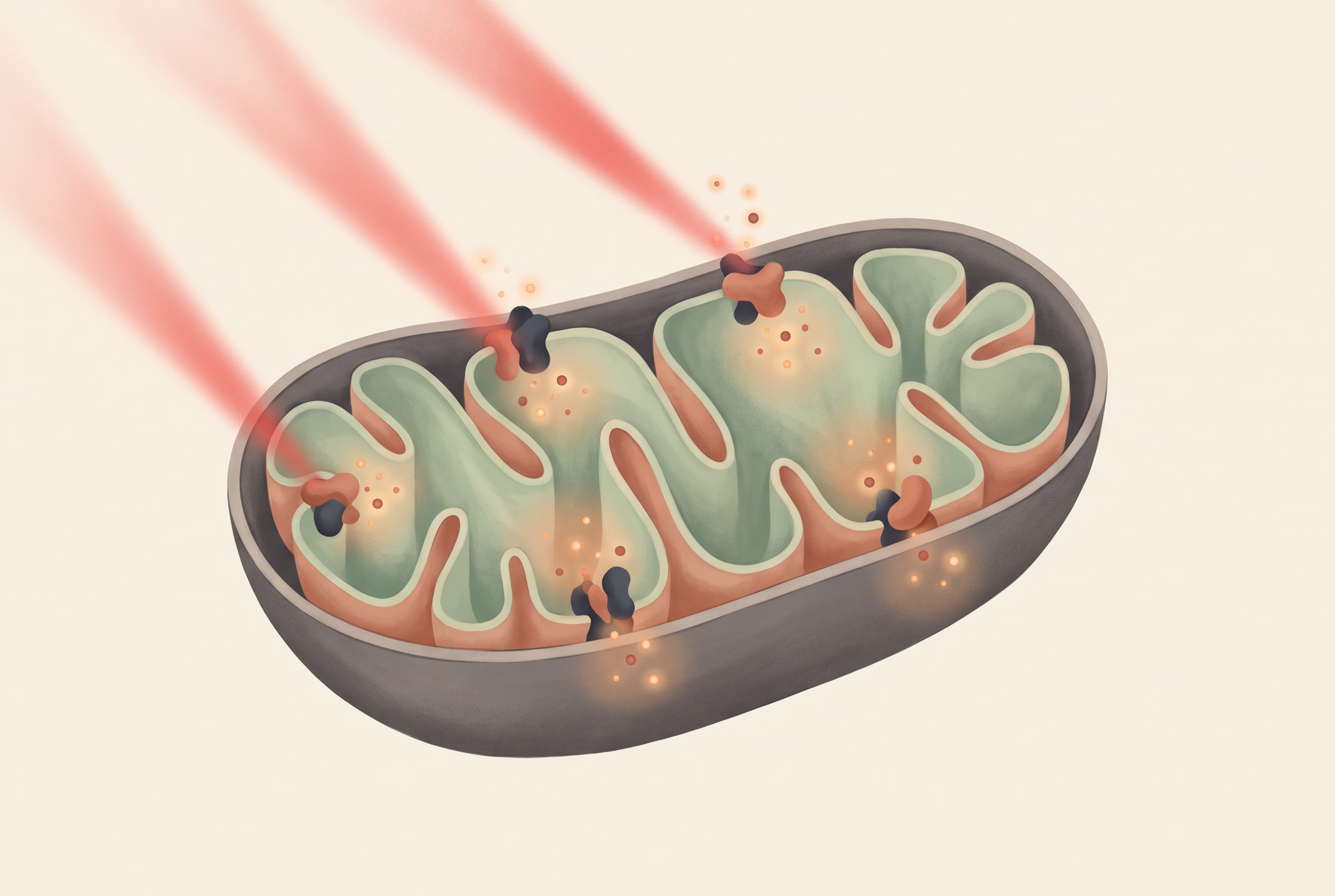
Red light therapy, or photobiomodulation, shines low-power red (about 630 to 670 nm) or near-infrared (about 780 to 950 nm) light on the body. The leading theory is that mitochondria absorb it and make more energy, but the mechanism is still debated.
Photobiomodulation started as low-level laser therapy and now mostly uses LEDs. It is not heat therapy and not ultraviolet light: the power is low enough that skin barely warms.
The main hypothesis is that cytochrome c oxidase, an enzyme in the mitochondrial energy chain, absorbs red and near-infrared light [14]. One proposed result is that nitric oxide is released from the enzyme, restoring electron flow and raising mitochondrial activity, which then triggers signaling in the cell [15]. Glen Jeffery, whose lab studies 670 nm light, has proposed a different route through water around mitochondria (Huberman Lab).
The dose matters in an unusual way. Cell and animal studies show a biphasic dose response: too little light does nothing and too much can inhibit the effect [16]. In mice with brain injury, 3 daily treatments helped, while 14 daily treatments at first left the mice worse off than no treatment [17]. This is one reason consumer devices with unknown output can disappoint.
What wavelength and dose should red light therapy use?
Studies with positive results mostly use 630 to 670 nm for skin, hair and eyes and 780 to 950 nm for muscles and joints. Skin trials used about 8 to 9 J/cm² per session; muscle studies used 20 to 300 J per muscle group.
Dose in photobiomodulation is energy per area: J/cm² = mW/cm² x seconds / 1,000. A face mask trial that ran at 6.4 mW/cm² for 21 minutes reported 8.05 J/cm², which is exactly what that formula gives [5].
| Use | Wavelength | Dose and schedule in trials | Source |
|---|---|---|---|
| Wrinkles and skin texture | 611 to 650 nm | About 9 J/cm², twice a week, 30 sessions | [4] |
| Face mask | 660 nm | 8.05 J/cm², 21 minutes, 2 to 3 times a week for 4 weeks | [5] |
| Pattern hair loss | 655 nm | 25 minutes every other day for 16 weeks | [1] |
| Muscle performance | 655 to 950 nm | 20 to 60 J for small muscles, 60 to 300 J for large ones | [10] |
| Knee osteoarthritis | 785 to 860 nm | 4 to 8 J per spot | [7] |
| Myopia in children | 650 nm into the eye | 3 minutes twice a day, 5 days a week, medical device | [18] |
Two practical points follow. First, irradiance falls quickly with distance, so a panel's advertised figure may not be what reaches your skin. Second, the biphasic dose response means longer sessions are not automatically better [16].
Wavelengths used in red light therapy studies
- Orange
- 600 to 620
- Red: skin, hair, eyes
- 620 to 700
- Far red, few trials
- 700 to 780
- Near-infrared: muscle, joints, brain
- 780 to 950
- Absorbed more by water
- 950 to 1,000
- 650 nm: Myopia control in children
- 655 nm: Hair growth helmets
- 660 nm: Face mask trial
- 670 nm: Aging vision and blood glucose
- 808 nm: No effect on curls or soreness
- 810 nm: Mouse brain injury, biphasic dose
- 830 nm: Knee osteoarthritis pain, 785 to 860 nm
Does red light therapy work for skin and wrinkles?
Modestly. In a controlled trial of 136 people, 30 sessions of red light improved skin roughness and collagen density on ultrasound, but a 2025 sham-controlled mask trial found no difference in wrinkle scores rated by blinded specialists.
The best known trial treated 113 volunteers twice a week with 611 to 650 nm or 570 to 850 nm light at about 9 J/cm² and compared them with 23 untreated controls. After 30 sessions, the treated groups had better complexion, smoother skin on profilometry and higher collagen density on ultrasound, and broad spectrum light did no better than red alone [4].
A newer double-blind trial in 95 women aged 45 to 60 is more sobering. A 660 nm mask shortened some wrinkles on image analysis and raised satisfaction, but blinded specialists using a wrinkle scale saw no difference from sham [5].
Reviews describe uses in wrinkles, scars, burns, acne and psoriasis [6]. The American Academy of Dermatology describes subtle to noticeable improvements, says results take ongoing treatment, and notes that FDA clearance says nothing about how well a device works (AAD). Dermatologist Apple Bodemer adds that many studies are funded by device makers (UW clipsheet).
Does red light therapy regrow hair?
For pattern hair loss, yes, to a degree. Sham-controlled trials of a 655 nm helmet gave about 35 to 37% more hair growth than sham in men and women over 16 weeks, and a 2025 meta-analysis of 38 studies found higher hair density than placebo.
Hair loss is the cosmetic use with the most consistent trials:
- In 44 men with androgenetic alopecia, a 655 nm laser and LED helmet used for 25 minutes every other day for 16 weeks produced about 35% more hair growth than a sham helmet [1].
- In 47 women, the same protocol produced about 37% more growth than sham [2].
- A 2025 meta-analysis of 38 studies with 3,098 patients found increased hair density compared with placebo over 4 to 26 weeks, though results varied widely between studies [3].
The AAD notes that red light will not regrow a full head of hair and is usually used alongside other treatments (AAD). It has not been tested for scarring alopecia or alopecia areata in enough patients to say [3].
Does red light therapy help muscle recovery and performance?
The evidence is mixed. Meta-analyses find small gains in repetitions and time to exhaustion when light is applied before exercise, but the quality of evidence is very low to moderate, and some well-controlled trials find no effect.
Most sports studies apply light to a muscle shortly before exercise rather than after it. A meta-analysis of 13 trials found improvements in repetitions and time to exhaustion, most consistently at 50 to 200 mW and 5 to 6 J per spot [9]. A larger review of 39 trials reached a more cautious conclusion: some benefit, but very low to moderate quality evidence and huge variation in protocols [10].
Negative trials exist. In a placebo-controlled crossover trial, 808 nm laser light on the biceps before curls did not change repetitions to failure, perceived effort or muscle soreness [11].
If recovery is your goal, the cold plunge guide covers immersion, which has larger soreness trials, and the sauna guide covers heat.
Which red light therapy claims go beyond the evidence?
The strongest clinical evidence is for preventing oral mucositis during cancer treatment and for knee osteoarthritis pain, both with specific clinical protocols. Claims for fat loss, testosterone, blood sugar and longevity rest on small studies, animal work or nothing.
Where trials are strongest. A cancer care guideline recommends specific photobiomodulation protocols to prevent oral mucositis in stem cell transplant and head and neck radiotherapy patients [8]. A meta-analysis of 22 placebo-controlled trials found laser therapy reduced knee osteoarthritis pain, with the best results at 4 to 8 J per spot at 785 to 860 nm [7]. These are clinical lasers at defined doses, not home panels.
Where the evidence is thin.
- Fat loss: eight sessions of 635 to 680 nm laser reduced waist girth by about 2 cm more than control in a 40 person trial [12]. That is a measuring tape result over 4 weeks, not proven fat loss.
- Blood sugar: 15 minutes of 670 nm light on the back cut the glucose rise after a sugar drink by 27.7% in a small study [13]. It has not been tested over weeks, or in people with diabetes. If you track HbA1c, there are no data on it.
- Vision with age: brief 670 nm light improved some color contrast measures in people over 40 [19]. Jeffery has said a macular degeneration trial showed no effect in patients (Huberman Lab).
- Testosterone, thyroid, detox and longevity: no controlled human trials support these claims.
Red light claims sorted by evidence
Stronger evidence
Clinical protocols with specific devices and doses.
- Preventing oral mucositis in cancer treatment
- Knee osteoarthritis pain
- Hair density in pattern hair loss
- Slowing myopia in children, with a medical device
Some evidence
Small or mixed trials.
- Wrinkles and skin texture
- Muscle performance and recovery
- Waist girth, about 2 cm over 4 weeks
- Blood sugar after a sugar drink
Little or no human evidence
No controlled human trials support these claims.
- Testosterone
- Fat loss beyond centimeters
- Thyroid
- Detox
- Longevity
The stronger results come from clinical lasers and medical devices at defined doses, not from home panels.
Is red light therapy safe for your eyes?
Short-term safety for skin looks good, but light aimed at the eyes is a medical intervention. A 12-year-old developed retinal damage after repeated red-light laser treatment for myopia, so use the eye protection a device specifies and never stare into a panel.
Red light can change the eye. In a 12 month trial in 264 children, 3 minutes of 650 nm light twice a day slowed eyeball growth to 0.13 mm compared with 0.38 mm with glasses alone, and no structural damage was found [18]. A meta-analysis of 7 trials confirmed the effect on myopia [20]. That shows the light reaches the retina in a biologically meaningful way.
The same exposure can harm. A case report described retinal damage in a 12-year-old girl after repeated low-level red-light laser therapy for myopia [21]. Consumer panels are not designed to be looked at, and how much of their light reaches the retina is unknown.
What that means in practice: wear the goggles your device specifies, not sunglasses (AAD); keep face masks closed-eye unless the maker says otherwise; and ask an ophthalmologist before using any light device if you have retinal disease, glaucoma or take light-sensitizing drugs.
Eyeball growth in one year with and without red light
- Glasses only0.38 mm of axial growth in 12 months
- Glasses plus red light, 3 minutes twice daily0.13 mm of axial growth in 12 months
Show the data
| Item | Value (mm of axial growth in 12 months) | Low | High | Note |
|---|---|---|---|---|
| Glasses only | 0.38 | 0.34 | 0.42 | |
| Glasses plus red light, 3 minutes twice daily | 0.13 | 0.09 | 0.17 |
How do you choose a red light therapy device?
Look for stated wavelengths that match the studies (630 to 670 nm, 810 to 850 nm), a measured irradiance in mW/cm² at a stated distance, and FDA clearance for safety. Clearance does not mean the device works.
A device is only as good as the dose it delivers. Before you buy:
- Wavelength. Check that it lists specific peaks in the ranges used in trials, such as 630 to 670 nm for skin and hair and 810 to 850 nm for deeper tissue.
- Irradiance at distance. A useful spec sheet gives mW/cm² measured at the distance you will use. Use that to compute dose with J/cm² = mW/cm² x seconds / 1,000.
- Treatment area. Hair trials used helmets that cover the scalp [1]; skin trials treated the whole face [4]. A small handheld wand cannot dose a large area evenly.
- Regulatory status. FDA cleared or 510(k) cleared means generally low risk; it says nothing about effectiveness, and "FDA approved" or "certified" claims on these devices are misleading (AAD).
- Eye protection. It should ship with goggles or state that eyes must stay closed.
Bryan Johnson's Blueprint uses a 655 nm cap for 6 minutes a day and 6 minute full-body panel sessions (Blueprint). Huberman discusses brief morning 670 nm exposure for aging eyes (Huberman Lab). Neither is a tested regimen; they show how people apply the trial findings.
How to work out a red light dose
Dose (J/cm²) = irradiance (mW/cm²) x time (seconds) / 1,000
- Irradiance
- Power reaching the skin, measured at the distance you use
- 6.4 mW/cm²
- Time
- Session length in seconds; the face mask trial ran 21 minutes
- 1,260 s
Irradiance falls quickly with distance, so use the figure measured where you sit. More is not better: in cell and animal studies, very high doses can inhibit the effect.
The studies, by type
Strongest designs first. Scroll each row; every card links to the paper and says whether it supports the protocol.
Systematic reviews and meta-analyses (6)
Randomized controlled trials (7)
Mechanistic studies in people (2)
Animal and cell studies (2)
Case reports and N-of-1 experiments (1)
Hypotheses and expert reviews (3)
Who follows it, who backs it, who doubts it
Public positions summarized in our words. Follow each link for the full context.
Follow it
Bryan JohnsonEntrepreneur, founder of Blueprint
Uses red and near-infrared light twice a day in 6 minute sessions and a 655 nm cap for hair, for collagen, healing and mitochondrial health, while telling followers the basics matter more if they lack access.
Support it
Glen JefferyProfessor of neuroscience, University College London
Argues that a few minutes of 670 nm or longer wavelength light, especially in the morning, boosts mitochondrial function and can improve aging vision and blood sugar control, while acknowledging small studies and a null macular degeneration trial.
Michael HamblinPhotomedicine researcher, long based at the Wellman Center for Photomedicine, Massachusetts General Hospital
A leading photobiomodulation researcher who attributes its effects mainly to light absorption by cytochrome c oxidase in mitochondria, and who notes that stressed and healthy cells can respond to the same light in opposite ways.
Andrew HubermanNeuroscientist at Stanford and host of the Huberman Lab podcast
Describes brief morning red light exposure as a way to offset age-related vision decline after 40, citing the Jeffery lab, and warns against bright light near the eyes and very intense local devices.
Huberman Lab: Using Light (Sunlight, Blue Light and Red Light) to Optimize Health
Mixed or cautious
Apple BodemerBoard-certified dermatologist, University of Wisconsin School of Medicine and Public Health
Says high-quality studies are few and many are funded by device makers, so results deserve skepticism, but sees enough evidence that red light may help some people.
Public examples
- Bryan Johnson's Blueprint
Red and near-infrared light twice daily in 6 minute sessions plus a 655 nm cap for 6 minutes a day as part of a hair routine.
- Huberman Lab light protocol
Brief morning exposure to long-wavelength red light, a few minutes a few times a week, framed around aging eyesight.
- Repeated low-level red light for childhood myopia
A specialist-supervised medical protocol: 650 nm light into the eyes for 3 minutes twice a day, 5 days a week.
How to follow it
- Pick one goal, such as pattern hair loss or skin texture, and match the device to the trials for it.
- Check the device lists wavelengths in the studied ranges and an irradiance in mW/cm² at a stated distance.
- Calculate the session time for your target dose: seconds = J/cm² x 1,000 / mW/cm².
- Clean the skin of sunscreen and makeup, wear the specified goggles and keep the distance constant.
- Follow a trial-like schedule, for example 2 to 3 sessions a week for skin or every other day for hair, for at least 12 to 16 weeks.
- Take standardized photos in the same light every 4 weeks to judge the effect.
How to know you are following it
Log each session with device, wavelength, distance, minutes and calculated dose (J/cm²). Adherence is sessions completed per week against the schedule, such as 3 of 3 for skin or 3 to 4 of 3 to 4 for hair.
Common mistakes
- Assuming more time or more power is better; very high doses can blunt the effect.
- Buying a device without a stated irradiance at a known distance.
- Treating FDA clearance as proof the device works.
- Looking into the light or using sunglasses instead of the specified goggles.
- Stopping after a few weeks; hair and skin trials ran 4 to 16 weeks.
- Using red light instead of proven treatments for a medical condition.
Who should be careful
Check with a clinician first if you
- You have a retinal disease, glaucoma or other eye condition, unless an ophthalmologist approves it.
- You take medicines that make you sensitive to light, or have a light-sensitive condition such as lupus.
- You have a skin cancer or a suspicious lesion in the treatment area that has not been checked.
- You have darker skin and plan face treatment, without first asking a dermatologist, since visible light can cause dark spots.
- It is for a child's eyes outside specialist care.
Possible side effects
- Eye strain, glare and, with light directed into the eyes, the potential for retinal damage.
- Mild warmth, redness or dryness of the skin.
- Headache or discomfort from bright light.
- Hyperpigmentation in some people with darker skin.
- Rarely, burns from high-power devices used too close to the skin.
Watch
Talks and explainers worth your time. Nothing loads from YouTube until you press play.
Dr. Glen Jeffery: Using Red Light to Improve Your Health & the Harmful Effects of LEDs
Andrew HubermanAndrew Huberman@hubermanlabSubscribers8MStartedApril 2013CountryUnited StatesVideos548Total views533.7MNew videos, last 30 days14New videos, last year133From YouTube, 2026-10-31Open on YouTube
A UCL vision scientist explains the 670 nm studies on aging eyes and blood glucose, and what is still unproven.
Dermatologist explains the science behind red light therapy
CBS New YorkCBS New York@cbsnewyorkSubscribers1.2MStartedDecember 2013CountryUnited StatesVideos176.1KTotal views1.5BNew videos, last 30 days500New videos, last year500+From YouTube, 2026-10-31Open on YouTube
A short news segment with a dermatologist on what red light can and cannot do for skin.
Red Light Therapy Myths BUSTED by Orthopedic Surgeon | Dr. Chris Raynor
Not Your Everyday OrthoDr. Chris Raynor | Not Your Everyday Ortho@chrisraynormdSubscribers735KStartedAugust 2006CountryCanadaVideos653Total views97.5MNew videos, last 30 days13New videos, last year103From YouTube, 2026-10-31Open on YouTube
An orthopedic surgeon reviews popular claims for joints and recovery against the research.
Biomarkers it can move
Common questions
What is the best wavelength for red light therapy?
Studies with positive results mostly use 630 to 670 nm red light for skin, hair and eyes and 780 to 950 nm near-infrared for muscles and joints. Hair helmets used 655 nm and a face mask trial used 660 nm.
How long should a red light therapy session be?
It depends on the device's irradiance. Time in seconds equals the target dose in J/cm² times 1,000 divided by mW/cm². Trials ran from 3 minutes for eye protocols to 21 minutes for a face mask and 25 minutes for hair helmets.
Can you do red light therapy every day?
Many devices allow daily use, but trials for skin used 2 to 3 sessions a week and hair trials every other day. Because the dose response is biphasic, more sessions are not necessarily better.
How much red light therapy is too much?
There is no agreed human limit. Cell and animal studies show that very high doses can inhibit the effect, so staying near trial doses, such as about 8 to 9 J/cm² per session for skin, is sensible.
Does red light therapy really work?
For some uses. Pattern hair loss and knee osteoarthritis pain have the most consistent trials, and a cancer care guideline supports specific protocols for oral mucositis. Skin and muscle results are modest and mixed, and many wellness claims are untested.
Can red light therapy damage your eyes?
It can. Light into the eye changes the retina; a 12-year-old developed retinal damage after repeated red-light laser treatment for myopia. Wear the goggles your device specifies and never look into a panel.
Does red light therapy help with weight loss?
One small trial found about 2 cm more waist girth loss over 4 weeks, but no study shows meaningful fat or weight loss.
Does red light therapy increase testosterone?
No controlled human trial shows that it does.
Is red light therapy the same as infrared sauna?
No. Red light therapy uses low-power light that barely warms the skin; an infrared sauna uses infrared heaters to raise body temperature. Their evidence bases are separate.
Can red light therapy cause cancer?
Research has not linked red light to cancer, unlike ultraviolet light, according to the American Academy of Dermatology. Have any suspicious skin lesion checked before treating that area.
Sources
- 1.Lanzafame RJ, Blanche RR, Bodian AB, et al. The growth of human scalp hair mediated by visible red light laser and LED sources in males. Lasers Surg Med, 2013. doi:10.1002/lsm.22173
- 2.Lanzafame RJ, Blanche RR, Chiacchierini RP, et al. The growth of human scalp hair in females using visible red light laser and LED sources. Lasers Surg Med, 2014. doi:10.1002/lsm.22277
- 3.Perez SM, Vattigunta M, Kelly C, et al. Low-Level Laser and LED Therapy in Alopecia: A Systematic Review and Meta-Analysis. Dermatol Surg, 2025. doi:10.1097/DSS.0000000000004442
- 4.Wunsch A, Matuschka K. A controlled trial to determine the efficacy of red and near-infrared light treatment in patient satisfaction, reduction of fine lines, wrinkles, skin roughness, and intradermal collagen density increase. Photomed Laser Surg, 2014. doi:10.1089/pho.2013.3616
- 5.Bragato EF, Paisano AF, Pavani C, et al. Role of photobiomodulation application frequency in facial rejuvenation: randomized, sham-controlled, double-blind, clinical trial. Lasers Med Sci, 2025. doi:10.1007/s10103-025-04383-1
- 6.Avci P, Gupta A, Sadasivam M, et al. Low-level laser (light) therapy (LLLT) in skin: stimulating, healing, restoring. Semin Cutan Med Surg, 2013. PubMed 24049929
- 7.Stausholm MB, Naterstad IF, Joensen J, et al. Efficacy of low-level laser therapy on pain and disability in knee osteoarthritis: systematic review and meta-analysis of randomised placebo-controlled trials. BMJ Open, 2019. doi:10.1136/bmjopen-2019-031142
- 8.Zadik Y, Arany PR, Fregnani ER, et al. Systematic review of photobiomodulation for the management of oral mucositis in cancer patients and clinical practice guidelines. Support Care Cancer, 2019. doi:10.1007/s00520-019-04890-2
- 9.Leal-Junior EC, Vanin AA, Miranda EF, et al. Effect of phototherapy (low-level laser therapy and light-emitting diode therapy) on exercise performance and markers of exercise recovery: a systematic review with meta-analysis. Lasers Med Sci, 2015. doi:10.1007/s10103-013-1465-4
- 10.Vanin AA, Verhagen E, Barboza SD, et al. Photobiomodulation therapy for the improvement of muscular performance and reduction of muscular fatigue associated with exercise in healthy people: a systematic review and meta-analysis. Lasers Med Sci, 2018. doi:10.1007/s10103-017-2368-6
- 11.Azuma RHE, Merlo JK, Jacinto JL, et al. Photobiomodulation Therapy at 808 nm Does Not Improve Biceps Brachii Performance to Exhaustion and Delayed-Onset Muscle Soreness in Young Adult Women: A Randomized, Controlled, Crossover Trial. Front Physiol, 2021. doi:10.3389/fphys.2021.664582
- 12.Caruso-Davis MK, Guillot TS, Podichetty VK, et al. Efficacy of low-level laser therapy for body contouring and spot fat reduction. Obes Surg, 2011. doi:10.1007/s11695-010-0126-y
- 13.Powner MB, Jeffery G. Light stimulation of mitochondria reduces blood glucose levels. J Biophotonics, 2024. doi:10.1002/jbio.202300521
- 14.Karu T. Primary and secondary mechanisms of action of visible to near-IR radiation on cells. J Photochem Photobiol B, 1999. doi:10.1016/S1011-1344(98)00219-X
- 15.Hamblin MR. Mechanisms and Mitochondrial Redox Signaling in Photobiomodulation. Photochem Photobiol, 2018. doi:10.1111/php.12864
- 16.Huang YY, Sharma SK, Carroll J, et al. Biphasic dose response in low level light therapy - an update. Dose Response, 2011. doi:10.2203/dose-response.11-009.Hamblin
- 17.Xuan W, Huang L, Hamblin MR. Repeated transcranial low-level laser therapy for traumatic brain injury in mice: biphasic dose response and long-term treatment outcome. J Biophotonics, 2016. doi:10.1002/jbio.201500336
- 18.Jiang Y, Zhu Z, Tan X, et al. Effect of Repeated Low-Level Red-Light Therapy for Myopia Control in Children: A Multicenter Randomized Controlled Trial. Ophthalmology, 2022. doi:10.1016/j.ophtha.2021.11.023
- 19.Shinhmar H, Grewal M, Sivaprasad S, et al. Optically Improved Mitochondrial Function Redeems Aged Human Visual Decline. J Gerontol A Biol Sci Med Sci, 2020. doi:10.1093/gerona/glaa155
- 20.Wang F, Peng W, Jiang Z. Repeated Low-Level Red Light Therapy for the Control of Myopia in Children: A Meta-Analysis of Randomized Controlled Trials. Eye Contact Lens, 2023. doi:10.1097/ICL.0000000000001020
- 21.Liu H, Yang Y, Guo J, et al. Retinal Damage After Repeated Low-level Red-Light Laser Exposure. JAMA Ophthalmol, 2023. doi:10.1001/jamaophthalmol.2023.1548
AumniVIDA explains health information for general wellness. Talk to your clinician before changing your diet, training or medication for a health condition.