
HbA1c test: fasting, home kits and how often
Updated October 31, 2026 · 10 sources · Written by the AumniVIDA team
UnitsShort answer
The HbA1c test needs no fasting and is unaffected by a recent meal, stress or exercise. It uses a whole-blood sample from a vein or finger prick. ADA advises screening from age 35, yearly testing with prediabetes and at least twice a year with diabetes. Diagnosis needs an FDA-approved method in a certified lab .
Key takeaways
- 1
No fasting is needed; recent food, stress, illness and activity do not affect the result [1].
- 2
For diagnosis, ADA requires an NGSP-certified method traceable to the DCCT assay, and point-of-care devices approved for diagnosis in certified labs [1].
- 3
Screen from age 35, every 3 years if normal and yearly with prediabetes [1].
- 4
With diabetes, test at least twice a year, or every 3 months when not at goal [2].
Do you need to fast for an A1c test?
No. HbA1c is a nonfasting test with no preparation needed, and it is unaffected by recent food intake, stress, illness or activity [1].
Fasting is needed for fasting plasma glucose, which requires at least 8 hours without calories [1]. If your clinician orders HbA1c together with fasting glucose or a lipid panel, follow the fasting instructions for those tests.
Because HbA1c is stable after the sample is drawn, it also avoids a common problem with glucose tests: glucose falls in a tube left unprocessed [1].
How is the A1c test done?
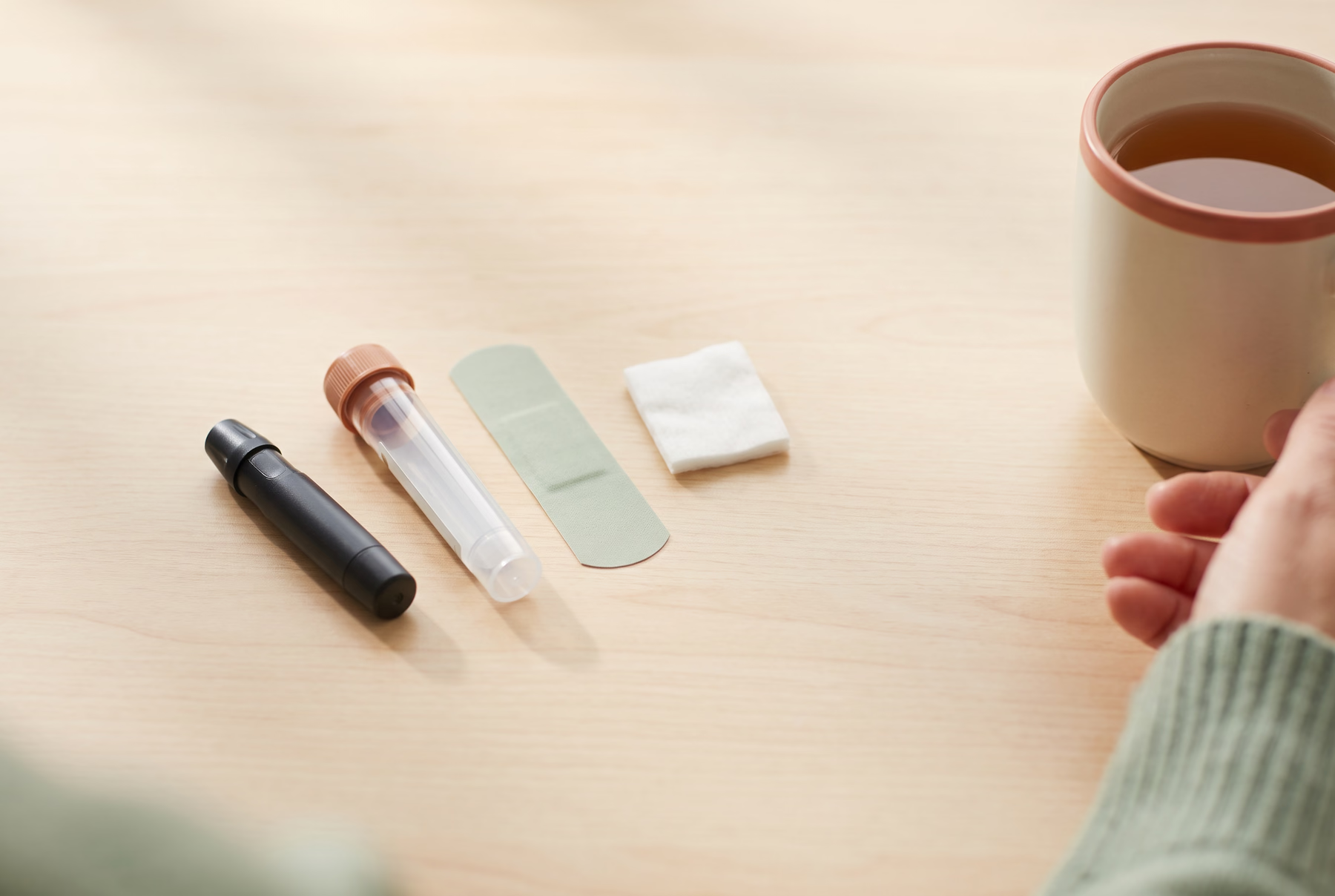
A lab measures the share of glycated hemoglobin in a whole-blood sample, taken from a vein or a finger prick. Results are reported in % (NGSP) or mmol/mol (IFCC). For diagnosis the method should be NGSP certified and traceable to the DCCT assay [1] [3].
Standardization is what makes a result from one lab comparable with the next. The NGSP, launched in 1996, aligned US labs to the DCCT assay; by 2000, most certified methods were within 0.8% HbA1c of target [4]. Outside the US, many assays are IFCC certified [1].
On lab reports the test may appear as HbA1c, hemoglobin A1c, glycated hemoglobin or glycohemoglobin.
Labs separate glycated from non-glycated hemoglobin by methods such as chromatography or immunoassay. Some methods are affected by hemoglobin variants such as sickle cell trait, and ADA points to the NGSP list of assays with known interferences [1]. If you know you carry a variant, mention it when the test is ordered.
Are home A1c test kits accurate?
Some point-of-care A1c devices are NGSP certified and FDA cleared for monitoring diabetes, but ADA restricts screening and diagnosis to devices approved for diagnosis, used by trained staff in certified labs [1]. Home kits suit tracking a trend; confirm any surprising result in a lab.
Home options include finger-prick analyzers that read a result in minutes and mail-in kits that send a dried or liquid sample to a lab. Accuracy depends on the device and on technique, such as getting a large enough blood drop.
Practical points:
- Use one method consistently to follow a trend.
- Check whether the device or lab is NGSP certified [1].
- Treat a home result in the prediabetes or diabetes range as a reason to get a lab test, not as a diagnosis [1].
- Remember that a kit cannot correct for the red cell factors that distort any A1c, such as iron deficiency or recent blood loss [5].
For people who want more than a number every few months, CGM shows glucose across the day and reports average glucose and time in range directly [6]. Its estimate of A1c, the GMI, often differs from a lab result [7].
How often should you get an A1c test?
ADA advises screening from age 35, or earlier with risk factors, and repeating at least every 3 years if normal. People with prediabetes should test yearly, and people with diabetes at least twice a year, or every 3 months when not at goal [1] [2].
Earlier screening applies to adults with overweight or obesity plus risk factors, and to people with other high-risk conditions [1]. NICE offers people at high risk a blood test at least once a year, preferably the same type each time [8].
Retesting sooner than about 3 months mostly shows the past, because HbA1c falls with a half-time of about 35 days [9].
| Situation | Suggested frequency | Source |
|---|---|---|
| Adults with no risk factors | Start at age 35; repeat at least every 3 years if normal | ADA 2026 |
| Prediabetes (ADA, 5.7% or higher) | Every year | ADA 2026 |
| High risk (NICE, 42 to 47 mmol/mol) | At least once a year | NICE PH38 |
| After gestational diabetes | At least every 1 to 3 years | ADA 2026 |
| Diabetes, meeting goals | At least twice a year | ADA 2026 |
| Diabetes, not meeting goals or after treatment change | About every 3 months | ADA 2026 |
What can affect your A1c test result?
Anything that changes red cell turnover or interferes with the assay: anemia, iron deficiency, blood loss, transfusion, hemolysis, splenectomy, G6PD deficiency, erythropoietin, HIV, cirrhosis, kidney failure, dialysis, pregnancy and some hemoglobin variants [1].
Tell whoever orders the test about any of these. The hub's compiled table shows the direction and size of each effect. When HbA1c is unreliable, ADA advises plasma glucose for diagnosis and fructosamine or CGM for monitoring [1] [2].
Is A1c or fasting glucose the better test?
They measure different things and work best together. A1c needs no fasting and varies less from day to day, and in ARIC it predicted heart disease better than fasting glucose; but it is less sensitive than the oral glucose tolerance test at its cut point [10] [1].
ADA lists the trade-offs: glucose is cheap and widely available but varies with meals, stress and time of day; A1c is stable and standardized but more expensive and affected by red cell factors [1]. Using both from the same sample is one accepted way to confirm a diagnosis [1].
In ARIC, fasting glucose lost its link to cardiovascular disease once HbA1c was in the model, while HbA1c kept its link after adjusting for fasting glucose [10]. The oral glucose tolerance test remains the most sensitive way to catch early glucose problems, and ADA prefers it in some settings, such as after organ transplant [1].
More about HbA1c
- HbA1c: the full guideHbA1c (A1c) is the percentage of hemoglobin in red blood cells that has glucose attached.
- HbA1c chart: normal, prediabetes and diabetes rangesA normal HbA1c is below 5.7% (39 mmol/mol).
- How to lower HbA1cWeight loss, diet pattern, structured exercise and medication lower HbA1c most.
- What does a high HbA1c mean?A high HbA1c means more hemoglobin has glucose attached, usually because average glucose has been raised for months.
- HbA1c to average glucose: conversion chartEstimated average glucose (eAG) in mg/dL equals 28.7 x A1c minus 46.7, from the ADAG study of 507 people.
Protocols that act on HbA1c
- Low-glycemic dietA low-glycemic diet favors carbohydrate foods that raise blood sugar slowly, rated by the glycemic index (GI): 55 or less is low and 70 or more is high.
- Time-restricted eatingTime-restricted eating means eating all of the day's food and caloric drinks within a consistent daily window, usually 6 to 10 hours, and fasting the rest of the day.
- Ketogenic dietA ketogenic diet keeps carbohydrate under about 20 to 50 g a day so the body burns fat and makes ketones, defined in supervised programs as blood BHB of 0.5 to 3.0 mmol/L.
- Mediterranean dietThe Mediterranean diet is an eating pattern built on vegetables, fruit, legumes, whole grains, nuts, fish and olive oil as the main fat, with little red or processed meat, butter or sweets.
Common questions
Should I eat before an A1c test?
You can eat normally; A1c is unaffected by a recent meal [1]. Fast only if another test drawn at the same time, such as fasting glucose, requires it.
Can A1c be checked with a finger prick?
Yes. Point-of-care devices and mail-in kits use a finger-prick sample; for diagnosis ADA requires a method approved for diagnosis in a certified lab [1].
What is A1c called on a blood test?
It may appear as HbA1c, hemoglobin A1c, glycated hemoglobin, glycosylated hemoglobin or glycohemoglobin. All refer to the same measurement.
When should I repeat A1c for prediabetes?
How long does an A1c test take?
The blood draw takes minutes. Point-of-care analyzers give a result in minutes; lab results usually come back within a few days, depending on the lab.
Sources
- 1.American Diabetes Association Professional Practice Committee for Diabetes. 2. Diagnosis and Classification of Diabetes: Standards of Care in Diabetes-2026. Diabetes Care, 2026. doi:10.2337/dc26-S002
- 2.American Diabetes Association Professional Practice Committee for Diabetes. 6. Glycemic Goals, Hypoglycemia, and Hyperglycemic Crises: Standards of Care in Diabetes-2026. Diabetes Care, 2026. doi:10.2337/dc26-S006
- 3.Hoelzel W, Weykamp C, Jeppsson JO, et al. IFCC reference system for measurement of hemoglobin A1c in human blood and the national standardization schemes in the United States, Japan, and Sweden: a method-comparison study. Clinical Chemistry, 2004. doi:10.1373/clinchem.2003.024802
- 4.Little RR, Rohlfing CL, Wiedmeyer HM, Myers GL, Sacks DB, Goldstein DE. The national glycohemoglobin standardization program: a five-year progress report. Clinical Chemistry, 2001. PubMed 11673367
- 5.English E, Idris I, Smith G, Dhatariya K, Kilpatrick ES, John WG. The effect of anaemia and abnormalities of erythrocyte indices on HbA1c analysis: a systematic review. Diabetologia, 2015. doi:10.1007/s00125-015-3599-3
- 6.Battelino T, Danne T, Bergenstal RM, et al. Clinical Targets for Continuous Glucose Monitoring Data Interpretation: Recommendations From the International Consensus on Time in Range. Diabetes Care, 2019. doi:10.2337/dci19-0028
- 7.Shah VN, Vigers T, Pyle L, Calhoun P, Bergenstal RM. Discordance Between Glucose Management Indicator and Glycated Hemoglobin in People Without Diabetes. Diabetes Technology and Therapeutics, 2023. doi:10.1089/dia.2022.0544
- 8.National Institute for Health and Care Excellence. Type 2 diabetes: prevention in people at high risk (PH38). NICE public health guideline, 2012. Link
- 9.Tahara Y, Shima K. Kinetics of HbA1c, glycated albumin, and fructosamine and analysis of their weight functions against preceding plasma glucose level. Diabetes Care, 1995. doi:10.2337/diacare.18.4.440
- 10.Selvin E, Steffes MW, Zhu H, et al. Glycated hemoglobin, diabetes, and cardiovascular risk in nondiabetic adults. New England Journal of Medicine, 2010. doi:10.1056/NEJMoa0908359