
How to lower HbA1c
Updated October 31, 2026 · 14 sources · Written by the AumniVIDA team
UnitsShort answer
Weight loss, diet pattern, structured exercise and medication lower HbA1c most. In type 2 diabetes trials, each kilogram lost lowered it about 0.1 points, a Mediterranean diet 0.47, structured aerobic exercise 0.73 and tirzepatide 2.10 versus placebo. Because red cells turn over slowly, changes take about 3 months to show .
How much each lever lowers HbA1c
- Tirzepatide vs placebo2.1 percentage points lower
Network meta-analysis of 76 trials (Yao 2024)
- Lose 10 kg1 percentage points lower
Modeled at 0.1 points per kg across 58 trials (Gummesson 2017)
- Structured exercise over 150 min a week0.89 percentage points lower
Umpierre 2011
- Structured aerobic exercise0.73 percentage points lower
Umpierre 2011
- Mediterranean diet vs lower-fat diet0.47 percentage points lower
Esposito 2015
- Low-carbohydrate diet, at 3 months0.47 percentage points lower
No difference by 12 months (Sainsbury 2018)
- Normal vs short sleep0.23 percentage points lower
Observational association (Lee 2017)
- More dietary fibre0.18 percentage points lower
2.0 mmol/mol converted to % points (Reynolds 2020)
Show the data
| Item | Value (percentage points lower) | Low | High | Note |
|---|---|---|---|---|
| Tirzepatide vs placebo | 2.1 | 1.74 | 2.47 | Network meta-analysis of 76 trials (Yao 2024) |
| Lose 10 kg | 1 | Modeled at 0.1 points per kg across 58 trials (Gummesson 2017) | ||
| Structured exercise over 150 min a week | 0.89 | Umpierre 2011 | ||
| Structured aerobic exercise | 0.73 | 0.4 | 1.06 | Umpierre 2011 |
| Mediterranean diet vs lower-fat diet | 0.47 | 0.38 | 0.56 | Esposito 2015 |
| Low-carbohydrate diet, at 3 months | 0.47 | 0.23 | 0.71 | No difference by 12 months (Sainsbury 2018) |
| Normal vs short sleep | 0.23 | 0.1 | 0.36 | Observational association (Lee 2017) |
| More dietary fibre | 0.18 | 0.06 | 0.3 | 2.0 mmol/mol converted to % points (Reynolds 2020) |
Key takeaways
- 1
Weight loss has a clear dose response: about 0.1 points lower HbA1c per kilogram in type 2 diabetes trials [1].
- 2
Structured exercise of more than 150 minutes a week lowered HbA1c by 0.89 points; advice alone worked only with diet advice [3].
- 3
- 4
- 5
HbA1c falls with a half-time of about 35 days after glucose improves, so recheck after about 3 months [7].
What lowers A1c the most?
Medication and substantial weight loss lower HbA1c the most, followed by structured exercise and diet pattern. The table ranks each lever by its average effect in meta-analyses, mostly of people with type 2 diabetes [4] [1] [3].
The numbers come from different populations and designs, so treat the order as a guide, not a league table. Sources: tirzepatide [4], oral drug classes [6], weight loss [1], exercise [3], Mediterranean diet [2], low-carbohydrate diets [5], fibre [8], sleep [9] and time-restricted eating [10].
Two patterns hold across the evidence. People who start higher see bigger drops: a 1 point higher baseline predicted a 0.5 point bigger fall on oral drugs [6], and weight loss lowered HbA1c more in people with poor control [1]. And levers stack: diet advice plus activity advice lowered HbA1c by 0.58 points, while activity advice alone did not change it [3].
| Lever | Average HbA1c reduction | Evidence | Population |
|---|---|---|---|
| Tirzepatide (GLP-1 and GIP receptor agonist) | 2.10 points vs placebo | Network meta-analysis, 76 trials | Type 2 diabetes |
| Oral diabetes drug classes | 0.5 to 1.25 points vs placebo | Meta-analysis, 61 trials | Type 2 diabetes |
| Weight loss | About 0.1 points per kg lost | Model across 58 trials | Type 2 diabetes with overweight |
| Structured exercise over 150 min a week | 0.89 points | Meta-analysis, 47 trials | Type 2 diabetes |
| Structured aerobic exercise | 0.73 points | Meta-analysis | Type 2 diabetes |
| Structured resistance training | 0.57 points | Meta-analysis | Type 2 diabetes |
| Mediterranean diet vs lower-fat diet | 0.47 points | Meta-analysis, 3 long-term trials | Type 2 diabetes |
| Low-carbohydrate diet (under 26% of energy) | 0.47 at 3 months, none by 12 months | Meta-analysis, 25 trials | Diabetes |
| More dietary fibre | 2.0 mmol/mol (about 0.18 points) | Meta-analysis, 33 trials | Prediabetes and diabetes |
| Normal sleep vs short sleep | 0.23 points difference | Meta-analysis of observational studies | Type 2 diabetes |
| Time-restricted eating vs calorie restriction | No difference in HbA1c | Network meta-analysis, 99 trials | Mixed adults |
How much does weight loss lower A1c?
Across 58 trials in type 2 diabetes, each kilogram of weight lost lowered HbA1c by about 0.1 percentage points [1]. In DiRECT, 46% of people on a structured weight loss program reached HbA1c below 6.5% without diabetes drugs at 12 months [11].
The relationship between weight loss and HbA1c was linear across diets, obesity drugs and surgery, and larger when HbA1c started high [1].
DiRECT tested a total diet replacement of 825 to 853 kcal a day for 3 to 5 months, followed by food reintroduction and support. Remission depended on the amount lost: 7% of those who lost 0 to 5 kg, 34% at 5 to 10 kg, 57% at 10 to 15 kg and 86% at 15 kg or more [11].
In prediabetes, the Diabetes Prevention Program's lifestyle arm, aiming for 7% weight loss and 150 minutes of activity a week, cut new diabetes by 58% [12]. In PLIS, 43% of people who lost at least 5% of their weight returned to normal glucose and HbA1c below 39 mmol/mol, and they had 73% lower diabetes risk over the next 2 years [13].
Which diet lowers A1c?
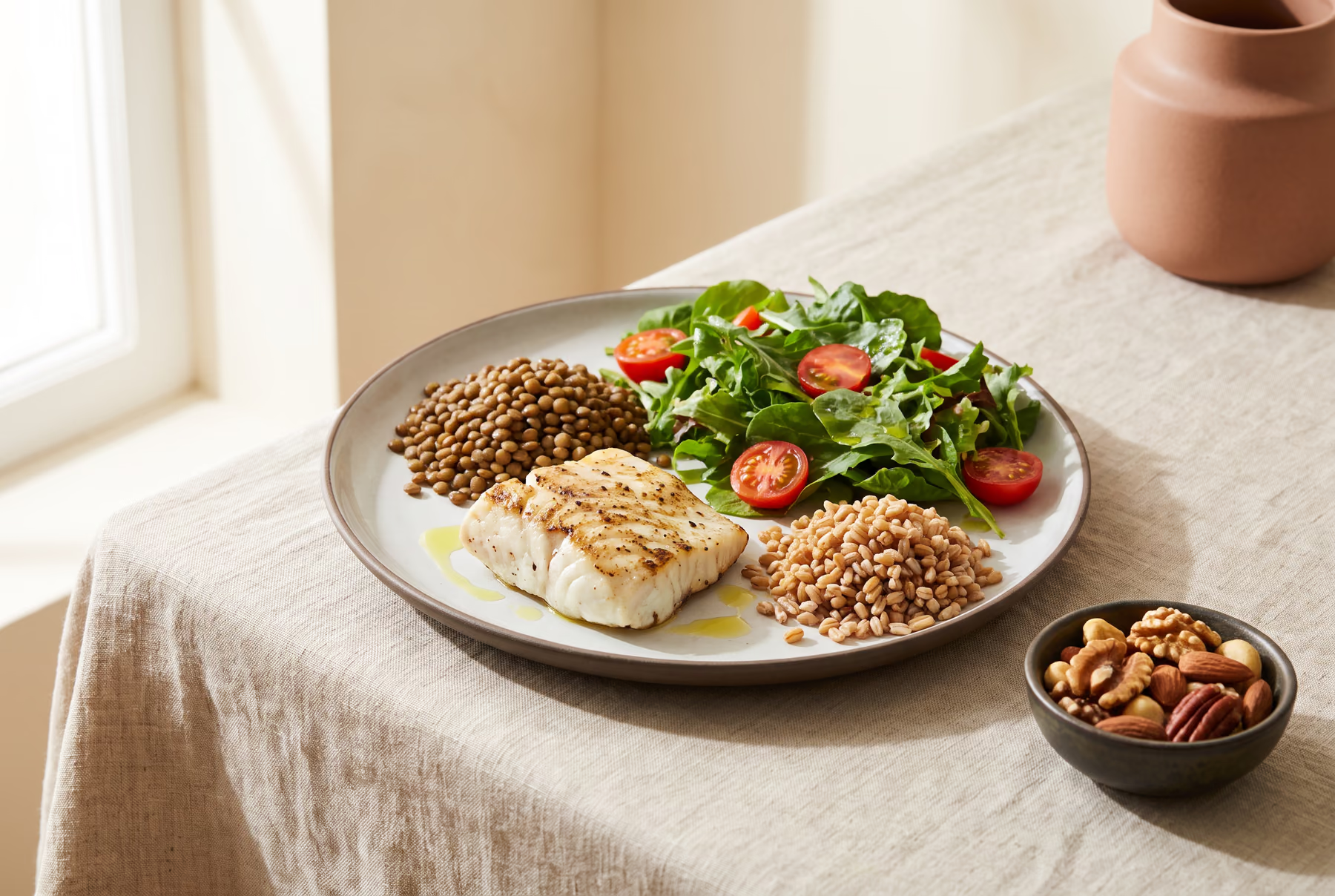
No single diet wins, but patterns built on vegetables, legumes, whole grains, fish and olive oil lowered HbA1c by 0.30 to 0.47 points, and more fibre lowered it by 2.0 mmol/mol. Low-carbohydrate diets lowered it by 0.47 points at 3 months, with the edge gone by 12 months [2] [8] [5].
- Mediterranean pattern. Long-term trials favored it over lower-fat diets by 0.47 points, and four meta-analyses agreed on 0.30 to 0.47 [2]. See the Mediterranean protocol.
- Fibre and whole grains. Raising fibre lowered HbA1c by 2.0 mmol/mol across 33 trials, with the largest gains for people moving from low to moderate intake [8]. The glucose stability protocol sets fibre and carbohydrate targets per meal.
- Low-carbohydrate. Diets under 26% of energy from carbohydrate lowered HbA1c by 0.47 points at 3 months and 0.36 at 6 months, with no difference at 12 or 24 months, likely because adherence drifts [5]. See keto and low-carb, and keep an eye on LDL cholesterol if you follow it.
- Meal timing. In a network meta-analysis of 99 trials, time-restricted eating and other intermittent fasting reduced weight about as well as continuous calorie restriction, with no difference in HbA1c [10]. Time-restricted eating can help if it makes eating less easier for you.
All of these patterns limit sugary drinks and refined starches, which raise glucose quickly.
How much does exercise lower A1c?
Structured exercise lowered HbA1c by 0.73 points for aerobic training, 0.57 for resistance training and 0.51 for both combined, and by 0.89 points when it exceeded 150 minutes a week [3].
The meta-analysis pooled 47 randomized trials of at least 12 weeks in type 2 diabetes. Structured, supervised training worked; physical activity advice alone did not change HbA1c, but advice combined with diet advice lowered it by 0.58 points [3].
Aerobic, resistance and combined training all lowered HbA1c in the pooled trials, so the best choice is the one you will keep doing. AumniVIDA's Zone 2 training protocol tracks steady aerobic volume toward the 150 minute mark.
Does sleep affect A1c?
In people with type 2 diabetes, short sleep was associated with 0.23 points higher HbA1c, long sleep with 0.13 points higher and poor sleep quality with 0.35 points higher than normal sleep [9]. These are associations from observational studies, not trial effects.
The pattern was U-shaped: both too little and too much sleep went with higher HbA1c [9]. The studies cannot show that changing sleep lowers HbA1c, but regular, adequate sleep supports appetite control and activity, which do. The sleep consistency protocol tracks regular bed and wake times.
How fast can you lower A1c?
HbA1c responds within weeks but takes about 3 months to reflect a change fully. After glucose was normalized, HbA1c fell with a half-time of about 35 days [7], and oral drugs showed most of their effect within 4 to 6 months [6].
Because recent weeks weigh most, a real improvement in glucose shows up partly within a month. A test after 2 to 3 weeks mostly reflects the past, though. ADA suggests checking every 3 months after a treatment change or when goals are not met, and at least twice a year otherwise [14].
Claims of lowering A1c in a week or overnight do not match how the marker works. Glucose can change overnight; HbA1c cannot.
When is medication part of lowering A1c?
Medication is the strongest lever once diabetes is diagnosed. Most oral drug classes lower HbA1c by 0.5 to 1.25 points [6], and GLP-1 receptor agonists lower it more, up to 2.10 points for tirzepatide versus placebo [4]. A clinician decides whether and which.
Lifestyle and medication are not alternatives; the trials showing the largest drops usually include both. Metformin also cut progression from prediabetes to diabetes by 31% in the Diabetes Prevention Program, less than the 58% from lifestyle [12]. AumniVIDA does not advise on medication; bring your HbA1c trend to your clinician.
More about HbA1c
- HbA1c: the full guideHbA1c (A1c) is the percentage of hemoglobin in red blood cells that has glucose attached.
- HbA1c chart: normal, prediabetes and diabetes rangesA normal HbA1c is below 5.7% (39 mmol/mol).
- What does a high HbA1c mean?A high HbA1c means more hemoglobin has glucose attached, usually because average glucose has been raised for months.
- HbA1c to average glucose: conversion chartEstimated average glucose (eAG) in mg/dL equals 28.7 x A1c minus 46.7, from the ADAG study of 507 people.
- HbA1c test: fasting, home kits and how oftenThe HbA1c test needs no fasting and is unaffected by a recent meal, stress or exercise.
Protocols that act on HbA1c
- Low-glycemic dietA low-glycemic diet favors carbohydrate foods that raise blood sugar slowly, rated by the glycemic index (GI): 55 or less is low and 70 or more is high.
- Time-restricted eatingTime-restricted eating means eating all of the day's food and caloric drinks within a consistent daily window, usually 6 to 10 hours, and fasting the rest of the day.
- Ketogenic dietA ketogenic diet keeps carbohydrate under about 20 to 50 g a day so the body burns fat and makes ketones, defined in supervised programs as blood BHB of 0.5 to 3.0 mmol/L.
- Mediterranean dietThe Mediterranean diet is an eating pattern built on vegetables, fruit, legumes, whole grains, nuts, fish and olive oil as the main fat, with little red or processed meat, butter or sweets.
Common questions
Can you lower A1c in a week?
No. HbA1c reflects glucose over about 3 months and falls with a half-time of about 35 days after glucose improves [7]. Glucose can improve within days, and A1c follows over the following weeks.
How do you lower A1c naturally?
What foods lower A1c?
Does intermittent fasting lower A1c?
It lowers weight about as well as continuous calorie restriction, and in a 99-trial network meta-analysis it did not lower HbA1c more than other approaches [10].
Can prediabetes be reversed?
Often, yes. In PLIS, 43% of people with prediabetes who lost at least 5% of their weight returned to normal glucose and HbA1c, with 73% lower diabetes risk afterwards [13].
Sources
- 1.Gummesson A, Nyman E, Knutsson M, Karpefors M. Effect of weight reduction on glycated haemoglobin in weight loss trials in patients with type 2 diabetes. Diabetes, Obesity and Metabolism, 2017. doi:10.1111/dom.12971
- 2.Esposito K, Maiorino MI, Bellastella G, Chiodini P, Panagiotakos D, Giugliano D. A journey into a Mediterranean diet and type 2 diabetes: a systematic review with meta-analyses. BMJ Open, 2015. doi:10.1136/bmjopen-2015-008222
- 3.Umpierre D, Ribeiro PA, Kramer CK, et al. Physical activity advice only or structured exercise training and association with HbA1c levels in type 2 diabetes: a systematic review and meta-analysis. JAMA, 2011. doi:10.1001/jama.2011.576
- 4.Yao H, Zhang A, Li D, et al. Comparative effectiveness of GLP-1 receptor agonists on glycaemic control, body weight, and lipid profile for type 2 diabetes: systematic review and network meta-analysis. BMJ, 2024. doi:10.1136/bmj-2023-076410
- 5.Sainsbury E, Kizirian NV, Partridge SR, Gill T, Colagiuri S, Gibson AA. Effect of dietary carbohydrate restriction on glycemic control in adults with diabetes: A systematic review and meta-analysis. Diabetes Research and Clinical Practice, 2018. doi:10.1016/j.diabres.2018.02.026
- 6.Sherifali D, Nerenberg K, Pullenayegum E, Cheng JE, Gerstein HC. The effect of oral antidiabetic agents on A1C levels: a systematic review and meta-analysis. Diabetes Care, 2010. doi:10.2337/dc09-1727
- 7.Tahara Y, Shima K. Kinetics of HbA1c, glycated albumin, and fructosamine and analysis of their weight functions against preceding plasma glucose level. Diabetes Care, 1995. doi:10.2337/diacare.18.4.440
- 8.Reynolds AN, Akerman AP, Mann J. Dietary fibre and whole grains in diabetes management: Systematic review and meta-analyses. PLoS Medicine, 2020. doi:10.1371/journal.pmed.1003053
- 9.Lee SWH, Ng KY, Chin WK. The impact of sleep amount and sleep quality on glycemic control in type 2 diabetes: A systematic review and meta-analysis. Sleep Medicine Reviews, 2017. doi:10.1016/j.smrv.2016.02.001
- 10.Semnani-Azad Z, Khan TA, Chiavaroli L, et al. Intermittent fasting strategies and their effects on body weight and other cardiometabolic risk factors: systematic review and network meta-analysis of randomised clinical trials. BMJ, 2025. doi:10.1136/bmj-2024-082007
- 11.Lean ME, Leslie WS, Barnes AC, et al. Primary care-led weight management for remission of type 2 diabetes (DiRECT): an open-label, cluster-randomised trial. Lancet, 2018. doi:10.1016/S0140-6736(17)33102-1
- 12.Knowler WC, Barrett-Connor E, Fowler SE, et al. Reduction in the incidence of type 2 diabetes with lifestyle intervention or metformin. New England Journal of Medicine, 2002. doi:10.1056/NEJMoa012512
- 13.Sandforth A, von Schwartzenberg RJ, Arreola EV, et al. Mechanisms of weight loss-induced remission in people with prediabetes: a post-hoc analysis of the randomised, controlled, multicentre Prediabetes Lifestyle Intervention Study (PLIS). Lancet Diabetes and Endocrinology, 2023. doi:10.1016/S2213-8587(23)00235-8
- 14.American Diabetes Association Professional Practice Committee for Diabetes. 6. Glycemic Goals, Hypoglycemia, and Hyperglycemic Crises: Standards of Care in Diabetes-2026. Diabetes Care, 2026. doi:10.2337/dc26-S006