
ApoB vs Lp(a): what is the difference?
Updated October 31, 2026 · 10 sources · Written by the AumniVIDA team
UnitsShort answer
ApoB counts every atherogenic particle, Lp(a) included. Lp(a) is one particle type, an LDL-like particle with an extra apo(a) chain, set mostly by genes. Per particle, Lp(a) is about 6 times as atherogenic as LDL. Test Lp(a) once in adulthood; ApoB can be retested as diet and treatment change.
Key takeaways
- 1
Every Lp(a) particle carries one ApoB-100, so ApoB includes Lp(a) [1].
- 2
Lp(a) is about 6.6 times as atherogenic as LDL per particle [2].
- 3
Lp(a) adds risk even after ApoB particle count is accounted for [3].
- 4
Guidelines recommend testing Lp(a) at least once in adulthood; above 50 mg/dL (105 nmol/L) is a risk modifier [4].
What is the difference between ApoB and Lp(a)?
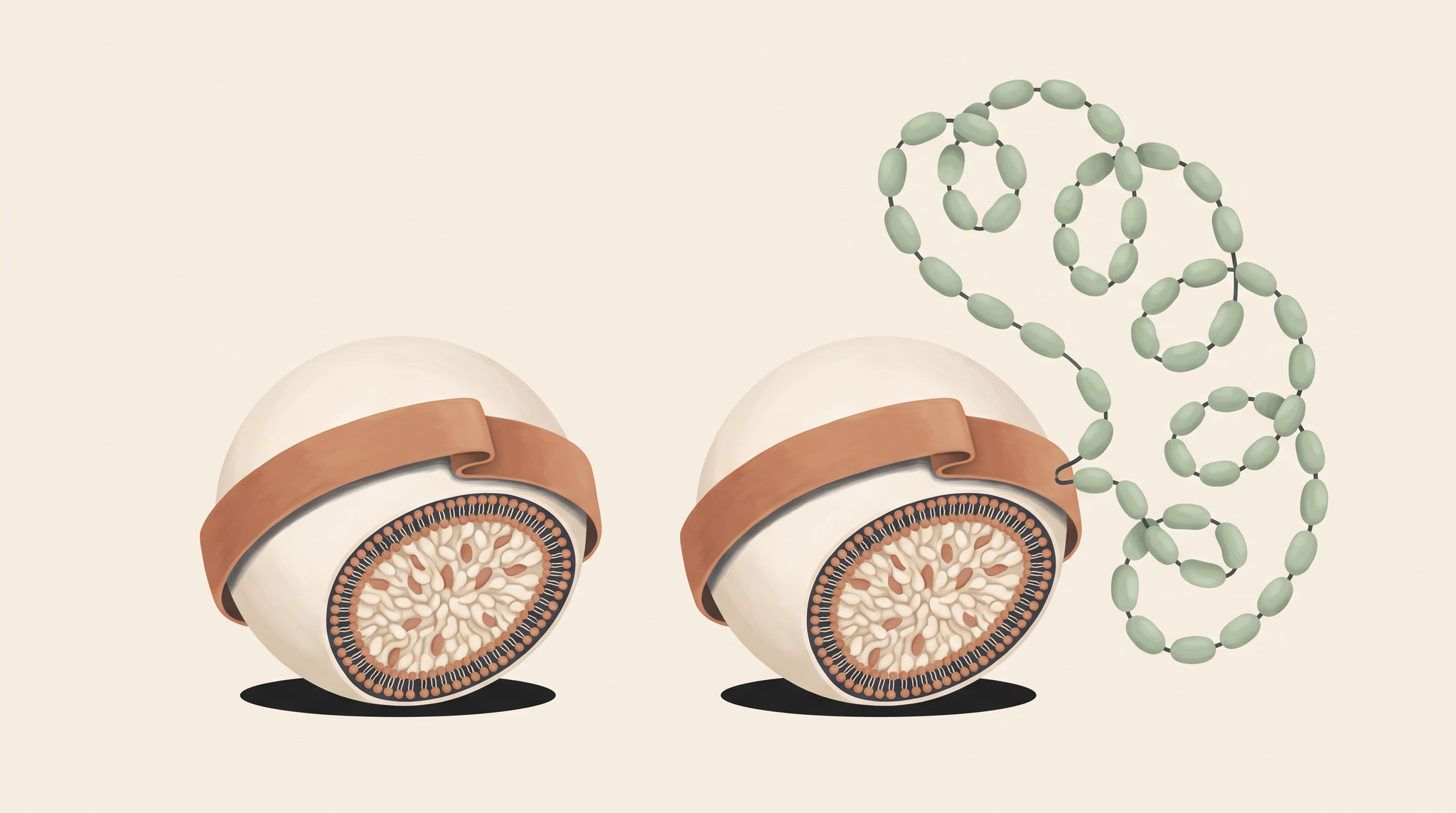
ApoB is a count of all atherogenic particles. Lp(a) is the concentration of one particle type. An Lp(a) particle is an LDL particle whose ApoB-100 is linked to an extra protein, apo(a).
The apo(a) chain may interfere with how the particle binds the LDL receptor and is cleared [5]. Lp(a) levels are measured in mg/dL or nmol/L depending on the assay [2], so the two numbers on your report are not directly comparable.
In practice, the two tests answer different questions. ApoB gives the total number of atherogenic particles, which changes with diet and treatment. Lp(a) gives how many of them are the more harmful inherited type, which changes little over life. Neither result can be worked out from the other.
| Feature | ApoB | Lp(a) |
|---|---|---|
| What it measures | All atherogenic particles | One particle type with apo(a) attached |
| Includes the other? | Yes, counts Lp(a) particles | No |
| Mainly set by | Genes, diet, weight, metabolism, drugs | Genes |
| Changes with diet | Yes, modestly | Little |
| How often to test | Repeat as diet or treatment changes | At least once in adulthood |
| Common cut point | ESC/EAS goals under 65 to 100 mg/dL by risk | Above 50 mg/dL (105 nmol/L) is a risk modifier |
| Units | mg/dL or g/L | mg/dL or nmol/L |
| Atherogenicity per particle | Reference (LDL) | About 6.6 times LDL |
Does an ApoB test include Lp(a)?
Yes. Each Lp(a) particle carries one ApoB-100, so it is counted in your ApoB result. But Lp(a) is usually a small share of particles, so a normal ApoB does not rule out a high Lp(a).
Lp(a)'s ApoB is included in the ApoB value, and its cholesterol is included in total, non-HDL and LDL cholesterol [1]. In UK Biobank, mean ApoB was about 1,870 nmol/L and mean Lp(a) about 45 nmol/L, with a median of 21 nmol/L [2], so Lp(a) is typically a few percent of particles. The routine ApoB test cannot separate it out.
Is Lp(a) more harmful than LDL?
Per particle, yes. A large genetic analysis estimated each Lp(a) particle is about 6.6 times as atherogenic as an LDL particle. Because Lp(a) particles are usually far fewer, total ApoB still carries most lipid risk for most people.
In UK Biobank and CARDIoGRAMplusC4D, the odds ratio for coronary disease per 50 nmol/L higher ApoB was 1.28 when it came from Lp(a) and 1.04 when it came from LDL, giving the 6.6-fold estimate (95% CI 5.1 to 8.8) [2]. A separate analysis found ApoB particle count captured lipid risk regardless of particle type, but Lp(a) still added risk on top, with a hazard ratio of 1.18 [3].
Put together, the numbers explain why both tests matter. For most people, LDL particles are so much more numerous that they carry most of the lipid risk. For the minority with very high Lp(a), the extra risk is large enough that the 2025 ESC/EAS update uses Lp(a) to refine risk in people near a treatment decision [4].
Should you test ApoB and Lp(a)?
Guidelines now recommend Lp(a) at least once in every adult, because it is mostly inherited and stable. ApoB is suggested selectively, mainly with high triglycerides, diabetes, obesity or low LDL-C on treatment.
The 2025 ESC/EAS update recommends Lp(a) at least once in every adult and treats levels above 50 mg/dL (105 nmol/L) as a risk modifier, with a second test reasonable after menopause [4]. It notes that risk begins to rise slightly from about 30 mg/dL (62 nmol/L) [4]. Canada [6] and the 2026 US guideline [7] also recommend a once-in-a-lifetime Lp(a).
ApoB is different. Guidelines suggest it selectively: with triglycerides above 133 mg/dL (1.5 mmol/L)1.5 mmol/L (133 mg/dL) in Canada [6], with diabetes, obesity or very low LDL-C in Europe [8], and for residual risk once LDL-C and non-HDL-C goals are met in the 2026 US guideline [9]. Because ApoB moves with diet and treatment, it is worth repeating; the NLA suggests 4 to 12 weeks after any change in therapy [5]. For ApoB indications in full, see the ApoB test.
When an ApoB test adds the most
Standard lipid panel done. When does adding ApoB help most?
- Triglycerides above 133 mg/dL (1.5 mmol/L)1.5 mmol/L (133 mg/dL), or 200 mg/dL or moreAdd ApoB: Canada (CCS 2021) uses the first cut point, the 2018 AHA/ACC guideline the second
- Diabetes, obesity or metabolic syndromeAdd ApoB: LDL-C may understate particle number (ESC/EAS 2019)
- Very low LDL-C on treatmentAdd ApoB: LDL-C may understate particle number (ESC/EAS 2019)
- LDL-C and non-HDL-C at goal, residual risk suspectedUse ApoB selectively (ACC/AHA 2026)
- Suspected inherited lipid disorder or family screeningAdd ApoB to clarify a possible genetic disorder (NLA 2024)
- Starting or changing lipid-lowering therapyRepeat ApoB 4 to 12 weeks later (NLA 2024)
No fasting needed (EAS/EFLM 2016). Discuss any result, and whether to test at all, with your clinician.
Can you lower Lp(a) the way you lower ApoB?
Not as easily. Diet barely moves Lp(a). PCSK9 inhibitors lower it by roughly a quarter, and drugs designed to lower Lp(a) by more than 85 percent are in development. Lowering total ApoB still reduces overall particle risk.
Evolocumab and alirocumab lowered Lp(a) by 23 to 29 percent on average in their outcome trials [2], and oral PCSK9 inhibitors by about 23 percent in short trials [10]. Agents that lower Lp(a) by more than 85 percent were in clinical development as of 2024 [2]. With high Lp(a), lowering total ApoB and LDL-C is the main lever available today, and targets are a question for your clinician; see how to lower ApoB and the Lp(a) hub.
More about ApoB
- ApoB: the full guideApoB (apolipoprotein B) is the protein on every LDL, VLDL, IDL and Lp(a) particle, one per particle, so a blood ApoB test counts the particles that drive atherosclerosis.
- ApoB test: how to measure it, what it costs and how to prepareAn ApoB test is a standard blood draw that counts atherogenic particles.
- How to lower ApoBMedications lower ApoB the most: PCSK9 inhibitors by 43 to 50 percent, statins by about 33 percent, and bempedoic acid or added ezetimibe by about 14 to 15 percent.
- What does a high ApoB mean?A high ApoB means more cholesterol-carrying particles are circulating, and more can lodge in the artery wall.
- What is a normal ApoB level?The median ApoB in US adults not on lipid drugs is 90 mg/dL (0.90 g/L), and labs flag 100 mg/dL (1.0 g/L) or higher.
- ApoB vs LDL cholesterol: which matters more?ApoB counts all atherogenic particles; LDL cholesterol measures the cholesterol inside LDL particles.
Protocols that act on ApoB
- Outlive and Medicine 3.0 (Peter Attia)Outlive is physician Peter Attia's 2023 book on Medicine 3.0, a prevention-first approach to longevity.
- Mediterranean dietThe Mediterranean diet is an eating pattern built on vegetables, fruit, legumes, whole grains, nuts, fish and olive oil as the main fat, with little red or processed meat, butter or sweets.
- Outlive and Medicine 3.0 (Peter Attia)Outlive is physician Peter Attia's 2023 book on Medicine 3.0, a prevention-first approach to longevity.
- Ketogenic dietA ketogenic diet keeps carbohydrate under about 20 to 50 g a day so the body burns fat and makes ketones, defined in supervised programs as blood BHB of 0.5 to 3.0 mmol/L.
Common questions
Is ApoB the same as Lp(a)?
No. Lp(a) is one kind of ApoB particle. ApoB counts all of them, Lp(a) included [1].
Can I have normal ApoB and high Lp(a)?
Yes. Lp(a) is usually a small share of ApoB particles [2], so a high Lp(a) can hide inside a normal ApoB.
Which is more important, ApoB or Lp(a)?
Both add information. Total ApoB captures most lipid risk, and Lp(a) adds independent risk on top [3].
Sources
- 1.Nordestgaard BG, Langsted A, Mora S, et al. Fasting is not routinely required for determination of a lipid profile: clinical and laboratory implications including flagging at desirable concentration cut-points-a joint consensus statement from the European Atherosclerosis Society and European Federation of Clinical Chemistry and Laboratory Medicine. Eur Heart J, 2016. doi:10.1093/eurheartj/ehw152
- 2.Björnson E, Adiels M, Taskinen MR, et al. Lipoprotein(a) Is Markedly More Atherogenic Than LDL: An Apolipoprotein B-Based Genetic Analysis. J Am Coll Cardiol, 2024. doi:10.1016/j.jacc.2023.10.039
- 3.Morze J, Melloni GEM, Wittenbecher C, et al. ApoB-containing lipoproteins: count, type, size, and risk of coronary artery disease. Eur Heart J, 2025. doi:10.1093/eurheartj/ehaf207
- 4.Mach F, Koskinas KC, Roeters van Lennep JE, et al. 2025 Focused Update of the 2019 ESC/EAS Guidelines for the management of dyslipidaemias. Eur Heart J, 2025. doi:10.1093/eurheartj/ehaf190
- 5.Soffer DE, Marston NA, Maki KC, et al. Role of apolipoprotein B in the clinical management of cardiovascular risk in adults: An Expert Clinical Consensus from the National Lipid Association. J Clin Lipidol, 2024. doi:10.1016/j.jacl.2024.08.013
- 6.Pearson GJ, Thanassoulis G, Anderson TJ, et al. 2021 Canadian Cardiovascular Society Guidelines for the Management of Dyslipidemia for the Prevention of Cardiovascular Disease in Adults. Can J Cardiol, 2021. doi:10.1016/j.cjca.2021.03.016
- 7.Abramov D, Minhas AMK, Shapiro MD, et al. Primary Prevention of Dyslipidemia: 10 Practice-Changing Takeaways from the 2026 ACC/AHA Multisociety Guideline. Curr Atheroscler Rep, 2026. doi:10.1007/s11883-026-01437-9
- 8.Mach F, Baigent C, Catapano AL, et al. 2019 ESC/EAS Guidelines for the management of dyslipidaemias: lipid modification to reduce cardiovascular risk. Eur Heart J, 2020. doi:10.1093/eurheartj/ehz455
- 9.Sabouret P, Mafrica D, Giamundo DM, et al. The 2026 ACC/AHA Dyslipidemia Guideline: A Critical and Transatlantic Perspective on Personalized Lipid Management. Life (Basel), 2026. doi:10.3390/life16091470
- 10.Olmastroni E, Xie S, Galimberti F, et al. Efficacy and Safety of Oral PCSK9 Inhibitors: Insights from a Meta-analysis of RCTS. Eur J Prev Cardiol, 2026. doi:10.1093/eurjpc/zwag273