
What does a high ApoB mean?
Updated October 31, 2026 · 14 sources · Written by the AumniVIDA team
UnitsShort answer
A high ApoB means more cholesterol-carrying particles are circulating, and more can lodge in the artery wall. Labs flag 100 mg/dL (1.0 g/L)1.0 g/L (100 mg/dL) or higher; the AHA/ACC calls 130 mg/dL (1.3 g/L)1.3 g/L (130 mg/dL) a risk enhancer. Common causes are genes, saturated fat, excess weight, insulin resistance and some medications.
Key takeaways
- 1
- 2
- 3
High ApoB with normal LDL-C is common with high triglycerides, obesity and insulin resistance [3].
- 4
High ApoB has no symptoms; it is found only by a blood test.
What does a high ApoB mean for heart risk?
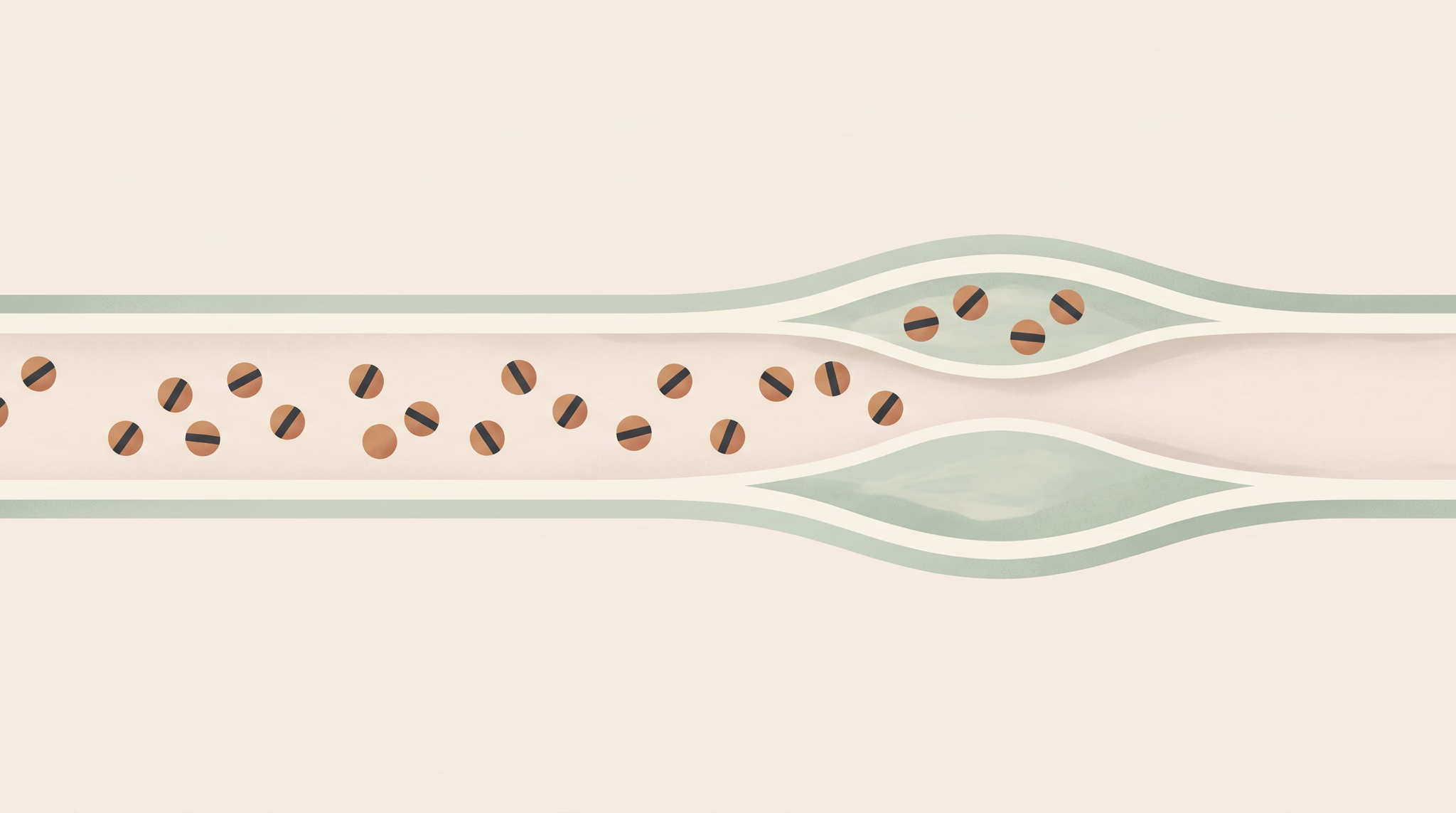
It means a higher count of particles that can enter and stay in the artery wall. Risk rises steadily with ApoB rather than switching on at one number, and it builds with the years of exposure.
In UK Biobank, each standard deviation higher ApoB carried an adjusted hazard ratio of 1.27 for heart attack [1], and each standard deviation higher ApoB particle count a hazard ratio of 1.33 for coronary artery disease [2]. LDL-driven risk rises with both the level and the duration of exposure [5], so a high ApoB at 35 matters more over a lifetime than the same number found at 75.
A high ApoB is one risk factor among several. Your clinician combines it with blood pressure, smoking, diabetes, family history, age and, if done, a coronary calcium score.
The mechanism is simple. Particles cross into the artery wall in proportion to how many are in the blood, and smaller particles bind more readily once inside [6]. More ApoB means more chances for a particle to get stuck, which is how plaque begins.
What ApoB level is considered high?
Labs flag 100 mg/dL (1.0 g/L)1.0 g/L (100 mg/dL) or higher. The AHA/ACC treats 130 mg/dL (1.3 g/L)1.3 g/L (130 mg/dL) or higher as a risk enhancer, and 120 mg/dL (1.2 g/L)1.2 g/L (120 mg/dL) or higher is the cut used to classify inherited high-cholesterol patterns.
- 100 mg/dL (1.0 g/L)1.0 g/L (100 mg/dL). The EAS and EFLM recommend labs flag this as abnormal [7]. It is also the ESC/EAS goal for moderate-risk people [8].
- 120 mg/dL (1.2 g/L)1.2 g/L (120 mg/dL). The NLA uses this cut, with triglycerides, to separate inherited patterns such as familial hypercholesterolemia and familial combined hyperlipidemia from triglyceride-only disorders [3].
- 130 mg/dL (1.3 g/L)1.3 g/L (130 mg/dL). A risk-enhancing factor in the AHA/ACC guideline, equal to LDL-C of about 160 mg/dL [4], and roughly the 90th percentile of US adults not on lipid drugs [3].
If you already have heart disease or diabetes, a much lower number can still be above your goal. See normal ApoB levels for every guideline goal.
ApoB goals and cut points by guideline (mg/dL)
- Very high risk goal met
- 300.3 to 650.65
- Moderate risk goal met
- 650.65 to 1001
- Lab flag
- 1001 to 1301.3
- Risk enhancer
- 1301.3 to 1601.6
- 65 mg/dL0.65 g/L: ESC very high
- 80 mg/dL0.8 g/L: ESC high
- 100 mg/dL1 g/L: ESC moderate
- 130 mg/dL1.3 g/L: AHA/ACC
What causes high ApoB?
The most common causes are inherited lipid disorders, a diet high in saturated fat, excess weight and insulin resistance, kidney, liver or thyroid disease, and medications such as hormone therapy, thiazide diuretics, antiretrovirals and immunosuppressants.
- Genes. Familial hypercholesterolemia, including familial defective ApoB-100 [9], and familial combined hyperlipidemia raise ApoB from birth [3]. Ask your clinician about family screening if relatives had early heart disease.
- Diet. High saturated fat intake raised ApoB in a controlled feeding trial [10]. Ketogenic diets raised ApoB in lean adults [11].
- Weight and metabolism. Obesity, insulin resistance and high triglycerides push particles smaller and more numerous, raising ApoB even when LDL-C looks normal [3]. Related hubs: triglycerides, HbA1c and fasting insulin.
- Other conditions. New kidney, liver or thyroid disease, and worsening blood sugar [3]. An underactive thyroid is worth checking; see TSH.
- Medications. Sex hormone therapy, thiazide diuretics, antiretroviral therapy and immunosuppressive drugs can change lipid levels [3].
What if ApoB is high but LDL cholesterol is normal?
It usually means your LDL particles are smaller and carry less cholesterol each, so LDL-C understates how many there are. Studies find risk follows the ApoB number in this situation.
In statin-treated patients, ApoB above the median with LDL-C below it raised the hazard of heart attack by 49 percent and of death by 21 percent, while the opposite pattern carried no extra risk [12]. The AMORIS authors suggested ApoB may be most useful in people with lipid abnormalities but normal or low LDL-C [13]. The full comparison is on ApoB vs LDL.

What should you do if your ApoB is high?
Share the result with your clinician, who can confirm it, look for causes such as thyroid or kidney disease or a medication, check Lp(a) once, and weigh it against your overall risk. Diet changes help, and medication is an option your clinician can discuss.
Questions worth bringing to the appointment:
- What is my goal or threshold for my risk category? Guidelines differ; see the guideline table.
- Could a medication, thyroid, kidney or liver condition, or blood sugar change explain it [3]?
- Have I had Lp(a) measured? It is recommended once in adulthood [14]. See the Lp(a) hub.
- Would a coronary calcium score or other tests change the plan?
- When should I retest? The NLA suggests 4 to 12 weeks after any change in therapy [3].
Diet levers and medications, ranked by effect, are on how to lower ApoB. Inflammation markers such as hs-CRP can add context to the overall picture.
More about ApoB
- ApoB: the full guideApoB (apolipoprotein B) is the protein on every LDL, VLDL, IDL and Lp(a) particle, one per particle, so a blood ApoB test counts the particles that drive atherosclerosis.
- ApoB test: how to measure it, what it costs and how to prepareAn ApoB test is a standard blood draw that counts atherogenic particles.
- How to lower ApoBMedications lower ApoB the most: PCSK9 inhibitors by 43 to 50 percent, statins by about 33 percent, and bempedoic acid or added ezetimibe by about 14 to 15 percent.
- What is a normal ApoB level?The median ApoB in US adults not on lipid drugs is 90 mg/dL (0.90 g/L), and labs flag 100 mg/dL (1.0 g/L) or higher.
- ApoB vs LDL cholesterol: which matters more?ApoB counts all atherogenic particles; LDL cholesterol measures the cholesterol inside LDL particles.
- ApoB vs Lp(a): what is the difference?ApoB counts every atherogenic particle, Lp(a) included.
Protocols that act on ApoB
- Outlive and Medicine 3.0 (Peter Attia)Outlive is physician Peter Attia's 2023 book on Medicine 3.0, a prevention-first approach to longevity.
- Mediterranean dietThe Mediterranean diet is an eating pattern built on vegetables, fruit, legumes, whole grains, nuts, fish and olive oil as the main fat, with little red or processed meat, butter or sweets.
- Outlive and Medicine 3.0 (Peter Attia)Outlive is physician Peter Attia's 2023 book on Medicine 3.0, a prevention-first approach to longevity.
- Ketogenic dietA ketogenic diet keeps carbohydrate under about 20 to 50 g a day so the body burns fat and makes ketones, defined in supervised programs as blood BHB of 0.5 to 3.0 mmol/L.
Common questions
Does high ApoB cause symptoms?
No. High ApoB causes no symptoms on its own. The plaque it drives can grow for decades before chest pain, a heart attack or a stroke, which is why it is found by blood test.
Is an ApoB of 100 mg/dL high?
Can high ApoB be temporary?
It can change with weight, diet, new illness or new medication [3]. That is why a single high result is usually confirmed and causes are checked before decisions are made.
Is high ApoB with low triglycerides a concern?
With triglycerides under 133 mg/dL and ApoB of 120 mg/dL or more, the NLA classifies the pattern as hypercholesterolemia, the pattern of familial hypercholesterolemia [3]. Your clinician may consider genetic causes.
Sources
- 1.Marston NA, Giugliano RP, Melloni GEM, et al. Association of Apolipoprotein B-Containing Lipoproteins and Risk of Myocardial Infarction in Individuals With and Without Atherosclerosis: Distinguishing Between Particle Concentration, Type, and Content. JAMA Cardiol, 2022. doi:10.1001/jamacardio.2021.5083
- 2.Morze J, Melloni GEM, Wittenbecher C, et al. ApoB-containing lipoproteins: count, type, size, and risk of coronary artery disease. Eur Heart J, 2025. doi:10.1093/eurheartj/ehaf207
- 3.Soffer DE, Marston NA, Maki KC, et al. Role of apolipoprotein B in the clinical management of cardiovascular risk in adults: An Expert Clinical Consensus from the National Lipid Association. J Clin Lipidol, 2024. doi:10.1016/j.jacl.2024.08.013
- 4.Grundy SM, Stone NJ, Bailey AL, et al. 2018 AHA/ACC/AACVPR/AAPA/ABC/ACPM/ADA/AGS/APhA/ASPC/NLA/PCNA Guideline on the Management of Blood Cholesterol: A Report of the American College of Cardiology/American Heart Association Task Force on Clinical Practice Guidelines. Circulation, 2019. doi:10.1161/CIR.0000000000000625
- 5.Ference BA, Ginsberg HN, Graham I, et al. Low-density lipoproteins cause atherosclerotic cardiovascular disease. 1. Evidence from genetic, epidemiologic, and clinical studies. A consensus statement from the European Atherosclerosis Society Consensus Panel. Eur Heart J, 2017. doi:10.1093/eurheartj/ehx144
- 6.Sniderman AD, Thanassoulis G, Glavinovic T, et al. Apolipoprotein B Particles and Cardiovascular Disease: A Narrative Review. JAMA Cardiol, 2019. doi:10.1001/jamacardio.2019.3780
- 7.Nordestgaard BG, Langsted A, Mora S, et al. Fasting is not routinely required for determination of a lipid profile: clinical and laboratory implications including flagging at desirable concentration cut-points-a joint consensus statement from the European Atherosclerosis Society and European Federation of Clinical Chemistry and Laboratory Medicine. Eur Heart J, 2016. doi:10.1093/eurheartj/ehw152
- 8.Mach F, Baigent C, Catapano AL, et al. 2019 ESC/EAS Guidelines for the management of dyslipidaemias: lipid modification to reduce cardiovascular risk. Eur Heart J, 2020. doi:10.1093/eurheartj/ehz455
- 9.Innerarity TL, Weisgraber KH, Arnold KS, et al. Familial defective apolipoprotein B-100: low density lipoproteins with abnormal receptor binding. Proc Natl Acad Sci U S A, 1987. doi:10.1073/pnas.84.19.6919
- 10.Bergeron N, Chiu S, Williams PT, et al. Effects of red meat, white meat, and nonmeat protein sources on atherogenic lipoprotein measures in the context of low compared with high saturated fat intake: a randomized controlled trial. Am J Clin Nutr, 2019. doi:10.1093/ajcn/nqz035
- 11.Joo M, Moon S, Lee YS, et al. Effects of very low-carbohydrate ketogenic diets on lipid profiles in normal-weight (body mass index < 25 kg/m2) adults: a meta-analysis. Nutr Rev, 2023. doi:10.1093/nutrit/nuad017
- 12.Johannesen CDL, Mortensen MB, Langsted A, et al. Apolipoprotein B and Non-HDL Cholesterol Better Reflect Residual Risk Than LDL Cholesterol in Statin-Treated Patients. J Am Coll Cardiol, 2021. doi:10.1016/j.jacc.2021.01.027
- 13.Walldius G, Jungner I, Holme I, et al. High apolipoprotein B, low apolipoprotein A-I, and improvement in the prediction of fatal myocardial infarction (AMORIS study): a prospective study. Lancet, 2001. doi:10.1016/S0140-6736(01)07098-2
- 14.Mach F, Koskinas KC, Roeters van Lennep JE, et al. 2025 Focused Update of the 2019 ESC/EAS Guidelines for the management of dyslipidaemias. Eur Heart J, 2025. doi:10.1093/eurheartj/ehaf190