
How to lower ApoB
Updated October 31, 2026 · 20 sources · Written by the AumniVIDA team
UnitsShort answer
Medications lower ApoB the most: PCSK9 inhibitors by 43 to 50 percent, statins by about 33 percent, and bempedoic acid or added ezetimibe by about 14 to 15 percent. Diet changes each lower it by a few mg/dL: psyllium by 5, walnuts by 4, oat beta-glucan by 3. Cutting saturated fat helps too.
Average ApoB reduction by medication (percent)
- Oral PCSK9 inhibitor (added to usual therapy)49.5 % lower ApoB
Meta-analysis of 5 trials, 8 to 24 weeks, versus placebo (Olmastroni 2026)
- PCSK9 antibody, used alone43.3 % lower ApoB
Monotherapy subgroups of 5 trials (Kyan 2026)
- Statins, all common doses33.1 % lower ApoB
11 studies, 17,035 people (Sniderman 2008)
- High-intensity statin32.8 % lower ApoB
Atorvastatin 40 to 80 mg or rosuvastatin 20 to 40 mg, 49 trials (Kyan 2026)
- Ezetimibe added to a statin15 % lower ApoB
Extra reduction in IMPROVE-IT, as summarized by the National Lipid Association (Soffer 2024)
- Bempedoic acid14.3 % lower ApoB
7 trials, 3,892 people, versus placebo (Masson 2021)
Show the data
| Item | Value (% lower ApoB) | Low | High | Note |
|---|---|---|---|---|
| Oral PCSK9 inhibitor (added to usual therapy) | 49.5 | 44.8 | 54.2 | Meta-analysis of 5 trials, 8 to 24 weeks, versus placebo (Olmastroni 2026) |
| PCSK9 antibody, used alone | 43.3 | Monotherapy subgroups of 5 trials (Kyan 2026) | ||
| Statins, all common doses | 33.1 | 11 studies, 17,035 people (Sniderman 2008) | ||
| High-intensity statin | 32.8 | Atorvastatin 40 to 80 mg or rosuvastatin 20 to 40 mg, 49 trials (Kyan 2026) | ||
| Ezetimibe added to a statin | 15 | Extra reduction in IMPROVE-IT, as summarized by the National Lipid Association (Soffer 2024) | ||
| Bempedoic acid | 14.3 | 12.1 | 16.4 | 7 trials, 3,892 people, versus placebo (Masson 2021) |
Key takeaways
- 1
- 2
Statins lower ApoB by about 33 percent, less than their 42 percent effect on LDL-C [3].
- 3
About 10 g a day of psyllium lowers ApoB by 5 mg/dL (0.05 g/L)0.05 g/L (5 mg/dL), the largest single-food effect in pooled trials [4].
- 4
A high saturated fat diet raised ApoB in a controlled feeding trial compared with a low saturated fat diet [5].
- 5
Ketogenic diets can raise ApoB substantially in lean people, by 35 mg/dL in a small pooled analysis [6].
Which changes lower ApoB the most?
Ranked by average effect in pooled trials: oral PCSK9 inhibitors (about 50 percent), PCSK9 antibodies (43 percent), statins (33 percent), added ezetimibe (15 percent) and bempedoic acid (14 percent). Single diet changes lower ApoB by about 3 to 5 mg/dL each.
The numbers below come from meta-analyses and large trials, so they are averages; individual responses vary.
- Oral PCSK9 inhibitors lowered ApoB by 49.5 percent versus placebo in five trials of people on background therapy [2].
- PCSK9 antibodies used alone lowered ApoB by 43.3 percent, compared with 32.8 percent for high-intensity statins [1].
- Statins across common doses lowered ApoB by 33.1 percent on average [3].
- Ezetimibe added to simvastatin lowered ApoB by a further 15 percent in IMPROVE-IT [7].
- Bempedoic acid lowered ApoB by 14.3 percent versus placebo [8].
- Inclisiran, a twice-yearly injection, lowered LDL-C by about 50 percent in pooled phase 3 trials, with ApoB falling too [9].
To put diet effects on the same scale: at the median US ApoB of 90 mg/dL [7], a 33 percent statin effect is about 30 mg/dL, while psyllium's 5 mg/dL is about 6 percent. Food changes stack, though, and they act on everyone at no prescription cost.
| Lever | Typical dose or change | Average ApoB change | Evidence |
|---|---|---|---|
| Oral PCSK9 inhibitor | Pill, added to usual therapy | -49.5% (95% CI -54.2 to -44.8) | Meta-analysis, 5 trials |
| PCSK9 antibody alone | Injection, without a statin | -43.3% | Meta-analysis, 5 trials |
| Statins | Common doses | -33.1% (LDL-C -42.1%) | Pooled analysis, 11 studies, 17,035 people |
| High-intensity statin | Atorvastatin 40 to 80 mg or rosuvastatin 20 to 40 mg | -32.8% | Meta-analysis, 49 trials |
| Ezetimibe added to a statin | Added to simvastatin | -15% extra | IMPROVE-IT trial |
| Bempedoic acid | 180 mg a day | -14.3% | Meta-analysis, 7 trials, 3,892 people |
| Psyllium | About 10 g a day | -5 mg/dL (-0.05 g/L)-0.05 g/L (-5 mg/dL) | Meta-analysis, 28 trials, 1,924 people |
| Walnuts | Walnut-enriched diet | -3.7 mg/dL | Meta-analysis, 26 trials, 1,059 people |
| Mediterranean diet with virgin olive oil | Versus low-fat diet, 3 months | -2.9 mg/dL | Randomized trial |
| Oat beta-glucan | About 3.5 g a day | -3 mg/dL (-0.03 g/L)-0.03 g/L (-3 mg/dL) | Meta-analysis, 58 trials, 3,974 people |
| Ketogenic diet, normal-weight adults | Very low carbohydrate | +35 mg/dL (+0.35 g/L) | Meta-analysis, 3 trials |
Average ApoB reduction by medication (percent)
- Oral PCSK9 inhibitor (added to usual therapy)49.5 % lower ApoB
Meta-analysis of 5 trials, 8 to 24 weeks, versus placebo (Olmastroni 2026)
- PCSK9 antibody, used alone43.3 % lower ApoB
Monotherapy subgroups of 5 trials (Kyan 2026)
- Statins, all common doses33.1 % lower ApoB
11 studies, 17,035 people (Sniderman 2008)
- High-intensity statin32.8 % lower ApoB
Atorvastatin 40 to 80 mg or rosuvastatin 20 to 40 mg, 49 trials (Kyan 2026)
- Ezetimibe added to a statin15 % lower ApoB
Extra reduction in IMPROVE-IT, as summarized by the National Lipid Association (Soffer 2024)
- Bempedoic acid14.3 % lower ApoB
7 trials, 3,892 people, versus placebo (Masson 2021)
Show the data
| Item | Value (% lower ApoB) | Low | High | Note |
|---|---|---|---|---|
| Oral PCSK9 inhibitor (added to usual therapy) | 49.5 | 44.8 | 54.2 | Meta-analysis of 5 trials, 8 to 24 weeks, versus placebo (Olmastroni 2026) |
| PCSK9 antibody, used alone | 43.3 | Monotherapy subgroups of 5 trials (Kyan 2026) | ||
| Statins, all common doses | 33.1 | 11 studies, 17,035 people (Sniderman 2008) | ||
| High-intensity statin | 32.8 | Atorvastatin 40 to 80 mg or rosuvastatin 20 to 40 mg, 49 trials (Kyan 2026) | ||
| Ezetimibe added to a statin | 15 | Extra reduction in IMPROVE-IT, as summarized by the National Lipid Association (Soffer 2024) | ||
| Bempedoic acid | 14.3 | 12.1 | 16.4 | 7 trials, 3,892 people, versus placebo (Masson 2021) |
Which foods lower ApoB?
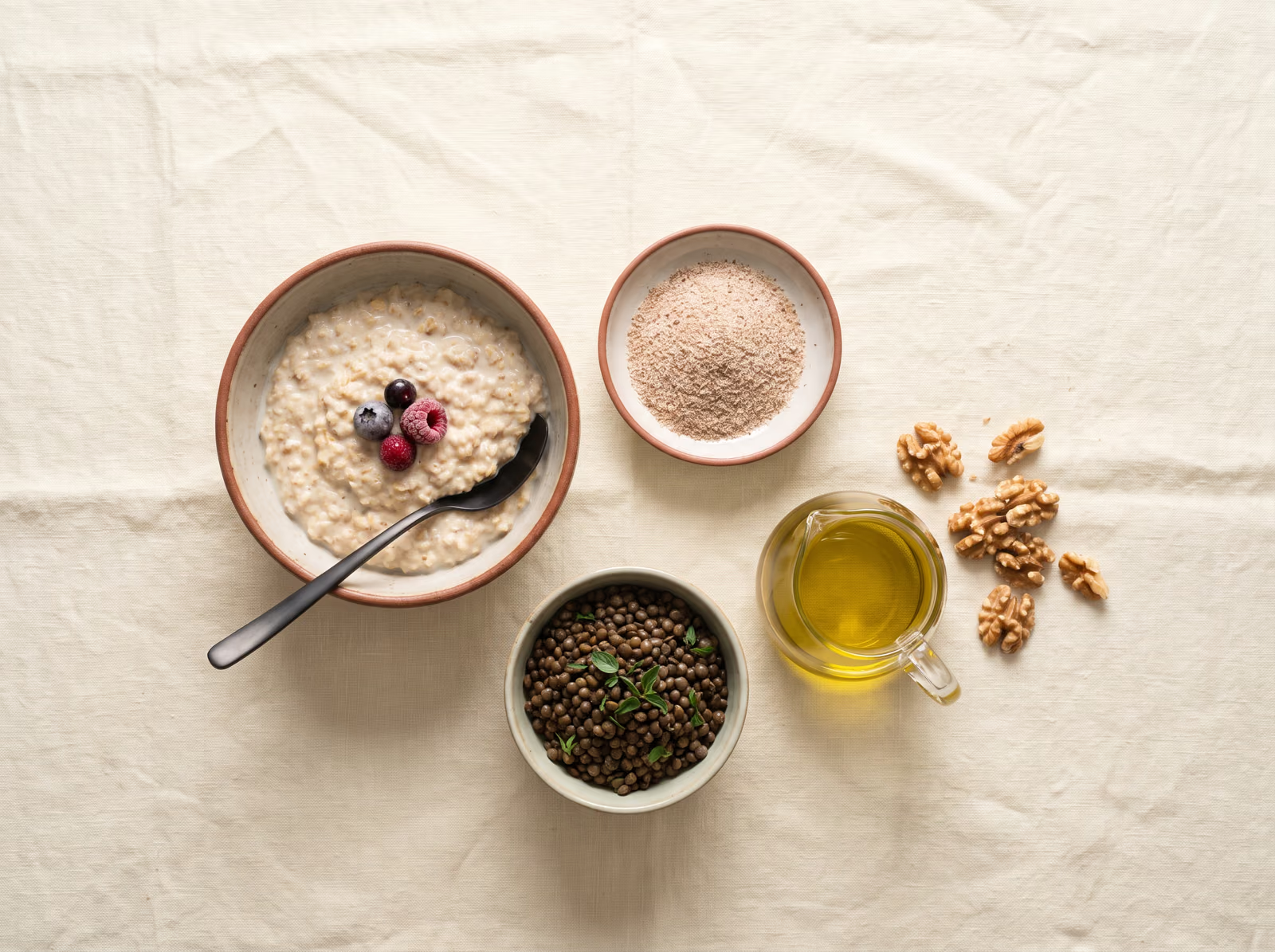
Viscous soluble fiber has the clearest ApoB evidence: psyllium lowers it by about 5 mg/dL and oat beta-glucan by about 3 mg/dL. Walnuts, a Mediterranean diet with virgin olive oil and the combined Portfolio diet also lower it.
- Psyllium. A median of about 10.2 g a day lowered ApoB by 5 mg/dL (0.05 g/L)0.05 g/L (5 mg/dL) across 28 trials, rated high-quality evidence [4].
- Oats. About 3.5 g a day of oat beta-glucan lowered ApoB by 3 mg/dL (0.03 g/L)0.03 g/L (3 mg/dL) across 58 trials [10].
- Walnuts. Walnut-enriched diets lowered ApoB by 3.7 mg/dL across 26 trials [11].
- Mediterranean pattern. A traditional Mediterranean diet with virgin olive oil lowered ApoB by 2.9 mg/dL compared with a low-fat diet over 3 months [12].
- Portfolio diet. Combining nuts, plant protein, viscous fiber and plant sterols lowered LDL-C by about 17 percent and also lowered ApoB [13].
- Beans and lentils alone. About one serving a day lowered LDL-C but did not change ApoB significantly in pooled trials [14], so count them as part of a pattern rather than a standalone fix.
AumniVIDA's longevity focus protocol scores soluble fiber (at least 5 g a day) and saturated fat from your logged meals, and the Mediterranean pattern and whole-food plant-based protocols track the foods above.
Does cutting saturated fat lower ApoB?
Yes. In a controlled feeding trial, a diet high in saturated fat raised ApoB compared with a low saturated fat diet, whatever the protein source. Red and white meat both raised ApoB compared with plant protein.
In a controlled feeding trial, 113 healthy adults ate high or low saturated fat diets with red meat, white meat or plant protein for four weeks each. High saturated fat raised LDL-C and ApoB regardless of protein source, and both red and white meat produced higher ApoB than plant protein [5]. Much of the increase came from large LDL particles.
The practical lever is swapping butter, fatty meat and coconut oil for olive oil, nuts and plant protein, which is also what the Mediterranean trial above tested [12].
What does a keto diet do to ApoB?
In lean people, ketogenic diets often raise ApoB. A pooled analysis of three trials in normal-weight adults found ApoB rose by 35 mg/dL (0.35 g/L)0.35 g/L (35 mg/dL). Responses vary widely from person to person.
The pooled analysis also found LDL-C rose by about 42 mg/dL (1.08 mmol/L)1.08 mmol/L (about 42 mg/dL), with higher HDL-C and no clear change in triglycerides [6]. It included only three trials, so treat the size of the effect as uncertain.
Some low-carb advocates argue that a diet-driven ApoB rise in lean, metabolically healthy people carries less risk. The most cited study for that view, a 2025 paper on plaque progression in people with keto-induced high LDL-C, was retracted in 2026 at the request of the authors and editors over methodological errors [15]. Genetic and trial evidence links ApoB to risk whatever raised it [16].
If you eat low-carb, AumniVIDA's keto and low-carb protocol keeps your lipid trend in view so you and your clinician can see what the diet does for you.
Do supplements lower ApoB?
Psyllium is the supplement with the best ApoB evidence. The 2025 European guideline does not support other supplements without documented safety and LDL-lowering efficacy, and notes that plant sterols lower LDL-C by about 10 percent without outcome data.
The 2025 ESC/EAS focused update says there is no compelling evidence that dietary supplements reduce cardiovascular risk [17]. Its specific points:
- Plant sterols at up to 2 g a day lower LDL-C by about 10 percent, but no study shows fewer heart attacks or strokes [17].
- Red yeast rice can lower cholesterol in purified high-dose forms, but convincing evidence of clinical benefit is missing, and the EU restricted products with 3 mg a day or more of monacolins in 2022 [17].
- Omega-3 fish oil does not lower LDL-C [17].
Psyllium, a fiber supplement, has pooled trial data showing a 5 mg/dL ApoB reduction [4]. Talk to your clinician before combining supplements with prescription lipid drugs.
Which medications lower ApoB?
Statins are the first-line drug and lower ApoB by about a third. Ezetimibe, bempedoic acid, PCSK9 antibodies, inclisiran and the new oral PCSK9 inhibitors add further reductions. Which one fits is a decision for you and your clinician.
- Statins cut cholesterol production in the liver. They lower ApoB by about 33 percent, while LDL-C falls about 42 percent, so ApoB often lags LDL-C on treatment [3].
- Ezetimibe blocks cholesterol absorption in the gut and added about 15 percent ApoB lowering to a statin in IMPROVE-IT, reaching a median ApoB of 67 mg/dL [7].
- Bempedoic acid acts upstream of statins in the liver. It lowered ApoB by about 14 percent [8] and cut major cardiovascular events (hazard ratio 0.87) in the CLEAR Outcomes trial [17].
- PCSK9 antibodies (evolocumab, alirocumab) and inclisiran keep more LDL receptors on liver cells. Antibodies alone lowered ApoB by 43 percent [1]; with a statin, FOURIER patients reached a median ApoB of 38 mg/dL [7]. Inclisiran lowered LDL-C by about 50 percent [9].
- Oral PCSK9 inhibitors are newer and lowered ApoB by about 50 percent in short trials [2].
Canada's guideline uses ApoB of 0.7 g/L or higher on a maximal statin as a threshold to add ezetimibe or a PCSK9 inhibitor in people with heart disease [18]. For what your number means, see what a high ApoB means.
How does Peter Attia approach lowering ApoB?
Physician and podcaster Peter Attia argues for treating early and aggressively. He has said he sees little reason for anyone to have ApoB above about 60 mg/dL and would like most people below the 5th percentile, which usually takes medication as well as diet.
In a clip from his podcast The Drive, Attia describes lowering ApoB well below guideline goals, combining a statin and a PCSK9 inhibitor in his own case, and starting earlier in life. His reasoning leans on genetic evidence that lifelong lower LDL tracks lower risk [19]. Guidelines are more conservative: the lowest ApoB goal in the ESC/EAS guideline is under 65 mg/dL, and only for very high risk [20].
AumniVIDA's Attia-style longevity protocol is community-compiled from his published frameworks; he has not reviewed or endorsed it. His summary is in the perspectives section of the ApoB hub.
More about ApoB
- ApoB: the full guideApoB (apolipoprotein B) is the protein on every LDL, VLDL, IDL and Lp(a) particle, one per particle, so a blood ApoB test counts the particles that drive atherosclerosis.
- ApoB test: how to measure it, what it costs and how to prepareAn ApoB test is a standard blood draw that counts atherogenic particles.
- What does a high ApoB mean?A high ApoB means more cholesterol-carrying particles are circulating, and more can lodge in the artery wall.
- What is a normal ApoB level?The median ApoB in US adults not on lipid drugs is 90 mg/dL (0.90 g/L), and labs flag 100 mg/dL (1.0 g/L) or higher.
- ApoB vs LDL cholesterol: which matters more?ApoB counts all atherogenic particles; LDL cholesterol measures the cholesterol inside LDL particles.
- ApoB vs Lp(a): what is the difference?ApoB counts every atherogenic particle, Lp(a) included.
Protocols that act on ApoB
- Outlive and Medicine 3.0 (Peter Attia)Outlive is physician Peter Attia's 2023 book on Medicine 3.0, a prevention-first approach to longevity.
- Mediterranean dietThe Mediterranean diet is an eating pattern built on vegetables, fruit, legumes, whole grains, nuts, fish and olive oil as the main fat, with little red or processed meat, butter or sweets.
- Outlive and Medicine 3.0 (Peter Attia)Outlive is physician Peter Attia's 2023 book on Medicine 3.0, a prevention-first approach to longevity.
- Ketogenic dietA ketogenic diet keeps carbohydrate under about 20 to 50 g a day so the body burns fat and makes ketones, defined in supervised programs as blood BHB of 0.5 to 3.0 mmol/L.
Common questions
How fast can ApoB drop?
Can you lower ApoB naturally without drugs?
What is the best statin for ApoB?
High-intensity statins (atorvastatin 40 to 80 mg or rosuvastatin 20 to 40 mg) lowered ApoB by about 33 percent in pooled trials [1]. Your clinician chooses the drug and dose based on your risk and tolerance.
Does exercise lower ApoB?
We did not find pooled trial data on exercise and ApoB strong enough to quote a number, so it is not in the ranking above. Exercise still improves other parts of cardiovascular risk, and the Zone 2 training protocol tracks it.
Does ezetimibe lower ApoB?
Yes. Added to a statin in IMPROVE-IT, it lowered ApoB by a further 15 percent [7].
Sources
- 1.Kyan K, Gornbein J, Saver J. The lipid lowering efficacy of PCSK9 inhibitors alone vs. statins alone: a meta-analysis. Front Cardiovasc Med, 2026. doi:10.3389/fcvm.2026.1769430
- 2.Olmastroni E, Xie S, Galimberti F, et al. Efficacy and Safety of Oral PCSK9 Inhibitors: Insights from a Meta-analysis of RCTS. Eur J Prev Cardiol, 2026. doi:10.1093/eurjpc/zwag273
- 3.Sniderman AD. Differential response of cholesterol and particle measures of atherogenic lipoproteins to LDL-lowering therapy: implications for clinical practice. J Clin Lipidol, 2008. doi:10.1016/j.jacl.2007.12.006
- 4.Jovanovski E, Yashpal S, Komishon A, et al. Effect of psyllium (Plantago ovata) fiber on LDL cholesterol and alternative lipid targets, non-HDL cholesterol and apolipoprotein B: a systematic review and meta-analysis of randomized controlled trials. Am J Clin Nutr, 2018. doi:10.1093/ajcn/nqy115
- 5.Bergeron N, Chiu S, Williams PT, et al. Effects of red meat, white meat, and nonmeat protein sources on atherogenic lipoprotein measures in the context of low compared with high saturated fat intake: a randomized controlled trial. Am J Clin Nutr, 2019. doi:10.1093/ajcn/nqz035
- 6.Joo M, Moon S, Lee YS, et al. Effects of very low-carbohydrate ketogenic diets on lipid profiles in normal-weight (body mass index < 25 kg/m2) adults: a meta-analysis. Nutr Rev, 2023. doi:10.1093/nutrit/nuad017
- 7.Soffer DE, Marston NA, Maki KC, et al. Role of apolipoprotein B in the clinical management of cardiovascular risk in adults: An Expert Clinical Consensus from the National Lipid Association. J Clin Lipidol, 2024. doi:10.1016/j.jacl.2024.08.013
- 8.Masson W, Lobo M, Lavalle-Cobo A, et al. Effect of Bempedoic Acid on atherogenic lipids and inflammation: A meta-analysis. Clin Investig Arterioscler, 2021. doi:10.1016/j.arteri.2020.09.002
- 9.Landmesser U, Ray KK, Raal FJ, et al. Inclisiran in Patients with CKD: Post Hoc Pooled Analysis of Three Phase 3 Trials. J Am Soc Nephrol, 2026. doi:10.1681/ASN.0000001006
- 10.Ho HV, Sievenpiper JL, Zurbau A, et al. The effect of oat β-glucan on LDL-cholesterol, non-HDL-cholesterol and apoB for CVD risk reduction: a systematic review and meta-analysis of randomised-controlled trials. Br J Nutr, 2016. doi:10.1017/S000711451600341X
- 11.Guasch-Ferré M, Li J, Hu FB, et al. Effects of walnut consumption on blood lipids and other cardiovascular risk factors: an updated meta-analysis and systematic review of controlled trials. Am J Clin Nutr, 2018. doi:10.1093/ajcn/nqy091
- 12.Solá R, Fitó M, Estruch R, et al. Effect of a traditional Mediterranean diet on apolipoproteins B, A-I, and their ratio: a randomized, controlled trial. Atherosclerosis, 2011. doi:10.1016/j.atherosclerosis.2011.04.026
- 13.Chiavaroli L, Nishi SK, Khan TA, et al. Portfolio Dietary Pattern and Cardiovascular Disease: A Systematic Review and Meta-analysis of Controlled Trials. Prog Cardiovasc Dis, 2018. doi:10.1016/j.pcad.2018.05.004
- 14.Ha V, Sievenpiper JL, de Souza RJ, et al. Effect of dietary pulse intake on established therapeutic lipid targets for cardiovascular risk reduction: a systematic review and meta-analysis of randomized controlled trials. CMAJ, 2014. doi:10.1503/cmaj.131727
- 15.Soto-Mota A, Norwitz NG, Manubolu VS, et al. Retraction: Longitudinal Data from the KETO-CTA Study: Plaque Predicts Plaque, ApoB Does Not. JACC Adv, 2026. doi:10.1016/j.jacadv.2026.102824
- 16.Ference BA, Kastelein JJP, Ray KK, et al. Association of Triglyceride-Lowering LPL Variants and LDL-C-Lowering LDLR Variants With Risk of Coronary Heart Disease. JAMA, 2019. doi:10.1001/jama.2018.20045
- 17.Mach F, Koskinas KC, Roeters van Lennep JE, et al. 2025 Focused Update of the 2019 ESC/EAS Guidelines for the management of dyslipidaemias. Eur Heart J, 2025. doi:10.1093/eurheartj/ehaf190
- 18.Pearson GJ, Thanassoulis G, Anderson TJ, et al. 2021 Canadian Cardiovascular Society Guidelines for the Management of Dyslipidemia for the Prevention of Cardiovascular Disease in Adults. Can J Cardiol, 2021. doi:10.1016/j.cjca.2021.03.016
- 19.Ference BA, Ginsberg HN, Graham I, et al. Low-density lipoproteins cause atherosclerotic cardiovascular disease. 1. Evidence from genetic, epidemiologic, and clinical studies. A consensus statement from the European Atherosclerosis Society Consensus Panel. Eur Heart J, 2017. doi:10.1093/eurheartj/ehx144
- 20.Mach F, Baigent C, Catapano AL, et al. 2019 ESC/EAS Guidelines for the management of dyslipidaemias: lipid modification to reduce cardiovascular risk. Eur Heart J, 2020. doi:10.1093/eurheartj/ehz455