
Foods that lower LDL cholesterol, and foods that raise it
Updated October 31, 2026 · 16 sources · Written by the AumniVIDA team
UnitsShort answer
Oats, barley, beans, lentils, nuts, soy foods and foods with added plant sterols lower LDL cholesterol, each by about 3% to 12%. Combined in the Portfolio diet they lowered LDL by 13% to 29%. Foods high in saturated fat raise it most; unfiltered coffee and, to a smaller degree, egg yolks raise it too.
Key takeaways
- 1
The Portfolio diet of sterols, soy, viscous fiber and nuts lowered LDL-C by 28.6% with food provided [1].
- 2
- 3
Saturated fat is the dietary factor that raises LDL-C most [5].
- 4
Unfiltered coffee raises LDL-C; filtered coffee barely does [6].
- 5
Eggs raise LDL-C modestly; overall eating pattern matters more than any single food [7].
What is the Portfolio diet for LDL cholesterol?
The Portfolio diet combines four cholesterol-lowering foods: plant sterols, soy protein, viscous fiber and nuts, within a diet low in saturated fat. It lowered LDL-C by 28.6% with food provided and about 13% with advice alone.
David Jenkins and colleagues at the University of Toronto designed it to stack small effects. In the 2003 trial, participants ate per 1,000 kcal about 1.0 g plant sterols, 21.4 g soy protein, 9.8 g viscous fiber and 14 g almonds [1]. After a month LDL-C fell by 28.6% on the diet, 30.9% on lovastatin 20 mg and 8.0% on a low saturated fat control diet.
In daily life the result was smaller. Across four Canadian centers, six months of advice lowered LDL-C by 13.1% to 13.8%, against 3.0% for standard advice, and people who stuck to it more closely saw larger drops [8].
The whole-food plant-based and Mediterranean diet protocols cover most Portfolio foods.
Which foods lower LDL cholesterol?
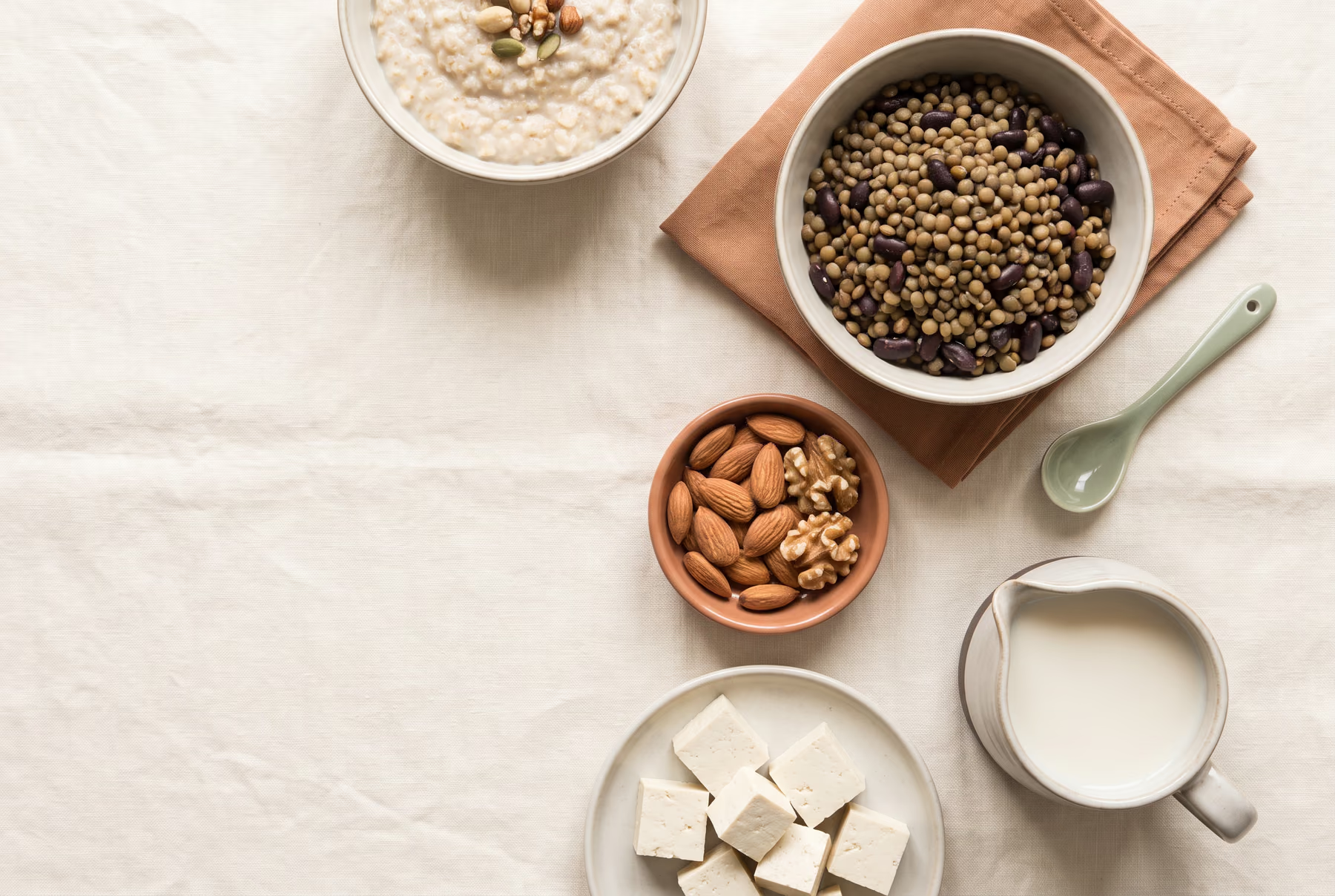
Foods with the strongest evidence are oats and barley, beans and lentils, nuts, soy foods and foods fortified with plant sterols. Each lowers LDL-C a little, and their effects add together.
- Oats and barley. Their beta-glucan is a viscous soluble fiber. A median 3.5 g a day lowered LDL-C by about 7 mg/dL (0.19 mmol/L)0.19 mmol/L (about 7 mg/dL) [2]. About three servings of oatmeal provide 3 g of soluble fiber [9].
- Beans, lentils, chickpeas and peas. About one serving (130 g) a day lowered LDL-C by about 7 mg/dL (0.17 mmol/L)0.17 mmol/L (about 7 mg/dL) [3].
- Nuts. 67 g a day lowered LDL-C by 10.2 mg/dL (7.4%), with similar effects across nut types [4].
- Soy foods. About 25 g of soy protein a day from foods such as tofu and soy milk lowered LDL-C by 3% to 4% [10].
- Plant sterols and stanols. Fortified spreads, yogurt drinks or capsules giving 0.6 to 3.3 g a day lowered LDL-C by 6% to 12% [11].
- Liquid vegetable oils. Olive, canola and sunflower oil in place of butter lower LDL by replacing saturated fat [12].
| Food | Amount studied | LDL-C change | Source |
|---|---|---|---|
| Oat beta-glucan | 3.5 g a day | 7 mg/dL (0.19 mmol/L)0.19 mmol/L (7 mg/dL) lower | Ho 2016 |
| Beans and lentils | 130 g a day | 7 mg/dL (0.17 mmol/L)0.17 mmol/L (7 mg/dL) lower | Ha 2014 |
| Nuts | 67 g a day | 10.2 mg/dL (0.26 mmol/L)0.26 mmol/L (10.2 mg/dL) lower | Sabate 2010 |
| Soy protein | 25 g a day | 4.8 mg/dL (0.12 mmol/L)0.12 mmol/L (4.8 mg/dL) lower | Blanco Mejia 2019 |
| Plant sterols | 0.6 to 3.3 g a day | 6% to 12% lower | Ras 2014 |
| Saturated fat swapped for carbohydrate | 10% of calories | 14 mg/dL (0.36 mmol/L)0.36 mmol/L (14 mg/dL) lower | Clarke 1997 |
| Dietary cholesterol added | Varied by trial | 6.7 mg/dL (0.17 mmol/L)0.17 mmol/L (6.7 mg/dL) higher | Berger 2015 |
| Coffee, mostly unfiltered | About 45 days | 5.4 mg/dL (0.14 mmol/L)0.14 mmol/L (5.4 mg/dL) higher | Cai 2012 |
Which foods raise LDL cholesterol?
Foods high in saturated fat raise LDL-C the most: fatty and processed meat, butter, cheese, cream, and coconut and palm oil. Dietary cholesterol from egg yolks and organ meats, and unfiltered coffee, raise it to a smaller degree.
In metabolic ward studies, saturated fat was the main dietary driver of LDL-C. Replacing 10% of calories from saturated fat with complex carbohydrate lowered LDL-C by about 14 mg/dL (0.36 mmol/L)0.36 mmol/L (about 14 mg/dL); polyunsaturated fat in place of carbohydrate lowered it a little more [5].
What replaces saturated fat matters for risk too. Unsaturated fats improve the total to HDL ratio, while refined carbohydrates do not [12]. Over at least two years, cutting saturated fat reduced combined cardiovascular events by 21% [13].
The keto and carnivore protocols are high in saturated fat by design, which is why they recommend checking LDL after the switch.
Do eggs raise LDL cholesterol?
A little. In trials, adding dietary cholesterol raised LDL-C by about 6.7 mg/dL (0.17 mmol/L)0.17 mmol/L (6.7 mg/dL) on average, and egg yolks are a main source. Cohort studies have not shown a clear link between dietary cholesterol and heart disease.
A 2015 meta-analysis found dietary cholesterol raised LDL-C by 6.7 mg/dL in 14 trials, with heterogeneous results [14]. Avoiding 200 mg a day of dietary cholesterol lowered LDL-C by about 4 mg/dL (0.10 mmol/L)0.10 mmol/L (about 4 mg/dL) in metabolic ward studies [5].
The American Heart Association advises focusing on eating patterns, such as Mediterranean or DASH, that are naturally modest in cholesterol rather than counting eggs [7]. Responses vary between people, so your own repeated panels are the best guide.
Does coffee raise LDL cholesterol?
Unfiltered coffee does. French press, boiled, Turkish and similar coffees raise LDL-C, while paper-filtered coffee causes very little rise. In trials coffee raised LDL-C by 5.4 mg/dL (0.14 mmol/L)0.14 mmol/L (5.4 mg/dL) on average.
Coffee beans contain oils that raise cholesterol, and a paper filter traps most of them. A meta-analysis of 14 trials found that unfiltered and boiled coffee raised total and LDL cholesterol in a dose-dependent way, while filtered coffee barely did [6]. A later meta-analysis of 12 trials found an average LDL-C rise of 5.4 mg/dL over about 45 days, larger with unfiltered coffee and in people with high cholesterol [15].
The trials we cite did not report espresso separately.
Does alcohol lower LDL cholesterol?
No. Alcohol raises HDL cholesterol, but it is not an LDL-lowering food. A meta-analysis of interventional studies found higher HDL with alcohol and did not list LDL among the markers it improved.
In 44 studies, alcohol raised HDL cholesterol by about 3.6 mg/dL (0.094 mmol/L)0.094 mmol/L (3.6 mg/dL) and lowered fibrinogen, but did not change triglycerides [16]. Raising HDL has not proven to protect the heart on its own, and alcohol has other harms.
If you are trying to lower LDL, alcohol does not help. For its effect on other blood fats, see the triglycerides hub.
More about LDL cholesterol
- LDL cholesterol: the full guideLDL cholesterol (LDL-C) is the cholesterol carried inside low-density lipoprotein particles, the main particles that deliver cholesterol to tissues and lodge in artery walls.
- How to lower LDL cholesterolSwap saturated fat for unsaturated fat, add soluble fiber, nuts, soy and plant sterols, and lose excess weight; together these foods lowered LDL cholesterol by 13% to 29% in Portfolio diet trials.
- What is a normal LDL cholesterol level?For adults, LDL cholesterol below 100 mg/dL (2.6 mmol/L) is optimal, 130 to 159 mg/dL (3.4 to 4.1 mmol/L) is borderline high and 190 mg/dL (4.9 mmol/L) or more is very high.
- What does high LDL cholesterol mean?High LDL cholesterol means more cholesterol-carrying particles are circulating that can enter and stay in artery walls, which raises the risk of heart attack and stroke over time.
- Can LDL cholesterol be too low?Trials have not found a level where LDL cholesterol becomes too low.
Protocols that act on LDL cholesterol
- Outlive and Medicine 3.0 (Peter Attia)Outlive is physician Peter Attia's 2023 book on Medicine 3.0, a prevention-first approach to longevity.
- Mediterranean dietThe Mediterranean diet is an eating pattern built on vegetables, fruit, legumes, whole grains, nuts, fish and olive oil as the main fat, with little red or processed meat, butter or sweets.
- Ketogenic dietA ketogenic diet keeps carbohydrate under about 20 to 50 g a day so the body burns fat and makes ketones, defined in supervised programs as blood BHB of 0.5 to 3.0 mmol/L.
- Carnivore dietThe carnivore diet is an animal-foods-only pattern of meat, fish, eggs and animal fat, often under 20 g of carbohydrate a day.
- Plant-based and vegan dietsA plant-based diet gets most or all of its food from plants: vegan diets exclude all animal foods, vegetarian diets exclude meat and fish.
Common questions
What breakfast lowers LDL cholesterol?
Does yogurt lower LDL cholesterol?
Plain yogurt is not a proven LDL-lowering food, but yogurt drinks fortified with plant sterols are. Sterols at 0.6 to 3.3 g a day lowered LDL-C by 6% to 12% [11].
Is espresso bad for LDL cholesterol?
Unfiltered coffee raises LDL-C more than filtered coffee [6]. Espresso was not reported separately in the meta-analyses we checked.
How many eggs a day are safe for LDL cholesterol?
Is red wine good for cholesterol?
Alcohol raises HDL slightly but does not lower LDL [16]. It is not a cholesterol treatment.
Sources
- 1.Jenkins DJ, Kendall CW, Marchie A, et al. Effects of a dietary portfolio of cholesterol-lowering foods vs lovastatin on serum lipids and C-reactive protein. JAMA, 2003. doi:10.1001/jama.290.4.502
- 2.Ho HV, Sievenpiper JL, Zurbau A, et al. The effect of oat beta-glucan on LDL-cholesterol, non-HDL-cholesterol and apoB for CVD risk reduction: a systematic review and meta-analysis of randomised-controlled trials. Br J Nutr, 2016. doi:10.1017/S000711451600341X
- 3.Ha V, Sievenpiper JL, de Souza RJ, et al. Effect of dietary pulse intake on established therapeutic lipid targets for cardiovascular risk reduction: a systematic review and meta-analysis of randomized controlled trials. CMAJ, 2014. doi:10.1503/cmaj.131727
- 4.Sabate J, Oda K, Ros E. Nut consumption and blood lipid levels: a pooled analysis of 25 intervention trials. Arch Intern Med, 2010. doi:10.1001/archinternmed.2010.79
- 5.Clarke R, Frost C, Collins R, Appleby P, Peto R. Dietary lipids and blood cholesterol: quantitative meta-analysis of metabolic ward studies. BMJ, 1997. doi:10.1136/bmj.314.7074.112
- 6.Jee SH, He J, Appel LJ, et al. Coffee consumption and serum lipids: a meta-analysis of randomized controlled clinical trials. Am J Epidemiol, 2001. doi:10.1093/aje/153.4.353
- 7.Carson JAS, Lichtenstein AH, Anderson CAM, et al. Dietary Cholesterol and Cardiovascular Risk: A Science Advisory From the American Heart Association. Circulation, 2020. doi:10.1161/CIR.0000000000000743
- 8.Jenkins DJ, Jones PJ, Lamarche B, et al. Effect of a dietary portfolio of cholesterol-lowering foods given at 2 levels of intensity of dietary advice on serum lipids in hyperlipidemia: a randomized controlled trial. JAMA, 2011. doi:10.1001/jama.2011.1202
- 9.Brown L, Rosner B, Willett WW, Sacks FM. Cholesterol-lowering effects of dietary fiber: a meta-analysis. Am J Clin Nutr, 1999. doi:10.1093/ajcn/69.1.30
- 10.Blanco Mejia S, Messina M, Li SS, et al. A Meta-Analysis of 46 Studies Identified by the FDA Demonstrates that Soy Protein Decreases Circulating LDL and Total Cholesterol Concentrations in Adults. J Nutr, 2019. doi:10.1093/jn/nxz020
- 11.Ras RT, Geleijnse JM, Trautwein EA. LDL-cholesterol-lowering effect of plant sterols and stanols across different dose ranges: a meta-analysis of randomised controlled studies. Br J Nutr, 2014. doi:10.1017/S0007114514000750
- 12.Mensink RP, Zock PL, Kester AD, Katan MB. Effects of dietary fatty acids and carbohydrates on the ratio of serum total to HDL cholesterol and on serum lipids and apolipoproteins: a meta-analysis of 60 controlled trials. Am J Clin Nutr, 2003. doi:10.1093/ajcn/77.5.1146
- 13.Hooper L, Martin N, Jimoh OF, et al. Reduction in saturated fat intake for cardiovascular disease. Cochrane Database Syst Rev, 2020. doi:10.1002/14651858.CD011737.pub2
- 14.Berger S, Raman G, Vishwanathan R, Jacques PF, Johnson EJ. Dietary cholesterol and cardiovascular disease: a systematic review and meta-analysis. Am J Clin Nutr, 2015. doi:10.3945/ajcn.114.100305
- 15.Cai L, Ma D, Zhang Y, Liu Z, Wang P. The effect of coffee consumption on serum lipids: a meta-analysis of randomized controlled trials. Eur J Clin Nutr, 2012. doi:10.1038/ejcn.2012.68
- 16.Brien SE, Ronksley PE, Turner BJ, Mukamal KJ, Ghali WA. Effect of alcohol consumption on biological markers associated with risk of coronary heart disease: systematic review and meta-analysis of interventional studies. BMJ, 2011. doi:10.1136/bmj.d636