
What does high LDL cholesterol mean?
Updated October 31, 2026 · 15 sources · Written by the AumniVIDA team
UnitsShort answer
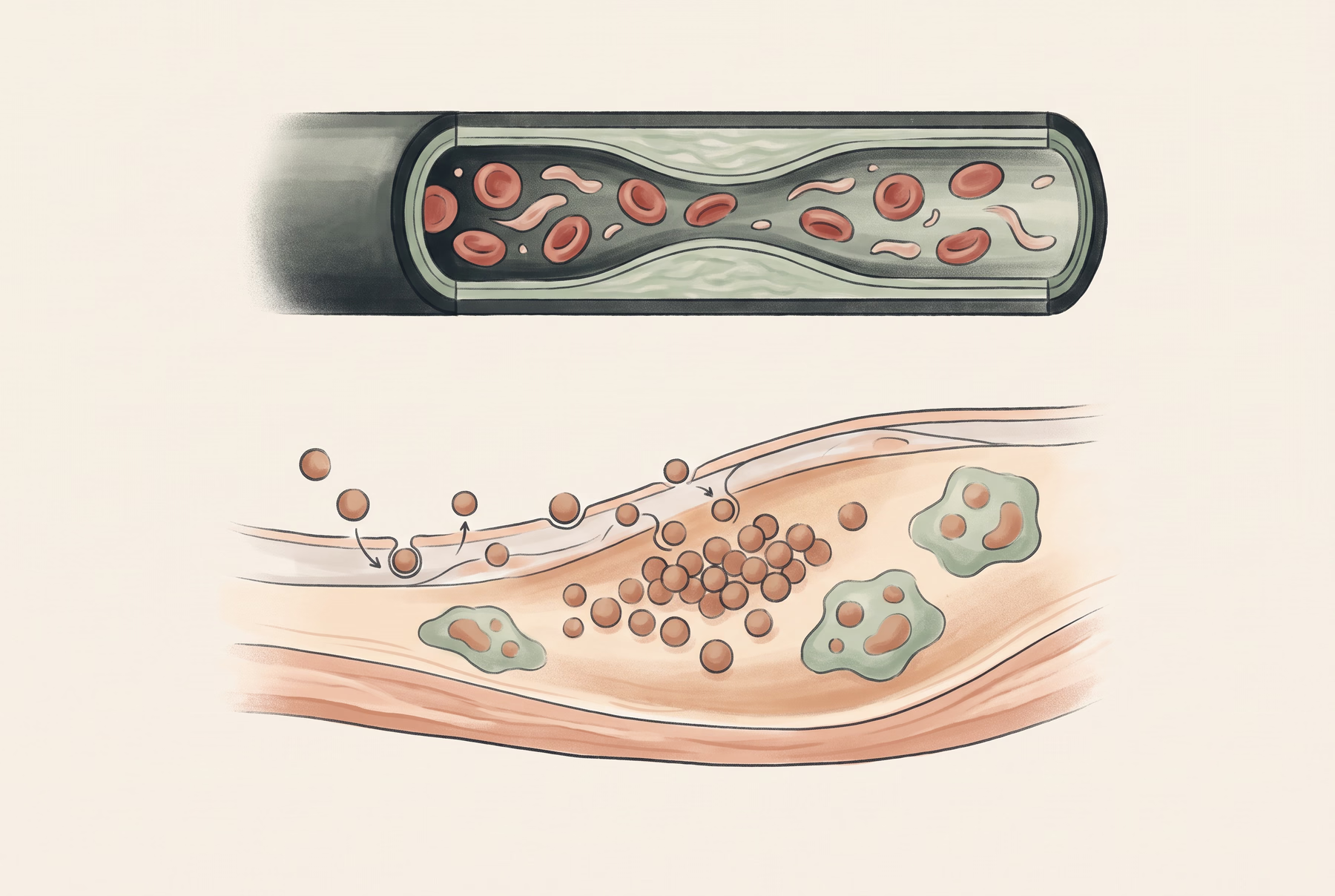
High LDL cholesterol means more cholesterol-carrying particles are circulating that can enter and stay in artery walls, which raises the risk of heart attack and stroke over time. It causes no symptoms. Values of 160 mg/dL (4.1 mmol/L)4.1 mmol/L (160 mg/dL) or more are high and 190 mg/dL (4.9 mmol/L)4.9 mmol/L (190 mg/dL) or more suggests a possible inherited cause.
Key takeaways
- 1
Higher LDL-C raises cardiovascular risk in a dose-dependent way, and longer exposure adds to it [1].
- 2
High LDL has no symptoms; very high inherited levels can cause tendon xanthomas [2].
- 3
About 1 in 14 people with LDL-C of 190 mg/dL (4.9 mmol/L)4.9 mmol/L (190 mg/dL) or more has familial hypercholesterolemia [3].
- 4
Common causes include diet, genes, menopause, an underactive thyroid, kidney disease and some medicines [4].
What does it mean if your LDL cholesterol is high?
It means more LDL particles are available to enter your artery walls. Over years that raises the chance of plaque, heart attack and stroke, in proportion to how high the level is and for how long.
The European Atherosclerosis Society describes the link as dose-dependent and log-linear: risk rises steadily with LDL-C, and the effect grows with years of exposure [1]. This is why a moderately high level in your 30s can matter as much as a higher level later.
The flip side is that lowering it works. Each 39 mg/dL (1 mmol/L)1 mmol/L (39 mg/dL) lower LDL-C cuts major vascular events by about 22% [5].
High LDL is one risk factor among several. Blood pressure, smoking, diabetes, family history and Lp(a) all change what a given LDL means. Guidelines combine them into a risk estimate before setting a goal [6].
What causes high LDL cholesterol?
The main causes are inherited differences in LDL clearance, diets high in saturated fat, and changes such as menopause. Medical conditions including an underactive thyroid, kidney disease and some medicines can also raise it.
- Genes. Familial hypercholesterolemia affects about 1 in 313 people worldwide [3]. Many more carry several common variants that each nudge LDL up.
- Saturated fat and dietary cholesterol. Swapping saturated fat for complex carbohydrate at 10% of calories lowers LDL-C by about 14 mg/dL (0.36 mmol/L)0.36 mmol/L (14 mg/dL), so the reverse raises it [7]. Added dietary cholesterol raised LDL-C by 6.7 mg/dL in trials [8].
- Menopause. LDL-C rises sharply around the final menstrual period [9].
- Low-carbohydrate diets in some lean people. Some lean, metabolically healthy people on ketogenic diets develop LDL-C of 190 mg/dL or more [10]. The keto protocol and carnivore protocol suggest checking lipids after the switch.
- Other conditions and medicines. The NHLBI panel lists hypothyroidism, diabetes, nephrotic syndrome, chronic kidney disease, obstructive liver disease and drugs such as corticosteroids, isotretinoin and some oral contraceptives [4]. A thyroid check is common when LDL rises without a clear reason; see the TSH hub.
Does high LDL cholesterol cause symptoms?
No. High LDL usually causes no symptoms until it has contributed to a heart attack, stroke or narrowed arteries. Very high inherited levels can cause cholesterol deposits in tendons, called tendon xanthomas.
Because there are no warning signs, the only way to know your LDL is a blood test. US experts recommend testing all children at 9 to 11 years and again at 17 to 21 [4].
Tendon xanthomas are one of the signs that should prompt screening for familial hypercholesterolemia [2]. Fatigue, headaches or chest symptoms are not caused by LDL itself. Chest pain or shortness of breath needs prompt medical attention whatever your LDL.
How high is too high for LDL cholesterol?
In adults, 160 mg/dL (4.1 mmol/L)4.1 mmol/L (160 mg/dL) or more is high and 190 mg/dL (4.9 mmol/L)4.9 mmol/L (190 mg/dL) or more is very high. At 190 or more, US guidelines advise a high-intensity statin without waiting for a risk calculation.
At 190 mg/dL or more, LDL is high enough that risk calculators are not needed: the 2018 US guideline recommends starting a high-intensity statin, and adding ezetimibe if LDL-C stays at 100 mg/dL (2.6 mmol/L)2.6 mmol/L (100 mg/dL) or more [11]. About 1 in 14 people at this level has familial hypercholesterolemia [3].
A European consensus advises screening for familial hypercholesterolemia when an adult has total cholesterol of 310 mg/dL (8 mmol/L)8 mmol/L (310 mg/dL) or more, a child 230 mg/dL (6 mmol/L)6 mmol/L (230 mg/dL) or more, or there is premature heart disease in the family [2]. If one person has it, close relatives each have a high chance of carrying it too.
For people already at high risk, "too high" starts much lower: above 70 or 55 mg/dL [6].
| Level | Adults | Children and adolescents |
|---|---|---|
| Borderline high | 130 to 159 (3.4 to 4.1) | 110 to 129 (2.8 to 3.3) |
| High | 160 to 189 (4.1 to 4.9) | 130 or more (3.4) |
| Very high, consider inherited cause | 190 or more (4.9) | Total cholesterol 230 or more (6) prompts family screening |
What should you do if your LDL cholesterol is high?
Repeat the test to confirm it, check for causes such as thyroid or kidney problems, and have your overall cardiovascular risk estimated. Diet changes can lower LDL-C by 13% to 29%, and medicines by 30% to 60% or more.
- Confirm it. One result can be off. A second panel, fasting if triglycerides are high, helps [12].
- Look for causes. Ask whether thyroid, kidney or liver tests and a medicine review make sense [4].
- Know your risk. Your clinician can estimate 10-year risk; a family history, Lp(a), apoB or a coronary calcium score can refine it [11].
- Start with food. See how to lower LDL for every lever ranked by effect [13].
- Discuss medicine if needed. Whether to add a statin or other drug depends on risk and is a decision for you and your clinician.
AumniVIDA can track your lipid panels over time and show how changes in food line up with changes in LDL. It does not diagnose or prescribe.
More about LDL cholesterol
- LDL cholesterol: the full guideLDL cholesterol (LDL-C) is the cholesterol carried inside low-density lipoprotein particles, the main particles that deliver cholesterol to tissues and lodge in artery walls.
- How to lower LDL cholesterolSwap saturated fat for unsaturated fat, add soluble fiber, nuts, soy and plant sterols, and lose excess weight; together these foods lowered LDL cholesterol by 13% to 29% in Portfolio diet trials.
- What is a normal LDL cholesterol level?For adults, LDL cholesterol below 100 mg/dL (2.6 mmol/L) is optimal, 130 to 159 mg/dL (3.4 to 4.1 mmol/L) is borderline high and 190 mg/dL (4.9 mmol/L) or more is very high.
- Foods that lower LDL cholesterol, and foods that raise itOats, barley, beans, lentils, nuts, soy foods and foods with added plant sterols lower LDL cholesterol, each by about 3% to 12%.
- Can LDL cholesterol be too low?Trials have not found a level where LDL cholesterol becomes too low.
Protocols that act on LDL cholesterol
- Outlive and Medicine 3.0 (Peter Attia)Outlive is physician Peter Attia's 2023 book on Medicine 3.0, a prevention-first approach to longevity.
- Mediterranean dietThe Mediterranean diet is an eating pattern built on vegetables, fruit, legumes, whole grains, nuts, fish and olive oil as the main fat, with little red or processed meat, butter or sweets.
- Ketogenic dietA ketogenic diet keeps carbohydrate under about 20 to 50 g a day so the body burns fat and makes ketones, defined in supervised programs as blood BHB of 0.5 to 3.0 mmol/L.
- Carnivore dietThe carnivore diet is an animal-foods-only pattern of meat, fish, eggs and animal fat, often under 20 g of carbohydrate a day.
- Plant-based and vegan dietsA plant-based diet gets most or all of its food from plants: vegan diets exclude all animal foods, vegetarian diets exclude meat and fish.
Common questions
Can stress raise LDL cholesterol?
Is high LDL cholesterol hereditary?
It can be. Familial hypercholesterolemia is passed down in families and affects about 1 in 313 people [3].
What is a high LDL on a blood test?
Can high LDL go away on its own?
Does high LDL cause high blood pressure?
No. They are separate risk factors that add up, which is why guidelines combine them in one risk estimate before setting an LDL goal [6].
Sources
- 1.Ference BA, Ginsberg HN, Graham I, et al. Low-density lipoproteins cause atherosclerotic cardiovascular disease. 1. Evidence from genetic, epidemiologic, and clinical studies. A consensus statement from the European Atherosclerosis Society Consensus Panel. Eur Heart J, 2017. doi:10.1093/eurheartj/ehx144
- 2.Nordestgaard BG, Chapman MJ, Humphries SE, et al. Familial hypercholesterolaemia is underdiagnosed and undertreated in the general population: guidance for clinicians to prevent coronary heart disease: consensus statement of the European Atherosclerosis Society. Eur Heart J, 2013. doi:10.1093/eurheartj/eht273
- 3.Beheshti SO, Madsen CM, Varbo A, Nordestgaard BG. Worldwide Prevalence of Familial Hypercholesterolemia: Meta-Analyses of 11 Million Subjects. J Am Coll Cardiol, 2020. doi:10.1016/j.jacc.2020.03.057
- 4.Expert Panel on Integrated Guidelines for Cardiovascular Health and Risk Reduction in Children and Adolescents, National Heart, Lung, and Blood Institute. Expert panel on integrated guidelines for cardiovascular health and risk reduction in children and adolescents: summary report. Pediatrics, 2011. doi:10.1542/peds.2009-2107C
- 5.Cholesterol Treatment Trialists' (CTT) Collaboration, Baigent C, Blackwell L, et al. Efficacy and safety of more intensive lowering of LDL cholesterol: a meta-analysis of data from 170,000 participants in 26 randomised trials. Lancet, 2010. doi:10.1016/S0140-6736(10)61350-5
- 6.Blumenthal RS, Morris PB, Gaudino M, et al. 2026 ACC/AHA/AACVPR/ABC/ACPM/ADA/AGS/APhA/ASPC/NLA/PCNA Guideline on the Management of Dyslipidemia: A Report of the American College of Cardiology/American Heart Association Joint Committee on Clinical Practice Guidelines. Circulation, 2026. doi:10.1161/CIR.0000000000001423
- 7.Clarke R, Frost C, Collins R, Appleby P, Peto R. Dietary lipids and blood cholesterol: quantitative meta-analysis of metabolic ward studies. BMJ, 1997. doi:10.1136/bmj.314.7074.112
- 8.Berger S, Raman G, Vishwanathan R, Jacques PF, Johnson EJ. Dietary cholesterol and cardiovascular disease: a systematic review and meta-analysis. Am J Clin Nutr, 2015. doi:10.3945/ajcn.114.100305
- 9.Matthews KA, Crawford SL, Chae CU, et al. Are changes in cardiovascular disease risk factors in midlife women due to chronological aging or to the menopausal transition?. J Am Coll Cardiol, 2009. doi:10.1016/j.jacc.2009.10.009
- 10.Budoff M, Manubolu VS, Kinninger A, et al. Carbohydrate Restriction-Induced Elevations in LDL-Cholesterol and Atherosclerosis: The KETO Trial. JACC Adv, 2024. doi:10.1016/j.jacadv.2024.101109
- 11.Grundy SM, Stone NJ, Bailey AL, et al. 2018 AHA/ACC/AACVPR/AAPA/ABC/ACPM/ADA/AGS/APhA/ASPC/NLA/PCNA Guideline on the Management of Blood Cholesterol: A Report of the American College of Cardiology/American Heart Association Task Force on Clinical Practice Guidelines. Circulation, 2019. doi:10.1161/CIR.0000000000000625
- 12.Nordestgaard BG, Langsted A, Mora S, et al. Fasting is not routinely required for determination of a lipid profile: clinical and laboratory implications including flagging at desirable concentration cut-points-a joint consensus statement from the European Atherosclerosis Society and European Federation of Clinical Chemistry and Laboratory Medicine. Eur Heart J, 2016. doi:10.1093/eurheartj/ehw152
- 13.Jenkins DJ, Jones PJ, Lamarche B, et al. Effect of a dietary portfolio of cholesterol-lowering foods given at 2 levels of intensity of dietary advice on serum lipids in hyperlipidemia: a randomized controlled trial. JAMA, 2011. doi:10.1001/jama.2011.1202
- 14.Dattilo AM, Kris-Etherton PM. Effects of weight reduction on blood lipids and lipoproteins: a meta-analysis. Am J Clin Nutr, 1992. doi:10.1093/ajcn/56.2.320
- 15.National Cholesterol Education Program Expert Panel. Third Report of the National Cholesterol Education Program (NCEP) Expert Panel on Detection, Evaluation, and Treatment of High Blood Cholesterol in Adults (Adult Treatment Panel III) final report. Circulation, 2002. PubMed 12485966