
Avoiding ultra-processed food
What is avoiding ultra-processed food?
Avoiding ultra-processed food means building meals from whole and minimally processed foods and limiting industrial formulations with additives, which make up over half of calories in the US and UK. Two randomized trials show people eat more and lose less weight on ultra-processed diets; disease links are strong but observational.

Most researchers agree that diets high in ultra-processed food are linked to worse health, and two randomized trials show they lead people to eat more or lose less weight. The debate is whether processing itself causes harm or mainly marks diets high in sugar, salt, refined starch and energy density, and whether the NOVA category is too broad and inconsistent to guide individual food choices.
The rules
The rules ofAvoiding ultra-processed food
- 1Base meals on NOVA group 1 foods: fruit, vegetables, legumes, whole grains, eggs, plain dairy, fresh meat and fish, nuts.
- 2Cook with group 2 culinary ingredients such as oils, butter, salt, sugar and flour, in kitchen amounts.
- 3Eat group 3 processed foods (cheese, simple bread, canned fish or beans) as part of meals.
- 4Limit group 4 products: anything whose ingredient list contains at least one industrial ingredient or cosmetic additive.
- 5Set a measurable target, such as UPF under 20% of daily calories or under 2 servings a day, and track it with a food log.
Share these rules as an image or a link.
| Strict UPF-free | No group 4 products at all; everything cooked from groups 1 to 3. |
|---|---|
| Calorie-share target | Keep group 4 below a set share of calories, commonly 10% to 20%. |
| Worst-first swaps | Cut sugary and artificially sweetened drinks, processed meats and packaged sweets first; keep useful UPF such as whole-grain bread and plain yogurt. |
| Guideline-based | Follow a national guideline that uses processing, such as Brazil's guidelines or the 2025 to 2030 Dietary Guidelines for Americans. |
What it aims to do
- Eat fewer calories without counting them, by choosing foods that are harder to overeat.
- Improve overall diet quality: more fiber, whole plant foods and protein, less added sugar and refined starch.
- Lower long-term risk of obesity, type 2 diabetes, heart disease and depression.
- Reduce exposure to additives such as emulsifiers and non-sugar sweeteners whose long-term effects are uncertain.
What it claims, and what the evidence shows
Grades reflect evidence in people. Animal and cell results alone never earn more than limited.
Body fat and weight
Moderate evidenceBlood sugar and insulin
Moderate evidenceHeart and blood vessels
Limited evidenceLifespan and mortality
Limited evidenceMood and stress
Limited evidenceBrain and cognition
Limited evidenceLowers dementia risk
UK Biobank linked each 10% more UPF to 25% higher dementia risk; the evidence is observational. [12]
Cancer risk
Mixed evidenceGut health
Limited evidence
Key takeaways
- 1
Ultra-processed foods are NOVA group 4: industrial formulations with ingredients or additives you would not use at home.
- 2
In the 2019 NIH trial, people ate about 508 kcal a day more on an ultra-processed diet and gained 0.9 kg in 2 weeks [1].
- 3
A 2024 BMJ umbrella review linked high UPF intake to 32 of 45 health outcomes, but most evidence was rated low quality [2].
- 4
- 5
What is considered an ultra-processed food?
An ultra-processed food is an industrial formulation made mostly from substances extracted or modified from foods, plus additives that make it tasty, shelf-stable and cheap. The NOVA system calls these group 4. A practical test is an ingredient list with at least one item you would not use in a home kitchen [16].
NOVA was created by Carlos Monteiro and colleagues at the University of São Paulo. It sorts every food into one of four groups by the extent and purpose of processing, not by fat, sugar or salt content [16].
| NOVA group | What it is | Examples |
|---|---|---|
| 1. Unprocessed or minimally processed | Whole foods that are only cleaned, frozen, dried, pasteurized or fermented | Fruit, vegetables, eggs, plain milk, fresh meat, beans, oats |
| 2. Processed culinary ingredients | Substances taken from foods or nature and used to cook | Oils, butter, sugar, salt, flour |
| 3. Processed foods | Group 1 foods with group 2 ingredients added | Canned fish, cheese, simple bread, salted nuts |
| 4. Ultra-processed foods | Industrial formulations with ingredients rarely used at home | Soft drinks, packaged snacks, nuggets, instant noodles, many cereals |
The marker ingredients are things like high-fructose corn syrup, hydrogenated or interesterified oils, hydrolyzed proteins, and classes of cosmetic additives such as flavors, colors, emulsifiers and non-sugar sweeteners [16].
How much of the diet is ultra-processed?
UPF are now the main source of calories in rich countries. US adults got 57.0% of their calories from UPF in 2017 to 2018, up from 53.5% in 2001 to 2002 [17]. In the UK the figure was about 56% from 2008 to 2019 [18]. The US MAHA Commission states that nearly 70% of an American child's calories now come from UPF [19].
Ultra-processed versus processed
Processing alone is not the target. Freezing peas, canning beans, fermenting yogurt and baking bread are all processing. The protocol targets group 4, the formulations built from refined extracts and additives.
The four NOVA groups, with examples
1. Unprocessed or minimally processed
Whole foods only cleaned, frozen, dried, pasteurized or fermented.
- Fruit and vegetables
- Eggs
- Plain milk
- Fresh meat and fish
- Beans
- Oats and rice
2. Processed culinary ingredients
Substances taken from foods or nature and used to cook.
- Oils
- Butter
- Sugar
- Salt
- Flour
3. Processed foods
Group 1 foods with group 2 ingredients added.
- Canned fish
- Cheese
- Simple bread
- Salted nuts
4. Ultra-processed foods
Markers: high-fructose corn syrup, hydrogenated oils, hydrolyzed proteins, flavors, colors, emulsifiers, non-sugar sweeteners.
- Soft drinks
- Packaged snacks and sweets
- Nuggets
- Instant noodles
- Many breakfast cereals
Food experts often disagree when sorting the same foods into NOVA groups, even with ingredient lists in hand.
What are the rules of a low ultra-processed food diet?
The protocol has one core rule: build meals from group 1 foods, cooked with group 2 ingredients, and eat group 3 foods in moderation, while keeping group 4 products to a small share of calories. Strict versions aim near zero; most practical versions set a target such as under 20% of calories.
There is no single official threshold. People follow the protocol at different levels of strictness:
- Strict: no group 4 products at all. Everything is cooked from whole foods and simple ingredients.
- Target-based: UPF below a set share of calories, often 10% to 20%, measured with a food log. Typical Western diets sit above 50% [17] [18].
- Swap-based: keep the meal pattern, swap the worst UPF categories first. Large US cohorts found that sugary and artificially sweetened drinks and processed meats carried most of the risk, while packaged whole-grain bread, cold cereals and yogurt did not [3] [4] [9].
The swap-based version matters because UPF are not one thing. In three Harvard cohorts, refined breads, sauces, sweetened drinks, animal-based products and ready meals were linked to higher type 2 diabetes risk, while cereals, dark and whole-grain breads, packaged snacks, fruit-based products and yogurt were linked to lower risk [4].
What a day can look like
- Breakfast: oats with milk, fruit and nuts, or eggs with bread made from flour, water, yeast and salt.
- Lunch: a bean and vegetable salad with olive oil and vinegar, or leftovers.
- Dinner: fish, chicken or tofu with rice or potatoes and vegetables.
- Snacks: fruit, plain yogurt, cheese, nuts.
Official guidance has started to move this way. Brazil built its national dietary guidelines around food processing, and the 2025 to 2030 Dietary Guidelines for Americans tell people to avoid highly processed food (see the examples on this page).
What did Kevin Hall's ultra-processed food trial show?
In a 2019 NIH inpatient trial, 20 adults ate about 508 kcal a day more on an ultra-processed diet than on an unprocessed diet matched for presented calories, sugar, salt, fat and fiber. They gained 0.9 kg in 2 weeks on the ultra-processed diet and lost 0.9 kg on the unprocessed one [1].
Kevin Hall's team admitted 20 weight-stable adults to the NIH Clinical Center. Each person ate an ultra-processed diet for 2 weeks and an unprocessed diet for 2 weeks, in random order, and could eat as much or as little as they wanted. Meals were matched for presented calories, energy density, macronutrients, sugar, sodium and fiber [1].
Results [1]:
- Energy intake was 508 kcal a day higher on the ultra-processed diet.
- The extra came from carbohydrate (280 kcal) and fat (230 kcal), not protein.
- Weight changes tracked intake closely (r = 0.8): +0.9 kg on UPF, -0.9 kg on unprocessed food.
The newer trial
The 2025 UPDATE trial in England asked a harder question: does processing still matter when both diets follow national guidelines? 55 adults ate two delivered 8-week diets that both met the UK Eatwell Guide, one minimally processed and one ultra-processed. Both led to weight loss, but more on minimally processed food: 2.06% versus 1.05% of body weight [7]. That 1 percentage point gap is small but came from diets that were otherwise nutritionally similar.
Why might people eat more?
Critics argue the 2019 result can be explained by measurable traits such as energy density, fiber and glycemic load rather than processing itself [5]. Hall has said in interviews that UPF tend to be more energy-dense and more often hyper-palatable, and that an interim look at a newer trial suggested people did not overeat when those traits were matched; that trial has not yet been published. The popular idea that UPF act like addictive drugs got little support from a PET study in which an ultra-processed milkshake caused no measurable dopamine release in the striatum [20].
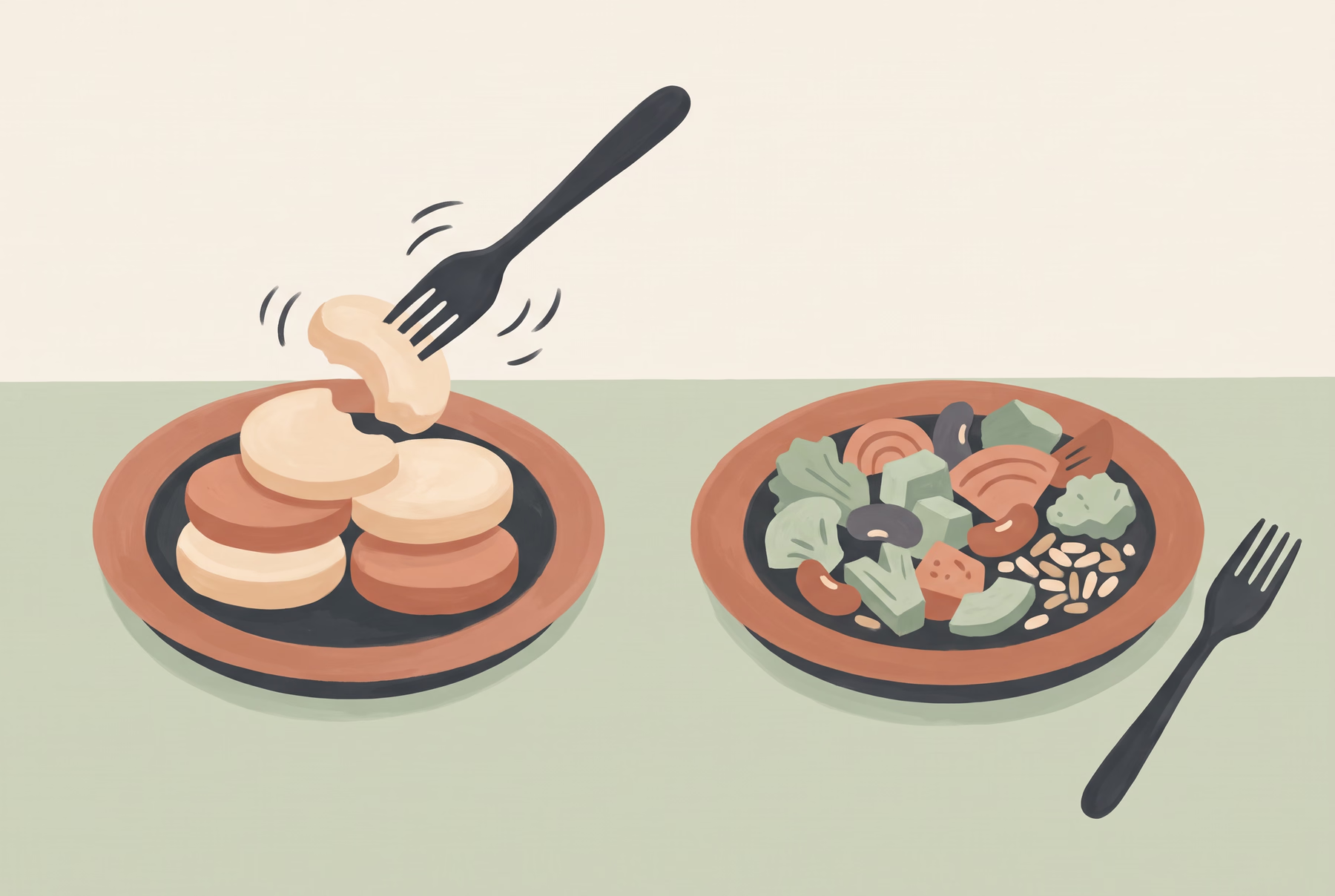
Is ultra-processed food bad for you?
Large observational studies consistently link high UPF intake with more obesity, type 2 diabetes, heart disease, depression and earlier death. A 2024 BMJ umbrella review found links for 32 of 45 outcomes [2]. Most of this evidence is observational and rated low quality, and effects vary a lot by food type.
The 2024 BMJ umbrella review pooled 45 meta-analyses covering nearly 9.9 million people. Higher UPF exposure was linked to higher risk for 32 of them [2]. The most credible associations (class I) were cardiovascular death (risk ratio 1.50), type 2 diabetes (12% higher per dose increment), anxiety (odds ratio 1.48) and common mental disorders (odds ratio 1.53) [2].
| Outcome | Key estimate | Source |
|---|---|---|
| All-cause death | 15% higher, highest vs lowest intake | 18 cohorts [10] |
| Type 2 diabetes | 12% higher per 10% more UPF | Meta-analysis [4] |
| Cardiovascular disease | 17% higher, highest vs lowest | 22 studies [3] |
| Cancer | 12% higher per 10% more UPF | French cohort [13] |
| Dementia | 25% higher per 10% more UPF | UK Biobank [12] |
| Depression | 49% higher, over 8.8 vs under 4 servings a day | US women [11] |
What the evidence does not show
- Causation for disease. No trial has run long enough to test heart attacks, cancer or death. The trials that exist measure weight and calorie intake over weeks [1] [7].
- That every UPF is equal. In the longest US mortality study, all-cause death was only 4% higher in the top quarter of intake, with no link to cancer or cardiovascular death; processed meats and sweetened drinks drove most of the signal [9]. Within each level of diet quality, UPF intake showed no consistent link with mortality [9].
- That the label is precise. Food experts agree only weakly on NOVA groups, with kappa scores of 0.32 to 0.34 [6].
Health outcomes linked to high UPF intake
- Heart disease death1.66 risk ratio or odds ratio, highest vs lowest exposure
Class II, low quality
- Obesity1.55 risk ratio or odds ratio, highest vs lowest exposure
Class II, low quality
- Common mental disorders1.53 risk ratio or odds ratio, highest vs lowest exposure
Class I, low quality
- Cardiovascular death1.5 risk ratio or odds ratio, highest vs lowest exposure
Class I, very low quality
- Anxiety1.48 risk ratio or odds ratio, highest vs lowest exposure
Class I, low quality
- Poor sleep1.41 risk ratio or odds ratio, highest vs lowest exposure
Class II, low quality
- Type 2 diabetes1.4 risk ratio or odds ratio, highest vs lowest exposure
Class II, very low quality
- Depression1.22 risk ratio or odds ratio, highest vs lowest exposure
Class II, low quality
- All-cause death1.21 risk ratio or odds ratio, highest vs lowest exposure
Class II, low quality
Show the data
| Item | Value (risk ratio or odds ratio, highest vs lowest exposure) | Low | High | Note |
|---|---|---|---|---|
| Heart disease death | 1.66 | 1.51 | 1.84 | Class II, low quality |
| Obesity | 1.55 | 1.36 | 1.77 | Class II, low quality |
| Common mental disorders | 1.53 | 1.43 | 1.63 | Class I, low quality |
| Cardiovascular death | 1.5 | 1.37 | 1.63 | Class I, very low quality |
| Anxiety | 1.48 | 1.37 | 1.59 | Class I, low quality |
| Poor sleep | 1.41 | 1.24 | 1.61 | Class II, low quality |
| Type 2 diabetes | 1.4 | 1.23 | 1.59 | Class II, very low quality |
| Depression | 1.22 | 1.16 | 1.28 | Class II, low quality |
| All-cause death | 1.21 | 1.15 | 1.27 | Class II, low quality |
Why would ultra-processed food harm health?
The leading explanations are overeating driven by high energy density, hyper-palatability and soft texture; poorer overall diet quality; and possible direct effects of some additives such as emulsifiers on gut microbes. The overeating effect has trial support [1]; additive effects rest mostly on animal and small human studies [15].
Proposed mechanisms, from best to least supported:
- Eating more calories. The two feeding trials show people eat more or lose less weight on UPF diets [1] [7]. Energy density and palatability are the main suspects [5].
- Displacing whole foods. Diets high in UPF tend to be lower in fiber and protective plant compounds; the Lancet series argues this displacement is a key driver of chronic disease [21].
- Additives and the gut. In mice, the emulsifiers carboxymethylcellulose and polysorbate-80 caused gut inflammation and metabolic syndrome [14]. In a controlled feeding study of 16 healthy adults, 15 g a day of carboxymethylcellulose for 11 days reduced microbial diversity and short-chain fatty acids [15]. That is a signal, not proof of disease.
- Addiction. Some researchers argue UPF high in refined carbohydrate and fat can be addictive [22]. A PET study did not find the drug-like dopamine surge this idea predicts [20].
Is it the processing or the nutrients?
This is the core of the scientific debate. Critics say NOVA mostly repackages what nutrient profiling already captures: sugar, salt, saturated fat, low fiber and high energy density [23] [5]. Supporters point to cohort analyses that adjust for nutrients and still find risk, and to the UPDATE trial, where both diets met nutrient guidelines and still differed in weight loss [24] [7].
What do critics say about the NOVA classification?
Critics say NOVA groups foods too broadly, is applied inconsistently, and labels some nutritious foods such as whole-grain bread and yogurt as unhealthy. They argue nutrient-based systems already capture the main risks [23] [5].
The main criticisms:
- Too broad. One category spans soda, hot dogs, infant formula, protein bars and packaged whole-grain bread. Gibney and colleagues argued this makes it unusable for food-based guidelines [23].
- Inconsistent. When 159 to 177 French food specialists sorted the same foods, agreement was low (Fleiss kappa 0.32 to 0.34), even with ingredient lists in hand [6].
- Confounded. People who eat more UPF also tend to smoke more, exercise less and have more chronic disease at baseline, and cohorts cannot fully remove this [11].
- Mislabels healthy foods. Some group 4 foods track with lower disease risk, including whole-grain breads, cereals and yogurt [4] [3].
Supporters reply that the evidence is now large and consistent across countries and outcomes, that two randomized trials show a causal effect on intake and weight, and that a simple message to prefer minimally processed food is easier to follow than nutrient targets [24] [21].
A fair reading
Both camps agree that sugary drinks, processed meats and refined snack foods are worth cutting. They disagree on whether processing is the cause or a marker, and on whether foods like packaged whole-grain bread deserve the same label as soda.
How the UPF evidence built up
2015
Emulsifiers cause gut inflammation and metabolic syndrome in mice
2017
Critics argue NOVA is too broad for dietary guidelines
2018
French cohort links UPF share to cancer risk
2019
NIH inpatient trial: about 508 kcal a day more eaten on UPF
2022
Small human trial: emulsifier CMC disturbs gut microbes
2022
Survey shows experts disagree on NOVA groups
2024
BMJ umbrella review: 32 of 45 outcomes linked to UPF
2025
UK trial: more weight loss on minimally processed diet
2025
Lancet series makes the case for UPF as a driver of chronic disease
How do you cut down on ultra-processed foods?
Start with the categories with the clearest risk: sugary and artificially sweetened drinks, processed meats and packaged sweets and snacks [9] [3]. Then cook simple meals from whole foods in batches, keep group 1 snacks at hand, and read ingredient lists for industrial additives [16].
A practical order of operations:
- Drinks first. Replace soda and sweetened drinks with water, tea, coffee or milk. Sweetened beverages showed one of the clearest mortality links [9].
- Processed meats next. Ready-to-eat meat products had the strongest mortality associations in the longest US study [9].
- Breakfast. Swap sweetened cereals and pastries for oats, eggs, plain yogurt and fruit.
- Batch cook. Two or three cooking sessions a week cover most meals.
- Keep easy whole foods. Fruit, nuts, cheese, canned beans and frozen vegetables are processed but not ultra-processed.
- Read labels. One industrial ingredient or cosmetic additive means group 4 [16].
How to measure adherence
Log everything you eat for 3 to 7 days and estimate the share of calories from group 4 products. Repeat monthly. A simpler proxy is counting UPF servings a day; in the Nurses' Health Study II, the lowest group ate fewer than 4 a day and the highest more than 8.8 [11].
Common mistakes
- Swapping one UPF for another with a health claim, such as protein bars or plant-based meat.
- Cutting nutritious group 3 and group 4 foods such as whole-grain bread and plain yogurt, which were not linked to harm [4].
- Expecting fast weight loss. The UPDATE trial difference was about 1 percentage point of body weight over 8 weeks [7].
How to check a label in 10 seconds
Read the ingredient list. What is on it?
- No ingredient list: fresh produce, plain meat, eggsGroup 1, unprocessed or minimally processed
- Only foods and kitchen ingredients such as oil, salt, sugar or yeastGroup 2 or 3, a culinary ingredient or processed food
- An industrial ingredient: high-fructose corn syrup, hydrogenated or interesterified oil, hydrolyzed proteinLikely ultra-processed, group 4
- A cosmetic additive: flavor, color, emulsifier or non-sugar sweetenerLikely ultra-processed, group 4
Group 4 does not settle healthfulness: packaged whole-grain bread, cereals and yogurt were linked to lower diabetes risk in large cohorts.
The studies, by type
Strongest designs first. Scroll each row; every card links to the paper and says whether it supports the protocol.
Systematic reviews and meta-analyses (3)
Randomized controlled trials (2)
Large observational studies in people (10)
Mechanistic studies in people (2)
Animal and cell studies (1)
Hypotheses and expert reviews (6)
Who follows it, who backs it, who doubts it
Public positions summarized in our words. Follow each link for the full context.
Support it
Carlos MonteiroNutrition epidemiologist, University of São Paulo, creator of the NOVA classification
Leads the case that the displacement of traditional diets by ultra-processed foods is a key driver of chronic disease worldwide, and argues that the evidence already justifies advising people to avoid them.
Chris van TullekenInfectious diseases doctor, UCL researcher and author of Ultra-Processed People
Describes UPF as a working definition of junk food and offers a shortcut: food wrapped in plastic with an ingredient you would not find in a home kitchen. He argues that marketing and formulation drive overeating.
Robert F. Kennedy Jr.US Secretary of Health and Human Services, chair of the MAHA Commission
His commission's report names the shift to ultra-processed foods as a main driver of childhood chronic disease and calls for moving children toward whole foods.
Mixed or cautious
Kevin HallMetabolism researcher, ran the 2019 NIH inpatient UPF trial
His trial is the strongest evidence that UPF diets drive overeating, yet he says being ultra-processed does not by itself make a food bad, points to energy density and hyper-palatability as likely reasons, and eats some UPF himself.
Oppose or doubt it
Arne AstrupNutrition researcher, formerly University of Copenhagen
Argues that NOVA rests on poorly defined processes, misclassifies foods, labels some nutrient-dense foods unhealthy, and adds little to existing nutrient profiling.
American Journal of Clinical Nutrition debate, 2022 (NO side)
Michael GibneyEmeritus professor of food and health, University College Dublin
Argues the UPF category is too broad to build food-based guidelines on and disputes claims that UPF are uniquely hyper-palatable or quasi-addictive.
American Journal of Clinical Nutrition, 2017: a critical appraisal
Public examples
- Dietary Guidelines for the Brazilian Population
Brazil's national guidelines (English edition 2015), built on the NOVA groups, set one golden rule: always prefer natural or minimally processed foods and freshly made dishes to ultra-processed foods.
- Dietary Guidelines for Americans 2025 to 2030 (Eat Real Food)
The US federal guidelines call on Americans, for the first time, to avoid highly processed food and center the advice on whole foods.
How to follow it
- Replace sugary and artificially sweetened drinks with water, tea, coffee or milk.
- Cut ready-to-eat processed meats such as hot dogs, sausages and deli meats.
- Change breakfast first: oats, eggs, plain yogurt, fruit and simple bread.
- Batch cook two or three times a week so most meals start from whole foods.
- Stock easy group 1 to 3 foods: fruit, nuts, cheese, canned beans and fish, frozen vegetables.
- Read ingredient lists and treat any industrial ingredient or cosmetic additive as a sign of group 4.
- Keep useful exceptions, such as whole-grain packaged bread or plain yogurt, if they help you eat well.
How to know you are following it
Log all food for 3 to 7 days every month and estimate the share of calories from NOVA group 4 products, or count UPF servings per day. Track body weight weekly and, if you test, HbA1c, fasting insulin and triglycerides every 3 to 6 months.
Common mistakes
- Swapping one UPF for another with a health claim, such as protein bars, 'keto' snacks or plant-based meat.
- Dropping nutritious foods such as whole-grain bread, plain yogurt or canned beans because they are processed.
- Treating 'organic' or 'natural' on a label as proof a product is not ultra-processed.
- Ignoring calories from whole foods: oils, nuts and cheese are easy to overeat too.
- Making it so strict that it becomes stressful or isolating, which can feed disordered eating.
Who should be careful
Check with a clinician first if you
- People with a current or past eating disorder should make diet changes with their care team, since strict food rules can trigger relapse.
- People who rely on fortified products (such as infant formula, medical nutrition drinks or fortified cereals) should not drop them without advice.
- People with diabetes on insulin or sulfonylureas should check with a clinician, since lower calorie intake can change medication needs.
Possible side effects
- More time and money spent on shopping and cooking.
- Short-term digestive changes when fiber intake rises quickly.
- Lower intake of nutrients that some UPF are fortified with, such as iodine in iodized products or B vitamins in cereals, if replacements are not chosen with care.
Watch
Talks and explainers worth your time. Nothing loads from YouTube until you press play.
The harsh reality of ultra processed food - with Chris Van Tulleken
The Royal InstitutionThe Royal Institution@theroyalinstitutionSubscribers1.8MStartedSeptember 2009CountryUnited KingdomVideos1.9KTotal views307.7MNew videos, last 30 days23New videos, last year329From YouTube, 2026-10-31Open on YouTube
A full public lecture making the strongest case for the UPF hypothesis, from the author of Ultra-Processed People.
The Most Honest Man In Nutrition Research | Kevin Hall PhD
Doctor MikeDoctor Mike@doctormikeSubscribers15.1MStartedAugust 2016CountryUnited StatesVideos1.3KTotal views5.8BNew videos, last 30 days12New videos, last year180From YouTube, 2026-10-31Open on YouTube
The scientist behind the 2019 inpatient trial explains what it did and did not show, including the uncertainty about mechanisms.
"Ultra-Processed Foods: Processing the Facts" with Dr. Ashley Gearhardt and Dr. Kevin Hall
McGill Office for Science and SocietyMcGill Office for Science and Society@mcgillossSubscribers10.4KStartedJune 2011CountryCanadaVideos825Total views1.2MNew videos, last 30 days9New videos, last year62From YouTube, 2026-10-31Open on YouTube
Two leading researchers with different views on food addiction and mechanisms discuss the evidence side by side.
What is ultra-processed food? - The Food Chain podcast, BBC World Service
BBC World ServiceBBC World Service@bbcworldserviceSubscribers2.3MStartedOctober 2019CountryUnited KingdomVideos3.2KTotal views395.9MNew videos, last 30 days102New videos, last year500+From YouTube, 2026-10-31Open on YouTube
A clear introduction to the NOVA definition and the debate around it.
5 Ways To Identify Ultra-Processed Foods with Chris van Tulleken
Penguin Books UKPenguin Books UK@penguinbooksukSubscribers396KStartedSeptember 2006CountryUnited KingdomVideos1.1KTotal views61.3MNew videos, last 30 days38New videos, last year72From YouTube, 2026-10-31Open on YouTube
A short, practical guide to spotting UPF on a label.
Biomarkers it can move
- HbA1cHbA1c (A1c) is the percentage of hemoglobin in red blood cells that has glucose attached.
- Fasting insulinFasting insulin is the level of insulin in your blood after at least 8 hours without food.
- TriglyceridesTriglycerides are the main form of fat in the body and in the blood, carried by VLDL from the liver and chylomicrons from the gut.
- hs-CRPhs-CRP is a blood test that measures C-reactive protein, an inflammation protein made by the liver, at very low levels.
- LDL cholesterolLDL cholesterol (LDL-C) is the cholesterol carried inside low-density lipoprotein particles, the main particles that deliver cholesterol to tissues and lodge in artery walls.
- ApoBApoB (apolipoprotein B) is the protein on every LDL, VLDL, IDL and Lp(a) particle, one per particle, so a blood ApoB test counts the particles that drive atherosclerosis.
Common questions
Is bread ultra-processed?
It depends on the ingredients. Bread made from flour, water, yeast and salt is a NOVA group 3 processed food. Mass-produced packaged bread with emulsifiers, preservatives or added sugars is usually group 4. Whole-grain packaged breads were linked to lower diabetes risk in large US cohorts [4].
Does ultra-processed food cause weight gain?
Does ultra-processed food cause cancer?
Is ultra-processed food linked to depression and dementia?
Can ultra-processed food be healthy?
Can ultra-processed food be organic?
Yes. NOVA classifies by processing and ingredients, not farming method. An organic soda, cookie or flavored snack made with refined extracts and cosmetic additives is still group 4 [16].
Is ultra-processed food addictive?
Sources
- 1.Hall KD, Ayuketah A, Brychta R, et al. Ultra-Processed Diets Cause Excess Calorie Intake and Weight Gain: An Inpatient Randomized Controlled Trial of Ad Libitum Food Intake. Cell Metabolism, 2019. doi:10.1016/j.cmet.2019.05.008
- 2.Lane MM, Gamage E, Du S, et al. Ultra-processed food exposure and adverse health outcomes: umbrella review of epidemiological meta-analyses. BMJ, 2024. doi:10.1136/bmj-2023-077310
- 3.Mendoza K, Smith-Warner SA, Rossato SL, et al. Ultra-processed foods and cardiovascular disease: analysis of three large US prospective cohorts and a systematic review and meta-analysis of prospective cohort studies. Lancet Regional Health Americas, 2024. doi:10.1016/j.lana.2024.100859
- 4.Chen Z, Khandpur N, Desjardins C, et al. Ultra-Processed Food Consumption and Risk of Type 2 Diabetes: Three Large Prospective U.S. Cohort Studies. Diabetes Care, 2023. doi:10.2337/dc22-1993
- 5.Astrup A, Monteiro CA. Does the concept of "ultra-processed foods" help inform dietary guidelines, beyond conventional classification systems? NO. American Journal of Clinical Nutrition, 2022. doi:10.1093/ajcn/nqac123
- 6.Braesco V, Souchon I, Sauvant P, et al. Ultra-processed foods: how functional is the NOVA system?. European Journal of Clinical Nutrition, 2022. doi:10.1038/s41430-022-01099-1
- 7.Dicken SJ, Jassil FC, Brown A, et al. Ultraprocessed or minimally processed diets following healthy dietary guidelines on weight and cardiometabolic health: a randomized, crossover trial. Nature Medicine, 2025. doi:10.1038/s41591-025-03842-0
- 8.Srour B, Fezeu LK, Kesse-Guyot E, et al. Ultra-processed food intake and risk of cardiovascular disease: prospective cohort study (NutriNet-Santé). BMJ, 2019. doi:10.1136/bmj.l1451
- 9.Fang Z, Rossato SL, Hang D, et al. Association of ultra-processed food consumption with all cause and cause specific mortality: population based cohort study. BMJ, 2024. doi:10.1136/bmj-2023-078476
- 10.Liang S, Zhou Y, Zhang Q, et al. Ultra-processed foods and risk of all-cause mortality: an updated systematic review and dose-response meta-analysis of prospective cohort studies. Systematic Reviews, 2025. doi:10.1186/s13643-025-02800-8
- 11.Samuthpongtorn C, Nguyen LH, Okereke OI, et al. Consumption of Ultraprocessed Food and Risk of Depression. JAMA Network Open, 2023. doi:10.1001/jamanetworkopen.2023.34770
- 12.Li H, Li S, Yang H, et al. Association of Ultraprocessed Food Consumption With Risk of Dementia: A Prospective Cohort Study. Neurology, 2022. doi:10.1212/WNL.0000000000200871
- 13.Fiolet T, Srour B, Sellem L, et al. Consumption of ultra-processed foods and cancer risk: results from NutriNet-Santé prospective cohort. BMJ, 2018. doi:10.1136/bmj.k322
- 14.Chassaing B, Koren O, Goodrich JK, et al. Dietary emulsifiers impact the mouse gut microbiota promoting colitis and metabolic syndrome. Nature, 2015. doi:10.1038/nature14232
- 15.Chassaing B, Compher C, Bonhomme B, et al. Randomized Controlled-Feeding Study of Dietary Emulsifier Carboxymethylcellulose Reveals Detrimental Impacts on the Gut Microbiota and Metabolome. Gastroenterology, 2022. doi:10.1053/j.gastro.2021.11.006
- 16.Monteiro CA, Cannon G, Levy RB, et al. Ultra-processed foods: what they are and how to identify them. Public Health Nutrition, 2019. doi:10.1017/S1368980018003762
- 17.Juul F, Parekh N, Martinez-Steele E, et al. Ultra-processed food consumption among US adults from 2001 to 2018. American Journal of Clinical Nutrition, 2022. doi:10.1093/ajcn/nqab305
- 18.Madruga M, Martínez Steele E, Reynolds C, et al. Trends in food consumption according to the degree of food processing among the UK population over 11 years. British Journal of Nutrition, 2023. doi:10.1017/S0007114522003361
- 19.Make America Healthy Again Commission. The MAHA Report: Make Our Children Healthy Again Assessment. The White House, 2025. Link
- 20.Darcey VL, Guo J, Chi M, et al. Brain dopamine responses to ultra-processed milkshakes are highly variable and not significantly related to adiposity in humans. Cell Metabolism, 2025. doi:10.1016/j.cmet.2025.02.002
- 21.Monteiro CA, Louzada ML, Steele-Martinez E, et al. Ultra-processed foods and human health: the main thesis and the evidence. Lancet, 2025. doi:10.1016/S0140-6736(25)01565-X
- 22.Gearhardt AN, Bueno NB, DiFeliceantonio AG, et al. Social, clinical, and policy implications of ultra-processed food addiction. BMJ, 2023. doi:10.1136/bmj-2023-075354
- 23.Gibney MJ, Forde CG, Mullally D, Gibney ER. Ultra-processed foods in human health: a critical appraisal. American Journal of Clinical Nutrition, 2017. doi:10.3945/ajcn.117.160440
- 24.Monteiro CA, Astrup A. Does the concept of "ultra-processed foods" help inform dietary guidelines, beyond conventional classification systems? YES. American Journal of Clinical Nutrition, 2022. doi:10.1093/ajcn/nqac122
AumniVIDA explains health information for general wellness. Talk to your clinician before changing your diet, training or medication for a health condition.