
Intermittent fasting
What is intermittent fasting?
Intermittent fasting is an eating pattern that cycles between set periods of eating and fasting. The main versions are daily time-restricted eating such as 16:8, the 5:2 diet with two very low calorie days a week, and alternate-day fasting. In trials it causes weight loss similar to daily calorie restriction, not more.
Large meta-analyses agree that intermittent fasting causes weight loss and modest cardiometabolic improvements compared with eating as usual. They also agree it is mostly no better than cutting calories every day, and that trials rarely run past 12 months. Claims about lifespan, brain health and cell repair rest mainly on animal studies.
The rules
The rules ofIntermittent fasting
- 1Follow a fixed, repeating schedule of fasting periods and eating periods, chosen in advance.
- 2During a fasting period, take no calories, or only the reduced calorie allowance your variant sets, such as 500 to 600 kcal on a 5:2 fast day.
- 3Water, black coffee and plain tea are allowed during fasting periods in most versions.
- 4Repeat the pattern every day (daily fasting) or every week (5:2, alternate-day fasting).
- 5Eat normally, not in excess, during eating periods; intermittent fasting sets timing, not food choice.
Share these rules as an image or a link.
| 16:8 time-restricted eating | Fast 16 hours and eat within an 8-hour window every day. Covered in depth on the time-restricted eating page. |
|---|---|
| 14:10 or 12:12 | Gentler daily windows of 10 or 12 hours, often used as a starting point. |
| 5:2 diet | Eat normally 5 days a week and about 500 to 600 kcal on 2 non-consecutive days. |
| Alternate-day fasting (modified) | Alternate a fast day of about 500 to 600 kcal, roughly 25% of energy needs, with a normal eating day. |
| Alternate-day fasting (zero calorie) | Alternate a 36-hour water-only fast with a normal eating day. |
| Whole-day fasting | One or two 24-hour fasts a week, for example dinner to dinner. |
| One meal a day (OMAD) | Eat once a day within about one hour and fast about 23 hours. Covered on the OMAD page. |
What it aims to do
- Lose weight and body fat without counting calories every day.
- Improve blood sugar control and insulin sensitivity.
- Lower cardiovascular risk factors such as blood pressure, triglycerides and LDL cholesterol.
- Trigger the metabolic switch from burning glucose to burning fat and ketones.
- Slow aging and protect the brain, which is the most ambitious and least tested aim.
What it claims, and what the evidence shows
Grades reflect evidence in people. Animal and cell results alone never earn more than limited.
Body fat and weight
Moderate evidenceBlood sugar and insulin
Limited evidenceHeart and blood vessels
Mixed evidenceInflammation
Limited evidenceLifespan and mortality
Not enough evidenceBrain and cognition
Not enough evidence
Key takeaways
- 1
Intermittent fasting is a family of schedules: daily windows such as 16:8, weekly patterns such as 5:2, and alternate-day fasting.
- 2
It works for weight loss mainly by making you eat less, so results match daily calorie restriction in trials up to 12 months.
- 3
Alternate-day fasting gives slightly more weight loss in short trials but has the most dropouts.
- 4
Blood sugar, insulin and blood pressure improve roughly in line with weight lost; LDL cholesterol can go either way.
- 5
Lifespan and brain claims come from animal studies; in older adults, long daily fasts have been linked to faster disease build-up.
- 6
Pregnancy, eating disorders and glucose-lowering medication need extra caution or a different approach.
What counts as intermittent fasting?
Any eating pattern that repeats planned periods of no or very little food. The three families are daily time-restricted eating, weekly patterns such as 5:2, and alternate-day fasting.
Intermittent fasting tells you when to eat, not what to eat. All versions share one feature: regular stretches long enough that the body runs low on stored glucose and starts relying more on fat [15].
The versions differ in how long each fast lasts and how often it comes round:
- Daily windows. You eat every day but only within a set window, such as 8 hours in 16:8. This is time-restricted eating, which also covers when in the day the window should sit.
- Weekly patterns. The 5:2 diet keeps five normal days and two days of about 500 to 600 kcal [6]. Whole-day fasting uses one or two 24-hour fasts instead.
- Alternate-day fasting. A fast day of about 25% of energy needs alternates with a normal day [3]. A stricter version allows only water on fast days [9].
- One meal a day. The most compressed daily version, with a fast of about 23 hours. It has its own evidence and risks, covered on the OMAD page.
Researchers group these together because they share a mechanism, but they are not interchangeable. A 12-hour overnight fast and a 36-hour water fast put very different demands on the body.
| Schedule | Fasting period | Calories on fasting days | Typical trial result |
|---|---|---|---|
| 16:8 daily window | 16 h every day | None | Small weight loss versus usual eating |
| 5:2 | 2 days a week | About 500 to 600 kcal | Same weight loss as daily restriction |
| Alternate-day (modified) | Every other day | About 25% of needs | Same or slightly more weight loss; most dropouts |
| Alternate-day (zero calorie) | 36 h every other day | None | About 37% fewer calories in a 4-week trial |
| Whole-day fasting | 24 h, once or twice a week | None | Similar to other schedules in pooled trials |
What happens in your body when you fast?
After roughly 12 hours without food, the liver's glycogen runs low and the body shifts toward burning fat and making ketones. Insulin falls during the fast, and insulin sensitivity can improve over repeated fasts.
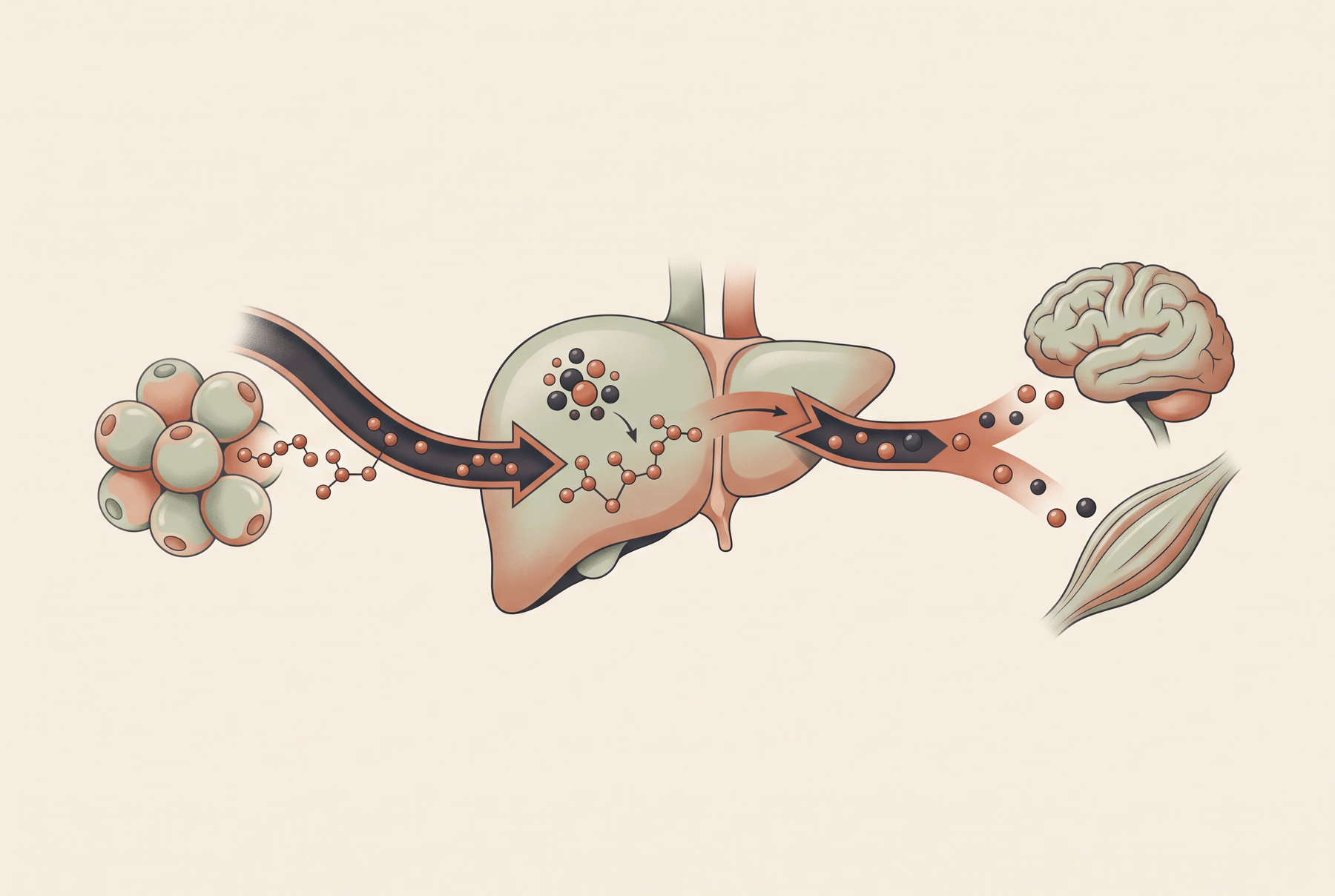
After a meal, your body runs mainly on glucose, and insulin helps store the surplus. As hours pass without food, the liver releases its stored glycogen to keep blood glucose steady. When that store runs low, usually beyond 12 hours, fat tissue releases fatty acids and the liver turns some of them into ketones such as beta-hydroxybutyrate [15]. Researchers call this the metabolic switch.
What the switch does in people is easier to measure than what it means:
- Ketones rise modestly. In healthy young men who fasted 20 hours every other day, beta-hydroxybutyrate rose from 0.06 to 0.10 mmol/L after each fast [7]. A strict alternate-day fasting trial found raised ketones even on eating days [9]. Some people track this at home with finger-prick ketone and glucose meters, as one N-of-1 study did [16].
- Insulin action improves. In the same 15-day study, with body weight held steady, insulin-driven glucose uptake rose from 6.3 to 7.3 mg/kg/min [7].
- Calories usually fall. Most of the benefit in free-living people comes from eating less. Strict alternate-day fasting cut intake by 37% on average [9].
Proponents argue that repeated switching also turns on cellular stress-resistance and repair pathways, including autophagy, which might slow aging [13]. That part of the theory rests largely on animal and cell studies, discussed below.
Does intermittent fasting work for weight loss?
Yes, compared with eating as usual, but it is mostly no better than cutting calories every day. A 2025 network meta-analysis of 99 trials found only alternate-day fasting beat daily restriction, by about 1.3 kg, and only in shorter trials.
Intermittent fasting reliably causes weight loss compared with no diet. The bigger question is whether it beats ordinary calorie restriction, and the best evidence says it mostly does not.
- Network meta-analysis, 2025. Pooling 99 randomized trials with 6,582 adults, all fasting schedules and daily calorie restriction lowered weight versus usual eating. Alternate-day fasting was the only schedule to beat daily restriction, by 1.29 kg (95% CI 0.59 to 1.99 kg), and the edge disappeared in trials of 24 weeks or more [1].
- Cochrane review, 2026. In 22 trials with at least six months of follow-up, intermittent fasting gave little to no difference in weight loss compared with regular dietary advice [2].
- Umbrella review, 2021. Of 104 associations from meta-analyses of 130 trials, only one, modified alternate-day fasting for 1 to 2 months, was backed by high-quality evidence [5].
Head-to-head trials tell the same story. Over 12 months, alternate-day fasting and daily restriction gave 6.0% and 5.3% weight loss, and 38% of the fasting group dropped out [3]. In a 6-month trial in 107 women, 5:2 and daily restriction gave 6.4 kg and 5.6 kg [4]. A one-year Norwegian trial found 8.0 kg versus 9.0 kg, with similar regain afterwards [8].
The practical conclusion: pick the pattern you can keep. Intermittent fasting is a way to create a calorie deficit, and for some people it is easier than counting calories every day.
Alternate-day fasting versus other strategies, weight change
- vs daily calorie restriction-1.29 kg
Moderate certainty; no difference in trials of 24 weeks or more
- vs time-restricted eating-1.69 kg
Moderate certainty
- vs whole-day fasting-1.05 kg
Moderate certainty
Show the data
| Item | Value (kg) | Low | High | Note |
|---|---|---|---|---|
| vs daily calorie restriction | -1.29 | -1.99 | -0.59 | Moderate certainty; no difference in trials of 24 weeks or more |
| vs time-restricted eating | -1.69 | -2.49 | -0.88 | Moderate certainty |
| vs whole-day fasting | -1.05 | -1.9 | -0.19 | Moderate certainty |
Does intermittent fasting lower blood sugar, cholesterol and blood pressure?
It improves blood sugar and blood pressure roughly in line with weight lost. Effects on LDL cholesterol are mixed, and one year-long alternate-day fasting trial saw LDL rise by 11.5 mg/dL compared with daily calorie restriction.
Blood sugar. In 137 adults with type 2 diabetes, two days a week of 500 to 600 kcal lowered HbA1c by 0.3 percentage points over 12 months, equivalent to daily calorie restriction (0.5 points) [6]. In women without diabetes, 5:2 lowered fasting insulin slightly more than daily restriction, by 1.2 microunits/mL [4]. Across 99 trials, no fasting schedule changed HbA1c more than daily restriction [1].
Fatty liver. In adults with fatty liver disease, alternate-day fasting with 600 kcal fast days plus exercise cut liver fat by 5.48 percentage points in 3 months, more than exercise alone [17].
Cholesterol. The picture is mixed. Pooled trials found alternate-day fasting lowered total cholesterol, triglycerides and non-HDL cholesterol more than time-restricted eating [1]. But in the longest alternate-day trial, LDL cholesterol was 11.5 mg/dL (0.30 mmol/L)0.30 mmol/L (11.5 mg/dL) higher than with daily restriction at 12 months [3]. If you fast, recheck your lipids after a few months.
Blood pressure and inflammation. Blood pressure and triglycerides improve with weight loss on 5:2, about as much as with daily restriction [8]. hs-CRP fell equally on 5:2 and daily restriction in one trial [4] and did not differ between alternate-day fasting and daily restriction in another [3].
Does intermittent fasting slow aging or protect the brain?
Not that anyone has shown in people. Mice on fasting schedules live longer and resist brain injury, but human evidence is limited to short-term markers and observational studies that point in both directions.
The most exciting claims for intermittent fasting come from animals:
- Mice on alternate-day fasting ate about as much as fed mice yet had lower glucose and insulin and brain cells more resistant to injury [14].
- In mice, a long daily fast was needed for the anti-aging effects of calorie restriction, and fasting alone reproduced many of them [10].
- Reviews by leading fasting researchers argue these stress-response pathways could slow aging and diseases such as Alzheimer's in people [13].
Human data are thinner. Strict alternate-day fasting for 4 weeks lowered some markers linked to aging, such as the inflammatory protein sICAM-1 [9], but markers are not outcomes. In Utah, heart patients who reported routine fasting, a practice common among Latter-day Saints, had lower odds of coronary artery disease, which cannot be separated from the rest of their lifestyle [11]. Pointing the other way, in 2,981 Swedish adults aged 60 and older, a habitual daily fast of 14 to 24 hours was linked to faster build-up of chronic disease than a fast of 6 to 11.5 hours, mainly after age 78 [12].
Autophagy, the cell's recycling process, is often named as the reason to fast. It is hard to measure in living people, and one study found fasting raised autophagy markers in mouse liver but not in human muscle [18]. Some leading trialists now say the field was oversold on the strength of mouse results; the people section below covers that debate.
Key intermittent fasting studies
2003
Mice on alternate-day fasting gain metabolic benefits without eating less
2011
5:2 matches daily calorie restriction in 107 women
2017
Year-long alternate-day fasting trial: no edge over calorie restriction
2018
5:2 matches daily restriction for HbA1c in type 2 diabetes
2019
NEJM review makes the case for fasting and aging
2025
Network meta-analysis of 99 trials: strategies largely equal
2026
Cochrane review: little to no difference versus dietary advice
Which intermittent fasting schedule is best?
The best schedule is the one you can sustain. Alternate-day fasting gives slightly more weight loss in short trials, 5:2 and daily windows give similar results, and daily windows are the easiest to keep.
Direct comparisons are few and short:
- 5:2 versus 16:8. In a 4-week trial in 68 women, both lowered weight (2.7 kg on average) and glucose, with faster fat loss on 5:2. Both groups lost about 0.6 kg of muscle [19].
- Alternate-day fasting versus the rest. In pooled trials, alternate-day fasting lowered weight 1.69 kg more than time-restricted eating and 1.05 kg more than whole-day fasting, with moderate certainty [1].
- Hunger and dropout. Participants on 5:2 reported higher hunger than those on daily restriction [8]. Alternate-day fasting had a 38% dropout rate over a year, and participants ate more than prescribed on fast days [3].
| If you want | Consider | Watch out for |
|---|---|---|
| A daily habit with no counting | 12:12 to 16:8 window | Small effect unless calories also fall |
| Five normal days a week | 5:2 | Hunger on fast days |
| The largest short-term loss | Modified alternate-day fasting | High dropout, LDL rise |
| Maximum simplicity | One meal a day | Glucose tolerance, protein, nutrients |
For most people the comparison that matters is intermittent fasting versus a calorie deficit. Trials show the two give about the same result [1], so choose on preference. If you like structure and dislike counting, fasting may suit you. If fast days leave you ravenous, daily restriction is the better tool.
Three schedules across one week
Schedule down, Day of the week across
16:8
- Mon8-hour eating window
- Tue8-hour eating window
- Wed8-hour eating window
- Thu8-hour eating window
- Fri8-hour eating window
- Sat8-hour eating window
- Sun8-hour eating window
5:2
- Mon500 to 600 kcal
- TueNormal eating
- WedNormal eating
- Thu500 to 600 kcal
- FriNormal eating
- SatNormal eating
- SunNormal eating
Alternate-day (modified)
- MonAbout 25% of energy needs
- TueNormal eating
- WedAbout 25% of energy needs
- ThuNormal eating
- FriAbout 25% of energy needs
- SatNormal eating
- SunAbout 25% of energy needs
| Mon | Tue | Wed | Thu | Fri | Sat | Sun | |
|---|---|---|---|---|---|---|---|
| 16:8 | 8-hour eating window | 8-hour eating window | 8-hour eating window | 8-hour eating window | 8-hour eating window | 8-hour eating window | 8-hour eating window |
| 5:2 | 500 to 600 kcal | Normal eating | Normal eating | 500 to 600 kcal | Normal eating | Normal eating | Normal eating |
| Alternate-day (modified) | About 25% of energy needs | Normal eating | About 25% of energy needs | Normal eating | About 25% of energy needs | Normal eating | About 25% of energy needs |
Fast days are examples; 5:2 uses any 2 non-consecutive days. Sources: Carter 2018 for 5:2 and Trepanowski 2017 for alternate-day fasting; daily windows are covered on the time-restricted eating and OMAD pages.
Is intermittent fasting safe for women and older adults?
Most short trials report few serious side effects in healthy adults, but the evidence is thin for women's hormones and for older adults. Long daily fasts have been linked to faster disease build-up after age 78.
Women's hormones. Only a few human trials have measured reproductive hormones. They suggest fasting lowers androgens and raises SHBG in premenopausal women with obesity, especially when eating ends before 4 p.m., and does not change estrogen, gonadotropins or prolactin [20]. That could help women with high androgens, as in PCOS, but the data are too sparse for firm conclusions. Pregnancy and breastfeeding are standard exclusions from fasting trials.
Eating disorders. Intermittent fasting is very common in young people: in a Canadian national survey, 47.7% of young women and 38.4% of young men had tried it in the past year, and it was linked to eating disorder symptoms [21]. The survey cannot show which came first, but anyone with an eating disorder history should avoid fasting schedules.
Older adults. Most trials enroll people under 65. In Swedish adults aged 78 and older, longer habitual fasts were linked to faster accumulation of chronic disease [12]. Older adults also need enough protein to keep muscle, which is harder in short eating windows.
Medication. People on insulin or sulfonylureas can fast safely only with dose changes; trials reduced these drugs at the start [6], and published cases of stopping insulin were done under close medical supervision [22].
Rare reactions. Combining fasting with a ketogenic diet has triggered prurigo pigmentosa, an itchy rash linked to ketosis [23].
The studies, by type
Strongest designs first. Scroll each row; every card links to the paper and says whether it supports the protocol.
Systematic reviews and meta-analyses (3)
Randomized controlled trials (7)
Large observational studies in people (3)
Mechanistic studies in people (2)
Animal and cell studies (2)
Case reports and N-of-1 experiments (3)
Hypotheses and expert reviews (3)
Who follows it, who backs it, who doubts it
Public positions summarized in our words. Follow each link for the full context.
Follow it
Michael MosleyPhysician and science broadcaster, co-founder of The Fast 800
Popularized the 5:2 diet and later co-founded The Fast 800, a program built on 800-calorie fast days, including a 5:2 version with two such days a week.
Support it
Mark MattsonNeuroscientist, Johns Hopkins University, formerly at the US National Institute on Aging
Describes intermittent fasting as an eating pattern rather than a diet, argues that the metabolic switch to ketones raises brain growth factors and stress resistance, and recommends daily 6 to 8 hour windows or 5:2, while urging medical supervision for people with risk factors.
Mixed or cautious
Krista VaradyProfessor of nutrition, University of Illinois Chicago, leading alternate-day fasting trialist
Has run many of the key fasting trials but now calls the approach "oversold", saying only a few dozen good studies exist, weight loss tops out around 5% like other diets, and early promises leaned on mouse data.
New York Times report republished by Oman Observer, February 2026
Valter LongoBiogerontologist, University of Southern California
Favors keeping daily eating within 12 hours or less and eating two meals a day for people prone to weight gain, but prefers simple, flexible rules over strict long daily fasts.
FoundMyFitness, Dr. Valter Longo's personal approach to fasting
Oppose or doubt it
James BettsProfessor of metabolic physiology, University of Bath
Argues that human data have not supported any special weight-loss benefit of fasting beyond calorie reduction, and that many pro-fasting studies are small, low quality or contain errors.
New York Times report republished by Oman Observer, February 2026
Public examples
- The Fast 800
Michael Mosley and Clare Bailey Mosley's program of 800-calorie fast days, including a 5:2 version with two fast days a week.
- The Fast Diet
The original 5:2 intermittent fasting site from Michael Mosley and Mimi Spencer.
- Eat Stop Eat
Brad Pilon's program of periodic breaks from eating, an early popular version of whole-day fasting.
How to follow it
- Pick one schedule that fits your week: a daily window (12:12, 14:10 or 16:8) if you want a habit, or 5:2 if you prefer two hard days and five normal ones.
- Start gently. Move from your current eating span toward 12 hours, then shorten by an hour every few days if you want a tighter window.
- On 5:2 or alternate-day fast days, plan the 500 to 600 kcal in advance, built around protein and vegetables.
- Drink water through fasting periods. Black coffee and plain tea are fine in most versions.
- Keep food quality high in eating periods; the schedule does not make a poor diet healthy.
- Keep protein intake adequate across the eating periods and keep doing resistance exercise to protect muscle.
- If you take medication for diabetes or blood pressure, agree a plan with your clinician before the first fast.
How to know you are following it
Log the time of your first and last calories each day, or the calories eaten on each fast day. Count the days per week you hit the schedule. Track weight weekly, and repeat HbA1c, lipids or fasting insulin after about 3 months if you want to see metabolic change.
Common mistakes
- Eating more than usual on non-fast days or in the eating window, which cancels the deficit.
- Treating fasting as permission to eat ultra-processed food when the window opens.
- Under-eating protein, which speeds up muscle loss.
- Jumping straight to long fasts and quitting after a week of hunger and headaches.
- Fasting on glucose-lowering drugs without a plan, which risks low blood sugar.
Who should be careful
Check with a clinician first if you
- You are pregnant or breastfeeding.
- You have had an eating disorder, or you notice fasting feeding binge eating or anxiety about food.
- You are under 18 or underweight.
- You take insulin, sulfonylureas or SGLT2 inhibitors: check with your clinician first, since doses may need changing.
- You are an older adult, especially over 75, with frailty or several chronic conditions: check with your clinician first.
- You have type 1 diabetes, kidney disease, gout or a history of gallstones: check with your clinician first.
Possible side effects
- Hunger, irritability and headaches while you adjust.
- Higher hunger on fast days than with daily calorie restriction.
- Loss of lean mass along with fat, especially if protein is low.
- Low blood sugar in people taking glucose-lowering medication.
- A rise in LDL cholesterol in some people, seen in an alternate-day fasting trial.
- Rarely, a ketosis-related rash (prurigo pigmentosa) when fasting is combined with a ketogenic diet.
Watch
Talks and explainers worth your time. Nothing loads from YouTube until you press play.
Intermittent Fasting: What it is and Surprising Health Benefits
Johns Hopkins MedicineJohns Hopkins Medicine@johnshopkinsmedicineSubscribers497KStartedDecember 2008CountryUnited StatesVideos5KTotal views138.2MNew videos, last 30 days22New videos, last year364From YouTube, 2026-10-31Open on YouTube
Mark Mattson explains the schedules and the metabolic switch in a moderated Johns Hopkins session.
Why fasting bolsters brain power: Mark Mattson at TEDxJohnsHopkinsUniversity
TEDx TalksTEDx Talks@tedxSubscribers44.7MStartedJune 2009CountryUnited StatesVideos273.1KTotal views9.2BNew videos, last 30 days500New videos, last year500+From YouTube, 2026-10-31Open on YouTube
The most watched case for fasting and the brain, useful for seeing how far the animal evidence is stretched.
What is intermittent fasting? Scientific take on 5:2 and 16:8 diets
ABC ScienceABC Science@abcscienceSubscribers725KStartedSeptember 2009CountryAustraliaVideos1.1KTotal views230.4MNew videos, last 30 days11New videos, last year139From YouTube, 2026-10-31Open on YouTube
A short, neutral comparison of 5:2, 16:8 and alternate-day fasting from a public science broadcaster.
Dr. Mark Mattson on the Benefits of Stress, Metabolic Switching, Fasting, and Hormesis
FoundMyFitnessFoundMyFitness@foundmyfitnessSubscribers736KStartedJune 2013CountryUnited StatesVideos153Total views40MNew videos, last 30 days2New videos, last year18From YouTube, 2026-10-31Open on YouTube
A long-form interview on the mechanism behind fasting, for readers who want the full hypothesis.
Biomarkers it can move
- HbA1cHbA1c (A1c) is the percentage of hemoglobin in red blood cells that has glucose attached.
- Fasting insulinFasting insulin is the level of insulin in your blood after at least 8 hours without food.
- LDL cholesterolLDL cholesterol (LDL-C) is the cholesterol carried inside low-density lipoprotein particles, the main particles that deliver cholesterol to tissues and lodge in artery walls.
- TriglyceridesTriglycerides are the main form of fat in the body and in the blood, carried by VLDL from the liver and chylomicrons from the gut.
- ApoBApoB (apolipoprotein B) is the protein on every LDL, VLDL, IDL and Lp(a) particle, one per particle, so a blood ApoB test counts the particles that drive atherosclerosis.
- hs-CRPhs-CRP is a blood test that measures C-reactive protein, an inflammation protein made by the liver, at very low levels.
Common questions
Can intermittent fasting be 12 hours?
Yes. A 12-hour overnight fast, such as 8 p.m. to 8 a.m., is the gentlest daily version and a common starting point. It is about where the metabolic switch begins, but most weight-loss trials used 8-hour windows or 5:2.
Is intermittent fasting better than a calorie deficit?
For weight loss, mostly not. Large meta-analyses find intermittent fasting and daily calorie restriction give about the same results over 6 to 12 months. Intermittent fasting is one way to create a calorie deficit; choose whichever you can keep up.
Can I do intermittent fasting every day?
Daily versions such as 14:10 or 16:8 are designed to be done every day. Weekly versions such as 5:2 and alternate-day fasting are not daily by design. Very long daily fasts are less studied, especially in older adults.
Can intermittent fasting cause weight gain?
It can if you eat more than usual when the window opens or on non-fast days. In one year-long trial, people on alternate-day fasting ate more than planned on fast days and less on feast days, which narrowed the deficit.
Does intermittent fasting lower cholesterol?
Sometimes. Triglycerides usually fall with weight loss, but LDL cholesterol has risen in some alternate-day fasting trials. Recheck your lipid panel after about three months if you start fasting.
Does intermittent fasting help with insulin resistance?
It can, mostly through weight loss. Trials show improvements in fasting insulin and HbA1c similar to daily calorie restriction. People taking insulin or sulfonylureas need a clinician's plan before fasting.
Can I do intermittent fasting while pregnant or breastfeeding?
Fasting is generally not advised during pregnancy or breastfeeding, and these groups are excluded from fasting trials. Talk to your midwife or doctor about safe ways to manage weight and blood sugar.
What is the difference between intermittent fasting and time-restricted eating?
Time-restricted eating is one type of intermittent fasting: you eat every day within a set window. Intermittent fasting also includes weekly patterns such as 5:2 and alternate-day fasting.
Is intermittent fasting the same as OMAD?
OMAD, one meal a day, is the most extreme daily form of intermittent fasting, with a fast of about 23 hours. It has its own evidence, including worse morning glucose tolerance in a small controlled trial.
Sources
- 1.Semnani-Azad Z, Khan TA, Chiavaroli L, et al. Intermittent fasting strategies and their effects on body weight and other cardiometabolic risk factors: systematic review and network meta-analysis of randomised clinical trials. BMJ, 2025. doi:10.1136/bmj-2024-082007
- 2.Garegnani LI, Oltra G, Ivaldi D, et al. Intermittent fasting for adults with overweight or obesity. Cochrane Database of Systematic Reviews, 2026. doi:10.1002/14651858.CD015610.pub2
- 3.Trepanowski JF, Kroeger CM, Barnosky A, et al. Effect of Alternate-Day Fasting on Weight Loss, Weight Maintenance, and Cardioprotection Among Metabolically Healthy Obese Adults: A Randomized Clinical Trial. JAMA Internal Medicine, 2017. doi:10.1001/jamainternmed.2017.0936
- 4.Harvie MN, Pegington M, Mattson MP, et al. The effects of intermittent or continuous energy restriction on weight loss and metabolic disease risk markers: a randomized trial in young overweight women. International Journal of Obesity, 2011. doi:10.1038/ijo.2010.171
- 5.Patikorn C, Roubal K, Veettil SK, et al. Intermittent Fasting and Obesity-Related Health Outcomes: An Umbrella Review of Meta-analyses of Randomized Clinical Trials. JAMA Network Open, 2021. doi:10.1001/jamanetworkopen.2021.39558
- 6.Carter S, Clifton PM, Keogh JB. Effect of Intermittent Compared With Continuous Energy Restricted Diet on Glycemic Control in Patients With Type 2 Diabetes: A Randomized Noninferiority Trial. JAMA Network Open, 2018. doi:10.1001/jamanetworkopen.2018.0756
- 7.Halberg N, Henriksen M, Söderhamn N, et al. Effect of intermittent fasting and refeeding on insulin action in healthy men. Journal of Applied Physiology, 2005. doi:10.1152/japplphysiol.00683.2005
- 8.Sundfør TM, Svendsen M, Tonstad S. Effect of intermittent versus continuous energy restriction on weight loss, maintenance and cardiometabolic risk: A randomized 1-year trial. Nutrition, Metabolism and Cardiovascular Diseases, 2018. doi:10.1016/j.numecd.2018.03.009
- 9.Stekovic S, Hofer SJ, Tripolt N, et al. Alternate Day Fasting Improves Physiological and Molecular Markers of Aging in Healthy, Non-obese Humans. Cell Metabolism, 2019. doi:10.1016/j.cmet.2019.07.016
- 10.Pak HH, Haws SA, Green CL, et al. Fasting drives the metabolic, molecular and geroprotective effects of a calorie-restricted diet in mice. Nature Metabolism, 2021. doi:10.1038/s42255-021-00466-9
- 11.Horne BD, May HT, Anderson JL, et al. Usefulness of routine periodic fasting to lower risk of coronary artery disease in patients undergoing coronary angiography. American Journal of Cardiology, 2008. doi:10.1016/j.amjcard.2008.05.021
- 12.Kalmbach L, Abbad-Gomez D, Beridze G, et al. Habitual fasting duration and accelerated multimorbidity in older adults. Journal of Internal Medicine, 2026. doi:10.1111/joim.70150
- 13.de Cabo R, Mattson MP. Effects of Intermittent Fasting on Health, Aging, and Disease. New England Journal of Medicine, 2019. doi:10.1056/NEJMra1905136
- 14.Anson RM, Guo Z, de Cabo R, et al. Intermittent fasting dissociates beneficial effects of dietary restriction on glucose metabolism and neuronal resistance to injury from calorie intake. Proceedings of the National Academy of Sciences, 2003. doi:10.1073/pnas.1035720100
- 15.Anton SD, Moehl K, Donahoo WT, et al. Flipping the Metabolic Switch: Understanding and Applying the Health Benefits of Fasting. Obesity, 2018. doi:10.1002/oby.22065
- 16.Wang P, Tadeo X, Chew HSJ, et al. N-of-1 health optimization: Digital monitoring of biomarker dynamics to gamify adherence to metabolic switching. PNAS Nexus, 2024. doi:10.1093/pnasnexus/pgae214
- 17.Ezpeleta M, Gabel K, Cienfuegos S, et al. Effect of alternate day fasting combined with aerobic exercise on non-alcoholic fatty liver disease: A randomized controlled trial. Cell Metabolism, 2023. doi:10.1016/j.cmet.2022.12.001
- 18.Chaudhary R, Liu B, Bensalem J, et al. Intermittent fasting activates markers of autophagy in mouse liver, but not muscle from mouse or humans. Nutrition, 2022. doi:10.1016/j.nut.2022.111662
- 19.Kim H, Yun W, Han J, et al. Daily 16:8 Versus Weekly 5:2 Intermittent Fasting for Weight Loss and Metabolic Health: A Randomized Controlled Trial. Obesity, 2026. doi:10.1002/oby.70322
- 20.Cienfuegos S, Corapi S, Gabel K, et al. Effect of Intermittent Fasting on Reproductive Hormone Levels in Females and Males: A Review of Human Trials. Nutrients, 2022. doi:10.3390/nu14112343
- 21.Ganson KT, Cuccolo K, Hallward L, et al. Intermittent fasting: Describing engagement and associations with eating disorder behaviors and psychopathology among Canadian adolescents and young adults. Eating Behaviors, 2022. doi:10.1016/j.eatbeh.2022.101681
- 22.Furmli S, Elmasry R, Ramos M, et al. Therapeutic use of intermittent fasting for people with type 2 diabetes as an alternative to insulin. BMJ Case Reports, 2018. doi:10.1136/bcr-2017-221854
- 23.Rzek D, Hulur I. Clinical Presentation and Treatment of a Patient With Prurigo Pigmentosa. Cureus, 2025. doi:10.7759/cureus.94225
AumniVIDA explains health information for general wellness. Talk to your clinician before changing your diet, training or medication for a health condition.