
OMAD (one meal a day)
What is omad (one meal a day)?
OMAD, or one meal a day, is the most compressed form of intermittent fasting: you eat all of the day's food in a single meal, usually within about one hour, and fast for roughly 23 hours. It cuts calories for most people, but small controlled trials found worse morning blood sugar and higher LDL cholesterol than three meals.
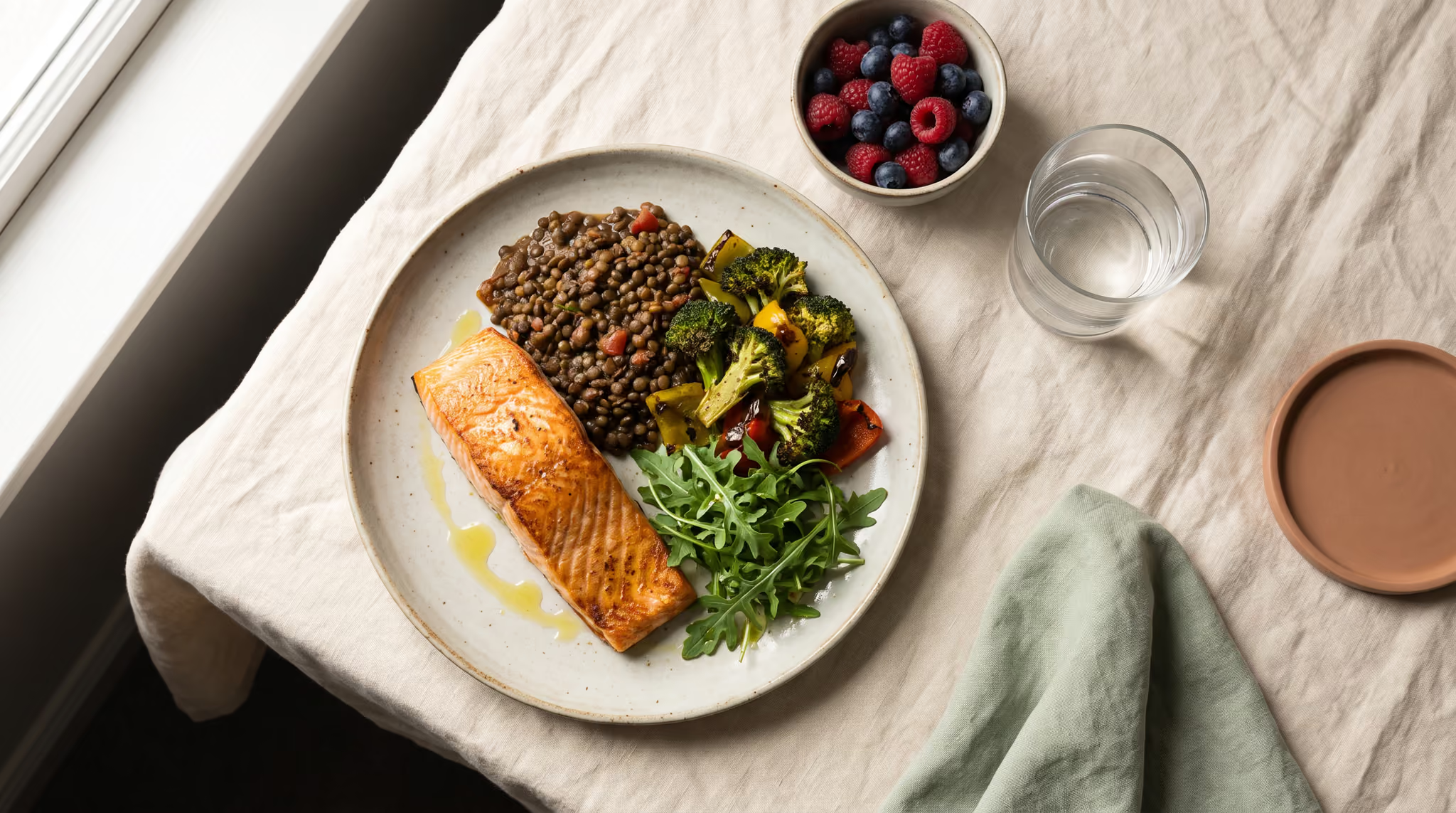
OMAD has almost no long-term trials. One 8-week controlled crossover trial, reported in two papers, and one 11-day trial exist, alongside a trial of a 4-hour window. They show fat loss but also higher blood pressure, higher LDL cholesterol and worse morning glucose tolerance with an evening meal. Large observational studies link eating once a day to higher mortality, which cannot prove cause.
The rules
The rules ofOMAD (one meal a day)
- 1Eat all food and caloric drinks in one meal, finished within about 1 hour.
- 2Fast for the other 23 hours, taking only water, black coffee, plain tea or other zero-calorie drinks.
- 3Eat the meal at about the same time each day.
- 4Make the one meal cover the full day's needs for energy, protein, fiber and micronutrients.
- 5Repeat daily, or on set days of the week if you follow a part-time version.
Share these rules as an image or a link.
| Strict OMAD (23:1) | One meal inside a 1-hour window every day. |
|---|---|
| 22:2 | One meal stretched over 2 hours, as in a trial that served it from 5 to 7 p.m. |
| 20:4 | A 4-hour window, often one large meal plus a snack, as in a trial that allowed eating only from 3 to 7 p.m. |
| Evening OMAD | The single meal at dinner time, a common choice because it fits family and social meals. |
| Early OMAD | The single meal in the late morning or early afternoon, chosen to suit the body clock. |
| Part-time OMAD | One meal a day on two or three days a week, with normal eating on the others. |
What it aims to do
- Create a large calorie deficit with one simple rule.
- Lose body fat without tracking food.
- Spend most of the day past the metabolic switch, running on fat and ketones.
- Save time on cooking and eating.
- Boost cell repair (autophagy), a claim with little human evidence.
What it claims, and what the evidence shows
Grades reflect evidence in people. Animal and cell results alone never earn more than limited.
Body fat and weight
Limited evidenceBlood sugar and insulin
Mixed evidenceHeart and blood vessels
Evidence againstMuscle and strength
Mixed evidenceAthletic performance
Limited evidenceKeeps exercise performance
In lean adults, 11 days of one evening meal did not lower aerobic capacity or strength and raised fat burning during exercise. [2]
Lifespan and mortality
Not enough evidence
Key takeaways
- 1
OMAD means one meal in about one hour and a fast of about 23 hours every day.
- 2
It usually cuts calories, but a single-meal day showed fat loss even without fewer calories in a small trial.
- 3
Controlled trials found higher blood pressure, higher LDL cholesterol and worse morning glucose tolerance than three meals.
- 4
Large US cohorts link eating once a day to higher all-cause and cardiovascular mortality; this does not prove cause.
- 5
Protein is the hardest part: plan a large protein serving and keep strength training.
- 6
If you try it, put the meal earlier in the day and monitor blood pressure, lipids and glucose.
What is OMAD, and how is it different from 16:8?
OMAD is a daily fast of about 23 hours with a single meal. It is the shortest possible daily eating window, so it is a much stronger dose than 16:8, which leaves 8 hours for two or three meals.
OMAD sits at the far end of intermittent fasting. Most fasting schedules either shorten the daily eating window, like time-restricted eating, or cut calories on certain days, like 5:2. OMAD does the first to the extreme: one meal, no snacks, every day.
Because it is so compressed, results from 16:8 trials do not transfer cleanly. A 16-hour fast ends near the start of the metabolic switch; a 23-hour fast spends most of a day beyond it. And fitting a day's food into one sitting changes how protein, glucose and fat are handled.
| Schedule | Daily fast | Meals | Controlled trial evidence |
|---|---|---|---|
| OMAD (23:1) | About 23 h | 1 | One 8-week crossover trial, one 11-day trial |
| 20:4 | 20 h | 1 to 2 | One 8-week trial of a 4-hour window |
| 16:8 | 16 h | 2 to 3 | Many trials up to 12 months |
| 5:2 | None on 5 days | Normal on 5 days | Several trials up to 12 months |
What happens to your body on one meal a day?
You spend most of each day fasting, burning more fat and feeling hungrier. In controlled trials, one meal a day raised hunger and the hunger hormone ghrelin, lowered cortisol and raised fat burning during exercise.
A single meal sets up a long daily cycle: a large rise in glucose, insulin and fats after the meal, then about 20 hours of falling fuel and rising fat use. Controlled studies show several effects:
- More fat burning. After 11 days of one 5 to 7 p.m. meal at weight-maintenance calories, lean adults burned more fat during exercise [2].
- More hunger. Eating one meal a day for 8 weeks significantly raised hunger compared with three meals [1], and raised ghrelin [5].
- Lower cortisol. The same trial found lower cortisol concentrations on one meal a day [1].
- A delayed insulin response. With the meal in the evening, the next morning's glucose tolerance test showed higher, longer glucose peaks and a slower insulin response [5].
One idea behind OMAD is that a daily 23-hour fast boosts autophagy, the recycling of worn-out cell parts. Autophagy is hard to measure in people. In one study, repeated 24-hour fasts raised autophagy markers in mouse liver but not in mouse or human muscle [14].
A day on OMAD
- Sleep00:00 to 06:30, 22:30 to 00:00
- Fasting: water, black coffee, plain tea06:30 to 18:00, 19:00 to 22:30, 06:30 to 12:00, 13:00 to 22:30
- Meal18:00 to 19:00, 12:00 to 13:00
Times are examples; both versions fast for about 23 hours, most of it past the metabolic switch. With an evening meal, trials found worse morning glucose tolerance; an earlier meal fits the body clock better.
Does OMAD work for weight loss?
Usually, because one meal is hard to make as large as three. A 4-hour window cut intake by about 550 kcal a day and weight by about 3% in 8 weeks, but no long-term OMAD weight-loss trial exists.
The closest trial to OMAD for weight loss allowed adults with obesity to eat only from 3 to 7 p.m. Without counting calories, they ate about 550 kcal a day less and lost about 3% of body weight in 8 weeks, the same as a 6-hour window [3].
Two small trials gave all weight-maintenance calories in one meal, so calories did not fall:
- Healthy normal-weight adults kept their weight within 2 kg but lost fat mass on one meal a day for 8 weeks [1].
- Lean adults on one 5 to 7 p.m. meal for 11 days lost 1.4 kg of body mass, against 0.5 kg on three meals, including 0.7 kg of fat mass [2].
Across trials, eating fewer meals a day lowered weight by 1.85 kg versus control (95% CI 0.13 to 3.55 kg), a small and uncertain effect [15]. An older meta-analysis found that meal frequency itself made little reliable difference to body composition [16]. In 50,660 Adventist adults, people eating one or two meals a day saw their BMI fall slowly over 7 years compared with those eating three [4].
So OMAD can work as a calorie-cutting rule. What is not known is whether people keep it up, or keep the weight off, beyond a few months. One published case lost about 10% of body weight in 3 months on supervised OMAD with exercise [8].
Is OMAD bad for blood sugar, cholesterol or blood pressure?
It can be. In an 8-week controlled trial, one evening meal raised blood pressure and total and LDL cholesterol and worsened morning glucose tolerance compared with three meals of the same calories.
The best controlled data on OMAD come from one US crossover trial that gave the same people one meal or three meals a day for 8 weeks each, at the same calories:
- Blood pressure rose on one meal a day [1].
- Total, LDL and HDL cholesterol rose [1]. If you track LDL cholesterol or ApoB, check them after a few months on OMAD.
- Morning fasting glucose was higher and glucose tolerance worse, with a delayed insulin response [5].
Timing may explain part of this, since the meal was eaten between 4 and 8 p.m. Shorter studies point the same way: in people with type 2 diabetes, skipping breakfast raised the glucose response to lunch by 36.8% and to dinner by 26.6% [6]. In contrast, an 11-day trial of a 5 to 7 p.m. meal in lean adults found lower glucose in the second half of the day [2].
Weight loss can mask these effects. In a published case, a man on supervised OMAD with exercise improved HbA1c and blood pressure as he lost weight, yet his LDL cholesterol rose [8]. The pattern to watch is good weight and glucose numbers with worsening lipids.
Can you keep or build muscle on OMAD?
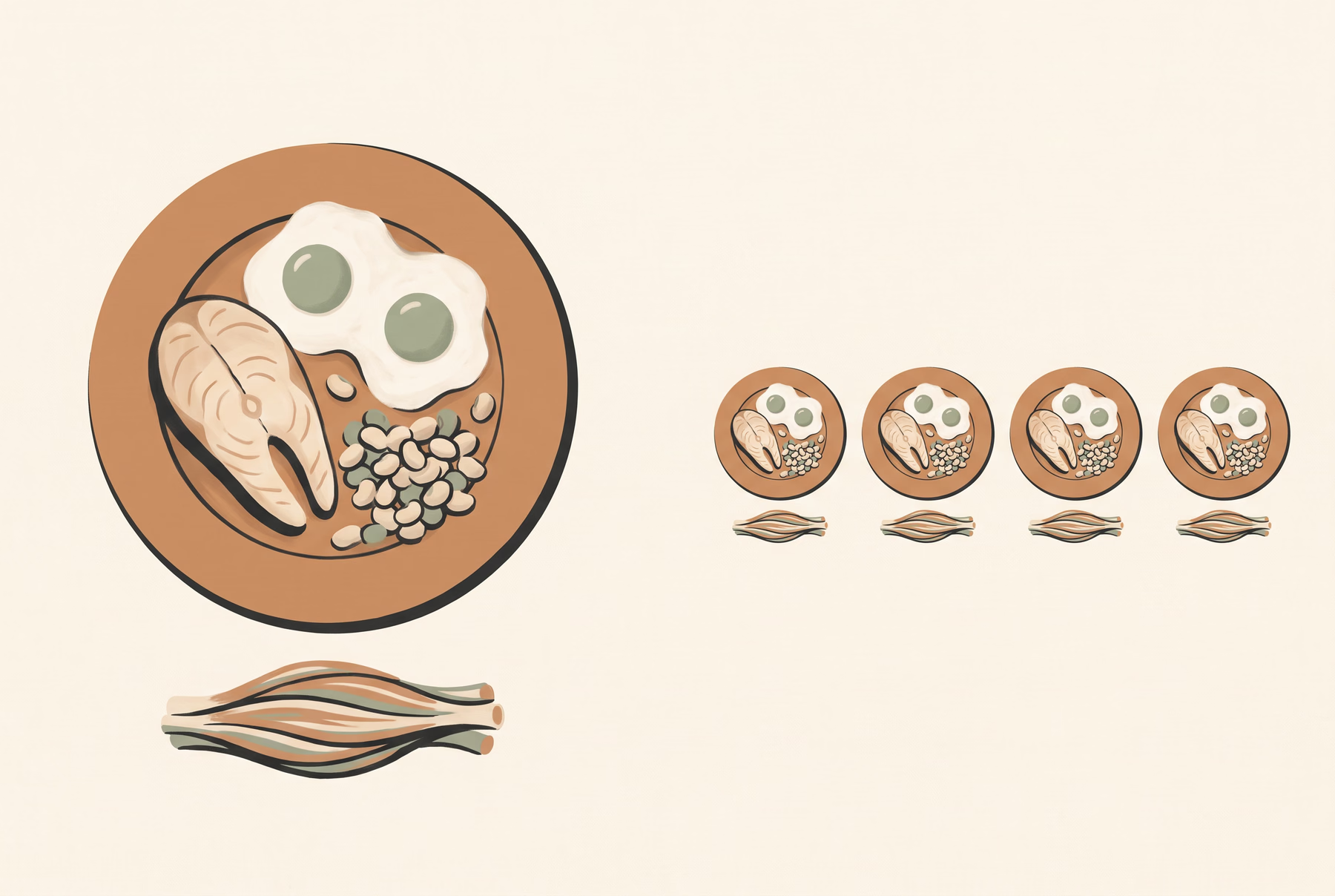
You can probably keep muscle if the meal has enough protein and you keep training, but OMAD is not the best pattern for building it. Spreading protein over the day built more muscle protein in a controlled study.
Muscle needs protein and training. OMAD puts all of the day's protein in one sitting, and the evidence on that is split:
- Spread is better in one study. After resistance exercise, 80 g of protein as 20 g every 3 hours built more muscle protein over 12 hours than two 40 g doses [10].
- Big doses work longer than thought. A single 100 g protein dose produced a larger anabolic response lasting more than 12 hours than a 25 g dose [9]. That weakens the old idea that muscle can use only a modest amount of protein from one meal.
- Strength held short term. Lean adults on one meal a day for 11 days kept their strength and aerobic capacity [2].
Sports nutrition experts conclude that eating more often may help preserve lean mass in athletes who are dieting, if protein is adequate [11]. For lifters on OMAD, the practical rules are a large protein serving in the meal, a training session a few hours before it, and regular checks of strength and body composition. If strength or muscle drops, a second meal is the simplest fix.
Is OMAD safe long term?
No one knows, because no long-term trial exists. In a US cohort of 24,011 adults, eating one meal a day was linked to 30% higher all-cause and 83% higher cardiovascular mortality than three meals, which suggests caution but cannot prove cause.
The long-term data on eating once a day are observational:
- Among 24,011 US adults aged 40 and older followed for about 8 years, eating one meal a day was linked to higher all-cause mortality (hazard ratio 1.30, 95% CI 1.03 to 1.64) and cardiovascular mortality (1.83, 95% CI 1.26 to 2.65) than three meals [7].
- Among 30,464 US adults, eating fewer than 3 times a day was linked to higher cardiovascular (1.33) and all-cause (1.16) mortality [13].
These studies took eating patterns from one or two days of recall. People who eat once a day may do so because of illness, shift work, poverty or poor appetite, all of which raise mortality. So the link may not be caused by the eating pattern. Still, no study shows the reverse, a lower risk of death, in people.
The longevity case for OMAD comes from mice. Male mice fed one meal a day ate it quickly, fasted the rest of the day and lived longer with less disease, whatever the diet [12]. Mice have far faster metabolisms than people, and a daily fast in a mouse is a much bigger stress. Reviews of fasting regimens, including OMAD, list promising mechanisms but also inconsistent results and weak methods [17].
Eating once a day and mortality in US adults
- Three meals a day (reference)1 hazard ratio
- One meal a day, all-cause death1.3 hazard ratio
- One meal a day, cardiovascular death1.83 hazard ratio
- Skipping breakfast vs eating it, cardiovascular death1.4 hazard ratio
Show the data
| Item | Value (hazard ratio) | Low | High | Note |
|---|---|---|---|---|
| Three meals a day (reference) | 1 | |||
| One meal a day, all-cause death | 1.3 | 1.03 | 1.64 | |
| One meal a day, cardiovascular death | 1.83 | 1.26 | 2.65 | |
| Skipping breakfast vs eating it, cardiovascular death | 1.4 | 1.09 | 1.78 |
What should you eat on OMAD, and when?
Eat one large, balanced meal that covers the day's protein, fiber and micronutrients, and if you can, eat it earlier in the day rather than late at night. OMAD sets timing; it does not make low-quality food healthy.
One sitting has to do the work of three. A plan that covers the basics:
| Part of the meal | Why | Example |
|---|---|---|
| A large protein serving | Muscle maintenance from one dose | Fish, chicken, eggs, tofu, Greek yogurt |
| Two or more vegetables | Fiber, potassium, folate | Leafy greens, broccoli, peppers |
| Legumes or whole grains | Fiber and steady glucose | Lentils, beans, oats, brown rice |
| Healthy fats | Fat-soluble vitamins, satiety | Olive oil, nuts, avocado |
| Fruit or dairy | Vitamin C, calcium | Berries, citrus, milk or kefir |
Two timing points come from the trials. The evening meal in the US trial worsened morning glucose tolerance [5], and in people with diabetes, skipping breakfast worsened glucose after later meals [6]. If your schedule allows, a late-morning or early-afternoon meal is the safer choice. Avoid eating your one meal right before bed.
Start gradually. A move through 12-hour, 16:8 and 20:4 windows over several weeks lets you see whether hunger, energy and training cope. Many people find a two-meal pattern gives most of the convenience with fewer downsides; see time-restricted eating for windows of 6 to 10 hours.
The studies, by type
Strongest designs first. Scroll each row; every card links to the paper and says whether it supports the protocol.
Systematic reviews and meta-analyses (2)
Randomized controlled trials (4)
Large observational studies in people (3)
Mechanistic studies in people (4)
Animal and cell studies (1)
Case reports and N-of-1 experiments (1)
Hypotheses and expert reviews (2)
Who follows it, who backs it, who doubts it
Public positions summarized in our words. Follow each link for the full context.
Follow it
Jack DorseyCofounder of Twitter and Block
Said on the Ben Greenfield Fitness podcast that he eats one meal a day on weekdays, typically protein with green vegetables and berries or dark chocolate, and sometimes goes three days on water only.
Herschel WalkerFormer NFL running back and MMA fighter
Has eaten one meal a day since he was a junior in high school, a habit he kept through college football, the NFL and his MMA career.
Support it
Jason FungNephrologist and author on intermittent fasting
Describes OMAD as a stricter form of intermittent fasting and names weight loss and type 2 diabetes as the conditions it helps most, citing a patient who stopped insulin after a month of OMAD three times a week.
Fox News, experts share varying opinions on the OMAD diet, December 2024
Mixed or cautious
Gil CarvalhoPhysician and neuroscientist, Nutrition Made Simple!
Sees OMAD as a simple way to cut calories for healthy people but warns that fasting does not fix a poor diet, that nutrient needs are hard to meet in one meal and that an evening meal may worsen glucose; he would eat the meal in the morning or early afternoon.
Oppose or doubt it
Lisa YoungRegistered dietitian nutritionist
Warns that OMAD overrides hunger and fullness signals, which can trigger disordered eating, and that it can cause fatigue, more hunger and low blood sugar.
Fox News, experts share varying opinions on the OMAD diet, December 2024
Joel KahnCardiologist
Points to studies linking a single evening meal to higher blood sugar and insulin resistance, and suggests that anyone who tries OMAD eat the meal in the morning.
Fox News, experts share varying opinions on the OMAD diet, December 2024
Public examples
- Jack Dorsey's weekday routine
One evening-style meal on weekdays with occasional multi-day water fasts, as he described on a 2019 podcast.
- Herschel Walker's single daily meal
A one-meal-a-day pattern followed for decades by a professional athlete, through football and MMA.
How to follow it
- Do not start from three meals. Move through a 12-hour window, then 16:8, then 20:4 over several weeks, and stop at the step that works for you.
- Choose a meal time you can keep every day. An earlier meal, late morning to mid-afternoon, fits the body clock better than a late dinner.
- Build the meal around protein first, then vegetables, legumes or whole grains, fruit and healthy fats, so one sitting covers the day.
- Check the meal in a nutrition tracker for a week to see whether it meets protein, fiber, calcium, iron and other needs.
- Drink water through the fast. Black coffee and plain tea are fine; milk, sugar and juice break the fast.
- Keep resistance training two or more times a week, ideally a few hours before the meal.
- If you take any medication with food, or for diabetes or blood pressure, agree a plan with your clinician first.
How to know you are following it
Log the start and end time of the meal; a day counts when all calories fall inside about one hour. Count OMAD days per week. Track weight weekly and waist monthly. Because the trial signals were higher blood pressure, LDL cholesterol and morning glucose, check blood pressure weekly and repeat a lipid panel and HbA1c or fasting glucose after about 8 to 12 weeks.
Common mistakes
- Treating the meal as unlimited: OMAD is often marketed as eating whatever you want in the hour, which undoes its benefits.
- Missing protein, fiber and micronutrients that are hard to fit into one sitting.
- Eating the one meal late at night, close to sleep.
- Jumping from three meals to OMAD overnight and rebounding into binge eating.
- Training hard on an empty tank without planning when to refuel.
Who should be careful
Check with a clinician first if you
- You are pregnant, breastfeeding or trying to conceive.
- You have had an eating disorder, or fasting triggers bingeing.
- You are under 18, underweight or an older adult at risk of muscle loss.
- You take insulin, sulfonylureas or SGLT2 inhibitors: check with your clinician first.
- You have high blood pressure, high LDL cholesterol or heart disease: check with your clinician first, since trials saw both rise.
- You take medication that must be taken with food two or three times a day.
Possible side effects
- Strong hunger, especially in the first weeks; hunger stayed higher than on three meals in a controlled trial.
- Higher blood pressure and LDL cholesterol in some people.
- Worse morning glucose tolerance when the meal is in the evening.
- Fatigue, poor concentration or dizziness late in the fast.
- Indigestion, reflux or discomfort from one very large meal.
- Nutrient shortfalls if the meal is not planned.
Watch
Talks and explainers worth your time. Nothing loads from YouTube until you press play.
Doctor Reviews OMAD (One Meal a Day)
Nutrition Made Simple!Nutrition Made Simple!@nutritionmadesimpleSubscribers404KStartedMay 2014CountryUnited StatesVideos477Total views45.5MNew videos, last 30 days4New videos, last year133From YouTube, 2026-10-31Open on YouTube
A physician-scientist weighs the simplicity of OMAD against nutrient and glucose concerns, without hype in either direction.
One Meal a Day (OMAD) and your Health. [Study 18, 144-146 Analysis]
PhysionicPhysionic@physionicSubscribers413KStartedOctober 2014CountryUnited StatesVideos947Total views59.2MNew videos, last 30 days12New videos, last year147From YouTube, 2026-10-31Open on YouTube
A detailed walk through the controlled one-meal-a-day trial data, including the blood pressure and body fat findings.
JASON FUNG 5’ | FASTING: 16x8 or OMAD. Easy to fit into family; friends lifestyle
DoctorsToTrustDoctorsToTrust@doctorstotrustSubscribers44.7KStartedApril 2012CountryUnited StatesVideos3.8KTotal views6.7MNew videos, last 30 days20New videos, last year437From YouTube, 2026-10-31Open on YouTube
A short clip of the best-known OMAD advocate explaining how he fits 16:8 or OMAD around family and social life.
Biomarkers it can move
- LDL cholesterolLDL cholesterol (LDL-C) is the cholesterol carried inside low-density lipoprotein particles, the main particles that deliver cholesterol to tissues and lodge in artery walls.
- ApoBApoB (apolipoprotein B) is the protein on every LDL, VLDL, IDL and Lp(a) particle, one per particle, so a blood ApoB test counts the particles that drive atherosclerosis.
- HbA1cHbA1c (A1c) is the percentage of hemoglobin in red blood cells that has glucose attached.
- Fasting insulinFasting insulin is the level of insulin in your blood after at least 8 hours without food.
- TriglyceridesTriglycerides are the main form of fat in the body and in the blood, carried by VLDL from the liver and chylomicrons from the gut.
Common questions
Is OMAD healthy?
It is not proven healthy or unhealthy over the long term. Short controlled trials show fat loss but also higher blood pressure, higher LDL cholesterol and worse morning glucose tolerance, and observational studies link eating once a day to higher mortality.
Is OMAD better than 16:8?
There is no head-to-head trial. 16:8 has far more evidence, including trials up to a year, and leaves room for two or three meals with enough protein. OMAD cuts calories harder but has more reported downsides.
Can you do OMAD every day?
Many people do, but daily OMAD has been studied for only 8 weeks at a time in controlled trials. Part-time OMAD, two or three days a week, is a gentler option.
What is the best time to eat on OMAD?
Evidence favors earlier in the day. An evening meal worsened morning glucose tolerance in a controlled trial, and breakfast skipping raised glucose after later meals in people with diabetes. Late morning to mid-afternoon is a reasonable choice.
Does OMAD cause muscle loss?
Not necessarily. Strength held over 11 days in one trial, and a large protein dose can build muscle for over 12 hours. But spreading protein across meals built more muscle in another study, so lifters need a big protein serving and regular checks.
How much weight can you lose on OMAD?
It varies. A 4-hour eating window led to about 3% weight loss in 8 weeks in adults with obesity. Long-term results are unknown, and weight returns if eating habits revert.
Does OMAD increase autophagy?
It has not been shown in people. Fasting raised autophagy markers in mouse liver, but not in human muscle in one study, and there is no reliable blood test for autophagy.
Can you drink coffee on OMAD?
Yes, black coffee, plain tea, water and other zero-calorie drinks are allowed during the fast. Milk, sugar, juice and alcohol count as food.
Can OMAD lower cholesterol?
Usually not. In a controlled trial, total and LDL cholesterol rose on one meal a day compared with three, and a published case saw LDL rise despite weight loss. Recheck lipids if you try it.
Sources
- 1.Stote KS, Baer DJ, Spears K, et al. A controlled trial of reduced meal frequency without caloric restriction in healthy, normal-weight, middle-aged adults. American Journal of Clinical Nutrition, 2007. doi:10.1093/ajcn/85.4.981
- 2.Meessen ECE, Andresen H, van Barneveld T, et al. Differential Effects of One Meal per Day in the Evening on Metabolic Health and Physical Performance in Lean Individuals. Frontiers in Physiology, 2021. doi:10.3389/fphys.2021.771944
- 3.Cienfuegos S, Gabel K, Kalam F, et al. Effects of 4- and 6-h Time-Restricted Feeding on Weight and Cardiometabolic Health: A Randomized Controlled Trial in Adults with Obesity. Cell Metabolism, 2020. doi:10.1016/j.cmet.2020.06.018
- 4.Kahleova H, Lloren JI, Mashchak A, et al. Meal Frequency and Timing Are Associated with Changes in Body Mass Index in Adventist Health Study 2. Journal of Nutrition, 2017. doi:10.3945/jn.116.244749
- 5.Carlson O, Martin B, Stote KS, et al. Impact of reduced meal frequency without caloric restriction on glucose regulation in healthy, normal-weight middle-aged men and women. Metabolism, 2007. doi:10.1016/j.metabol.2007.07.018
- 6.Jakubowicz D, Wainstein J, Ahren B, et al. Fasting until noon triggers increased postprandial hyperglycemia and impaired insulin response after lunch and dinner in individuals with type 2 diabetes: a randomized clinical trial. Diabetes Care, 2015. doi:10.2337/dc15-0761
- 7.Sun Y, Rong S, Liu B, et al. Meal Skipping and Shorter Meal Intervals Are Associated with Increased Risk of All-Cause and Cardiovascular Disease Mortality among US Adults. Journal of the Academy of Nutrition and Dietetics, 2023. doi:10.1016/j.jand.2022.08.119
- 8.Alfhaid F. Management of prediabetes and class III obesity in a 42-year-old male through One-Meal-a-Day. Journal of Family Medicine and Primary Care, 2025. doi:10.4103/jfmpc.jfmpc_247_25
- 9.Trommelen J, van Lieshout GAA, Nyakayiru J, et al. The anabolic response to protein ingestion during recovery from exercise has no upper limit in magnitude and duration in vivo in humans. Cell Reports Medicine, 2023. doi:10.1016/j.xcrm.2023.101324
- 10.Areta JL, Burke LM, Ross ML, et al. Timing and distribution of protein ingestion during prolonged recovery from resistance exercise alters myofibrillar protein synthesis. Journal of Physiology, 2013. doi:10.1113/jphysiol.2012.244897
- 11.La Bounty PM, Campbell BI, Wilson J, et al. International Society of Sports Nutrition position stand: meal frequency. Journal of the International Society of Sports Nutrition, 2011. doi:10.1186/1550-2783-8-4
- 12.Mitchell SJ, Bernier M, Mattison JA, et al. Daily Fasting Improves Health and Survival in Male Mice Independent of Diet Composition and Calories. Cell Metabolism, 2019. doi:10.1016/j.cmet.2018.08.011
- 13.Cheng W, Meng X, Gao J, et al. Relationship between circadian eating behavior (daily eating frequency and nighttime fasting duration) and cardiovascular mortality. International Journal of Behavioral Nutrition and Physical Activity, 2024. doi:10.1186/s12966-023-01556-5
- 14.Chaudhary R, Liu B, Bensalem J, et al. Intermittent fasting activates markers of autophagy in mouse liver, but not muscle from mouse or humans. Nutrition, 2022. doi:10.1016/j.nut.2022.111662
- 15.Liu HY, Eso AA, Cook N, et al. Meal Timing and Anthropometric and Metabolic Outcomes: A Systematic Review and Meta-Analysis. JAMA Network Open, 2024. doi:10.1001/jamanetworkopen.2024.42163
- 16.Schoenfeld BJ, Aragon AA, Krieger JW. Effects of meal frequency on weight loss and body composition: a meta-analysis. Nutrition Reviews, 2015. doi:10.1093/nutrit/nuu017
- 17.Gautam KA, Lal P, Malik T, et al. Intermittent fasting: Impact, mechanisms and cautions across medical and lifestyle domains. European Journal of Clinical Nutrition, 2026. doi:10.1038/s41430-026-01768-5
AumniVIDA explains health information for general wellness. Talk to your clinician before changing your diet, training or medication for a health condition.